







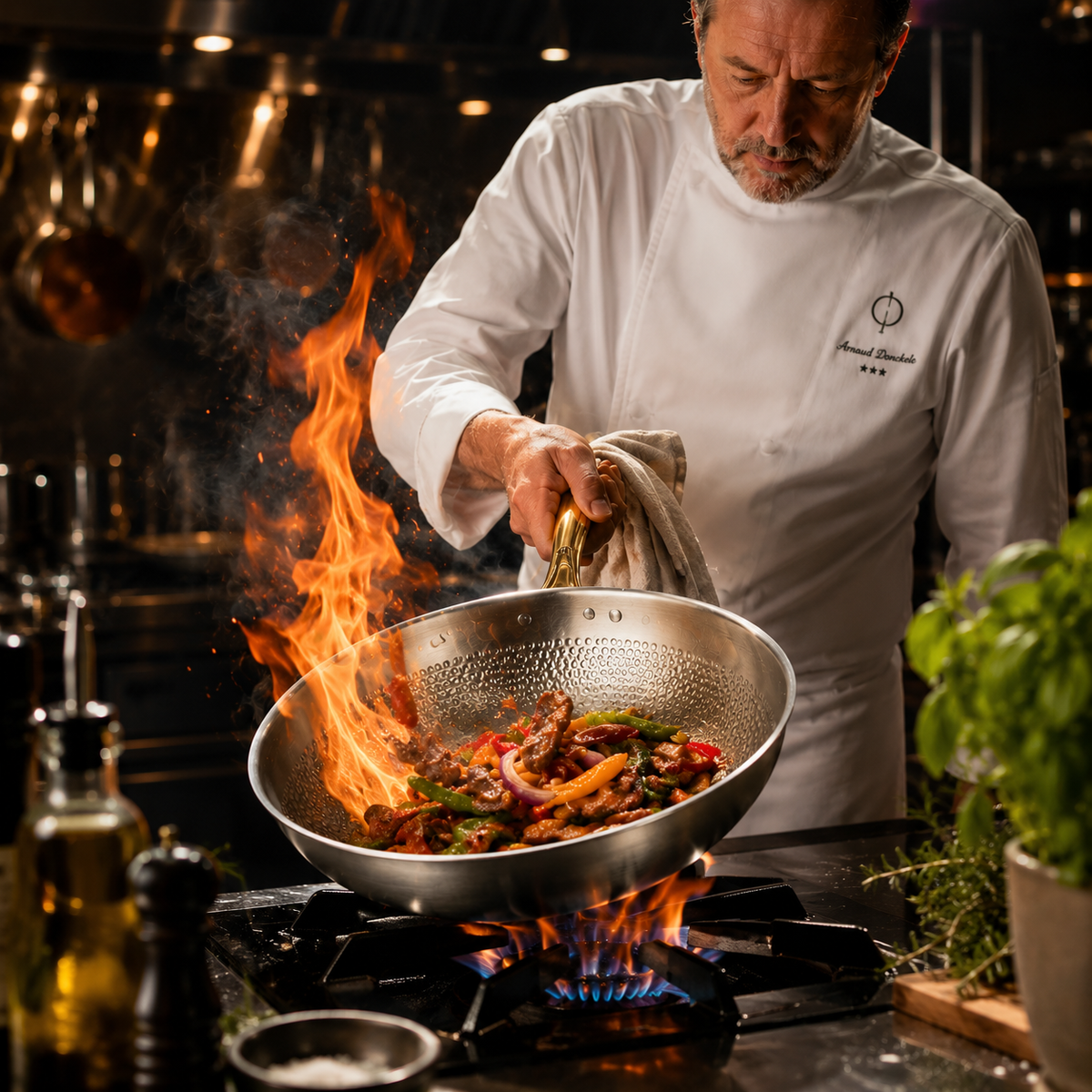





Everything you need to know before buying a titanium saute pan: what it's for, how it compares to stainless steel and cast iron, sizing, induction compatibility, seasoning, and care.
The essentials in 30 seconds
- A saute pan combines straight high sides with a wide base for searing then simmering
- Pure grade 1 titanium cooking surface has no coating, no PFAS, and no PTFE
- Three recycled aluminum cores and a stainless steel base enable even heating and induction compatibility
- Titanium needs preheating and fat like stainless steel, without building a physical seasoning layer
- Scratches on titanium are cosmetic only and never flake or release anything into food
A titanium saute pan sits between a frying pan and a dutch oven: high straight sides, wide cooking surface, enough capacity to go from a quick sauté to a slow braise. A pure grade 1 titanium cooking surface — with no coating, no PFAS, no PTFE — changes how this specific shape performs, because you get the high sides of a pot with the responsiveness of a pan. This guide answers the real questions people ask before buying one: weight, price, induction compatibility, and the learning curve everyone mentions.
What is a saute pan and how is it different from a frying pan or a dutch oven?
A saute pan has straight, high sides (usually 7-10 cm) and a wide, flat base — unlike a frying pan's sloped sides or a dutch oven's deep, narrow shape. That combination lets you sear, deglaze, and simmer in the same vessel without switching pots.
- Frying pan: sloped sides, made for flipping and quick, dry cooking — eggs, pancakes, steaks.
- Saute pan: straight sides, flat wide base — browning, then adding liquid, then reducing a sauce, all in one pan.
- Dutch oven: deep, heavy, built for long braises and stews, but a poor choice for a fast sauté because the sides are too high and the base too small relative to volume.
If you cook a lot of "sear then simmer" dishes — chicken thighs, risotto, braised vegetables — the saute pan is the piece that replaces three smaller pans.
Why choose a pure titanium saute pan over stainless steel or cast iron
The cooking surface is 100% pure grade 1 titanium — it's not a coating, so there's nothing to flake off and no PFAS, PFOA, or PTFE. Underneath, three recycled aluminum cores spread the heat evenly and a stainless steel base makes the pan induction-compatible; titanium itself doesn't conduct heat well, which is exactly why those layers are there.
The honest comparison, based on what people actually complain about on forums:
| Material | Sticking | Weight | Coating / PFAS | Long-term durability | Maintenance |
|---|---|---|---|---|---|
| Coated non-stick | Low at first, worsens fast | Light | Coating, often PTFE/PFAS-based | Degrades in 1-3 years, flakes | Low heat only, no metal utensils |
| Stainless steel | Food sticks until technique is mastered | Medium | None | Very durable | Needs oil/fat management |
| Cast iron | Good once seasoned | Heavy | None (seasoning layer is oil-based) | Very durable | Seasoning upkeep, rust risk |
| Titanium grade 1 cooking surface (uncoated) | Needs preheating + fat, like stainless | Ultra-light | None — no coating, nothing to flake | Designed to last a lifetime | Preheat, use fat, hand wash recommended |
Scratches are the one honest caveat: the titanium surface does scratch with metal utensils over time, like any bare metal. Those scratches are cosmetic — they don't flake off, degrade the surface, or release anything into food, which is the opposite of what happens with a coated pan once it starts flaking.
What size and capacity to choose depending on household size
Pick your saute pan size based on how many people you cook for regularly, not on how big your biggest meal ever gets. A pan that's too large for daily use just means more empty surface to heat and more oil to manage.
- 1-2 people: a smaller saute pan (around 24 cm) covers daily meals, side dishes, and most sautés.
- 3-4 people: a mid-size saute pan (around 28 cm) is the most versatile choice — enough room for a full dish plus sauce reduction.
- 5+ people or batch cooking: go larger (30+ cm) if you regularly braise for a crowd or meal-prep in bulk.
If you're choosing between a saute pan and a frying pan as your single daily driver, see our comparison on titanium vs. stainless steel pans for the broader trade-offs.
Titanium saute pan and induction, gas, oven: compatibility
A pure titanium cooking surface saute pan works on induction, gas, electric, and in the oven. There's no coating to worry about melting or releasing fumes at high heat, which is one less thing to think about when you switch between stovetop searing and oven finishing.
- Induction: compatible — the stainless steel base responds well to induction's fast, even heat.
- Gas and electric: compatible on all standard home setups.
- Oven: safe to finish a dish in the oven, handle included, since there's no coating with a temperature ceiling.
Seasoning and getting used to it: what changes compared to stainless steel
Titanium isn't a non-stick pan out of the box, and it's honest to say so. Like stainless steel, it needs preheating before adding food and a reasonable amount of fat — skip that step and eggs will stick, same as they would in any uncoated pan.
What people call "seasoning" or "culottage" with titanium is really just building the habit, not building a physical layer like you would with cast iron:
- Preheat the empty pan over medium heat for a minute or two before adding oil or butter.
- Add fat, let it heat until it shimmers, then add food — don't rush this step.
- Don't move the food too early; let a crust form naturally, it releases on its own.
This is the real learning curve people mention when switching from a coated pan: the first few cooks take attention. After that, it becomes automatic, the same way cooking on stainless steel eventually does. Our preheating guide walks through the exact technique step by step.
Daily care: what to do and not do
Titanium cookware is low-maintenance compared to cast iron, but a few habits make it last and perform better day to day.
- Do: preheat before adding fat, use a bit of oil or butter even for "non-stick" style cooking, hand wash after use.
- Do: use metal utensils without worry — there's no coating to damage, only cosmetic surface marks over time.
- Don't: expect zero-oil cooking like a coated non-stick pan — that's not how uncoated metal works.
- Don't: worry about scratches affecting safety — they're cosmetic, not a sign the pan is wearing out or releasing anything.
This is also where titanium differs from coated pans people describe replacing every year or two: there's no non-stick layer to wear down, stain, or lose its "food release" over time, because the surface itself is the cooking surface — not a coating sitting on top of it.
Our recommendations by use (simmering, sautéing, light frying)
How you mostly cook should decide the saute pan you buy, more than brand comparisons or specs.
- Slow-simmered dishes (braises, sauces, risotto): a mid-to-large saute pan with high sides keeps liquid in and gives enough surface area to reduce a sauce properly.
- Quick sautés (vegetables, stir-fry style cooking): preheat well, keep food moving, and don't overcrowd the pan — the titanium surface responds fast to heat changes.
- Light frying (eggs, thin cuts, pan-fried fish): a well-preheated titanium surface with enough fat performs close to a non-stick pan, without the coating that eventually flakes.
For a deeper look at how titanium compares across an entire cookware set, our 2026 titanium pan buying guide covers frying pans, woks, and saute pans side by side. You can see the full saute pan range on the titanium saute pan product page.
FAQ
Does a titanium saute pan work on induction?
Yes. The stainless steel base makes it fully induction-compatible, along with gas and electric stovetops, with no special adapter needed.
Do you need to season a titanium saute pan before first use?
There's no physical seasoning layer to build like with cast iron. You just need to preheat the empty pan and add fat before cooking — the same habit used with stainless steel — and food won't stick.
What's the difference between a saute pan and a deep frying pan?
A saute pan has straight, high sides and a wide flat base, built for searing then simmering. A deep frying pan has sloped sides, better suited to flipping food than holding liquid for a sauce.
Is a titanium saute pan lighter than a cast iron one?
Yes, this saute pan is ultra-light compared to cast iron for an equivalent size, while matching its long-term durability — a common reason people switch after years of handling heavy cast iron pans.
Can you simmer for a long time in a titanium saute pan without issues?
Yes. Since there's no coating with a heat ceiling, long simmers and braises are safe. Just monitor liquid levels as you would with any pan during extended cooking.
Does a titanium saute pan scratch?
Yes, the bare titanium surface can scratch with metal utensils over time, like any uncoated metal. These marks are cosmetic only — they don't flake, degrade, or release anything into food, unlike a coated non-stick surface.