







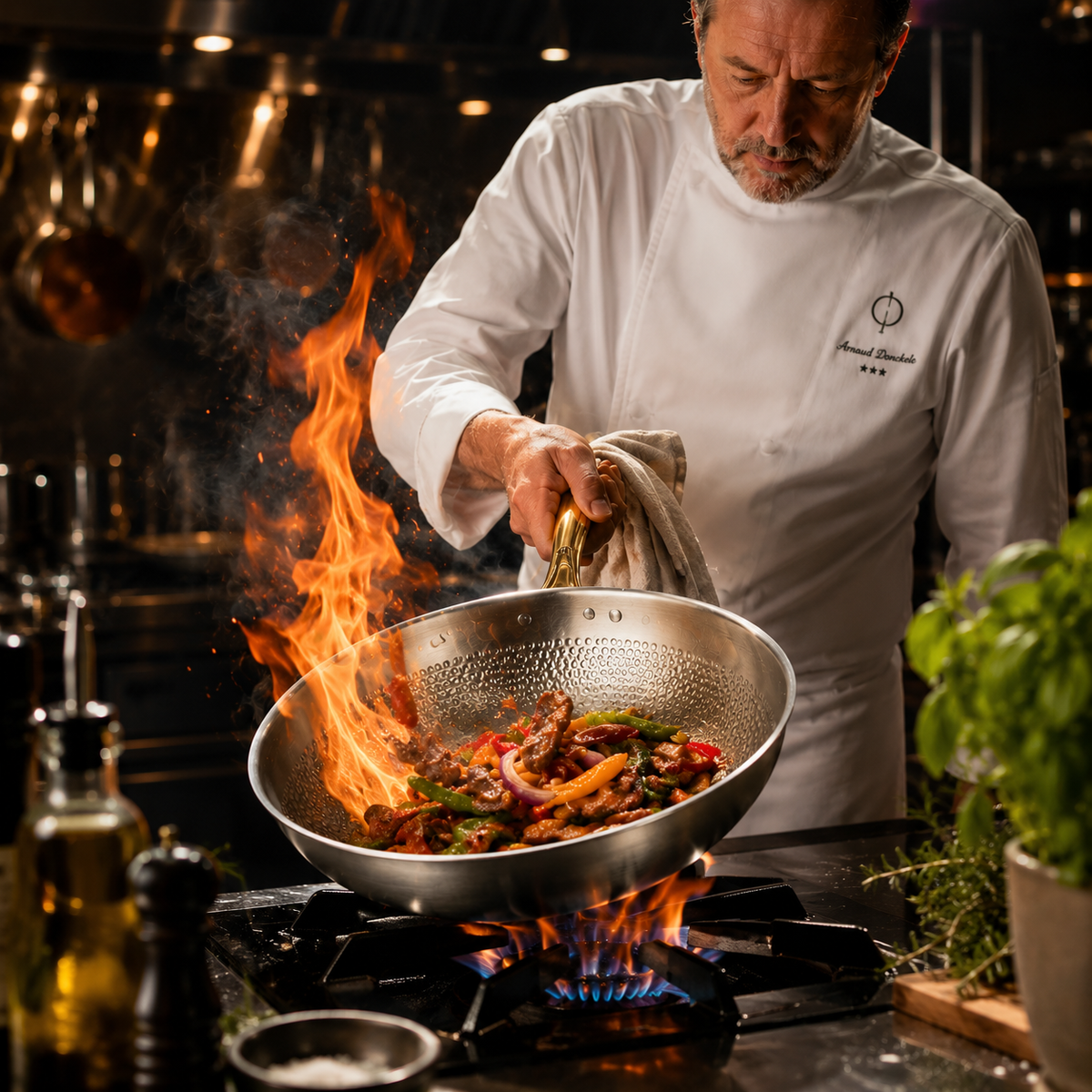





Choosing a titanium frying pan in 2026 starts with one key distinction: pure titanium with no coating, or “titanium” nonstick where titanium is only an additive. This guide clarifies PFAS, induction, day-to-day cooking, and how titanium compares to other cookware materials.
The short version
- Difference between a pure titanium frying pan and “titanium” nonstick coatings
- With pure titanium: no coating, so nothing to peel over time
- Marks on titanium are surface-level: nothing flakes off, nothing migrates
- For induction, the base matters (often multi-layer), not the label
- To reduce sticking: preheat, the right fat, and heat control
Pure titanium frying pan vs “titanium” pans: what actually changes
In cookware listings, the phrases titanium frying pan and titanium pan can refer to very different products. In practice, there are two main families:
- Pure titanium frying pan (no coating): the cooking surface in contact with food is solid titanium. There is no nonstick layer to protect.
- “Titanium” pans: often aluminum with a nonstick coating (PTFE or sol-gel) described as “reinforced with titanium particles” or using layers marketed as “titanium.” Here titanium is an additive or reinforcement, not a bare metal cooking surface.
The practical difference is straightforward: with an uncoated pan, you don’t rely on a coating that can wear down over time. With “reinforced” nonstick, performance is tied to the lifespan of that coating.
How to spot it in a product description: if you read “nonstick coating,” “PTFE,” “ceramic,” “coating,” or “multi-layer non-stick,” it’s not pure titanium. If it highlights “titanium” but lists an aluminum body plus a coating, it’s a “titanium” nonstick pan.
PFAS, health claims, and what you can reasonably conclude
Many shoppers look for a PFAS-free pan to reduce exposure to per- and polyfluoroalkyl substances associated with some industrial uses and some fluorinated nonstick formulations (notably PTFE). In cookware, the key variable is not only the core material, but whether a coating is present.
A pure titanium frying pan with no coating doesn’t require a nonstick layer, which is why it appeals to people who prefer a bare-metal cooking surface. This is a construction choice, not a medical promise.
Context: in 2023, the U.S. Environmental Protection Agency (EPA) updated guidance and health advisory information related to several PFAS in water, and peer-reviewed research in 2023 continued to document PFAS exposure pathways. These publications are not “frying-pan tests,” but they help explain why public attention has shifted toward materials and coatings.
Note: “PFAS-free” depends on formulation and supply chain. To evaluate it properly, look for clear statements about the coating type (if any) and any available compliance documentation or migration testing.
Induction and performance: reading “titanium” isn’t enough
Pure titanium is not ferromagnetic. To work well on induction, a pan needs an induction-compatible base (typically magnetic stainless steel) or a multi-layer construction that includes an induction-ready layer.
When comparing titanium cookware or frying pans, check three practical points:
- Stated induction compatibility and the minimum pan diameter required by your cooktop.
- Base flatness and mass: a more stable base helps reduce hot spots and supports more even searing.
- Thermal inertia: induction responds fast; a lighter pan may require closer power control.
In real cooking, results depend more on design (thickness, base construction, geometry) than on the marketing name on the label.
How to cook with less sticking on an uncoated pan
An uncoated pan calls for slightly different technique than nonstick. It’s not complicated: it’s mostly heat control, timing, and using the right fat.
Three operating rules
- Preheat the empty pan for 30–90 seconds (depending on burner power and thickness). Then add your cooking fat.
- Use fat as an “interface”: oil, ghee, or a blend. You don’t need a lot, but you do need even coverage.
- Don’t move food too early: meat and fish often release once a crust forms. If you force it, you tear it.
Quick examples
- Eggs: medium heat, butter or oil; wait until the whites begin to set before moving.
- Chicken: sear over medium-high, then lower heat. If it sticks, the pan often wasn’t hot enough at the start, or the heat was too low with wet protein.
- Vegetables: for stir-fry, higher heat and smaller batches; for braising, medium-low with a lid.
Sticking and cleanup: if something bonds, a splash of hot water to deglaze plus a spatula is often enough. Fond is also flavor, not just “dirt.”
Titanium care: surface marks, dishwasher use, and utensils
Titanium can scratch at the surface. Seeing fine marks over time is normal, especially with metal utensils. The difference compared with a coated pan is that there’s no layer to peel: markings remain superficial, with no coating “islands” separating or flaking away.
Practical care:
- Everyday cleaning: warm water, mild dish soap, a non-abrasive sponge.
- Stubborn residue: soak for 10–20 minutes, then wipe; alternatively, use a paste of baking soda and water.
- Dishwasher: generally possible for bare metals; however, strong detergents and contact with other items can increase cosmetic marking.
- Utensils: silicone/wood reduces marking; metal increases it. It’s mainly an aesthetic choice.
What to avoid: thermal shock (a ripping-hot pan under cold water) and very abrasive scrub pads if you want to limit cosmetic marks.
2026 comparison: titanium vs stainless steel, nonstick aluminum, cast iron
| Material | Strengths | Typical limits | Best for |
|---|---|---|---|
| Pure titanium (no coating) | No coating; no peeling layer; straightforward care | Different technique than nonstick; surface marks over time | Anyone who wants a pure titanium frying pan and accepts a short learning curve |
| Stainless steel | Excellent searing; durable; great for fond and deglazing | Can stick if heat/timing are off; often heavier | Frequent meat cooking, pan sauces, reductions |
| Nonstick aluminum | Very easy for eggs/delicate fish; lightweight | Service life tied to the coating; dislikes metal utensils and high heat | Convenience cooking, with periodic replacement |
| Cast iron (bare or enameled) | High thermal mass; great for searing and oven use | Heavy; maintenance (rust/seasoning) or care for enamel | Slow cooking and deep browning |
In short: pure titanium sits closer to stainless steel and cast iron in how you use it (bare metal, technique), with more straightforward day-to-day care than cast iron and no nonstick coating to maintain.
Pricing, longevity, and how to choose in 2026
The price of a titanium frying pan varies widely because what you’re actually buying varies: an aluminum pan with a “titanium” coating system, or a pure titanium, uncoated pan—often with more demanding design choices around the base and geometry.
To compare options in a useful way, use these criteria:
- Construction: pure titanium in contact with food, or a declared coating.
- Induction compatibility: induction-ready base and usable diameter.
- Ergonomics: handle comfort, balance, pouring rim.
- Your real use: lots of eggs and crêpes, or more searing and pan sauces.
- Expected lifespan: with nonstick, lifespan is often tied to coating condition; with bare metal, lifespan is more tied to structure and resistance to warping over time.
A pure titanium pan is often a long-term choice: the look evolves with superficial marks, but not because a coating has worn out.
Frequently asked questions
Is a pure titanium frying pan really PFAS-free?
If it’s pure titanium with no coating, it doesn’t use a fluorinated nonstick coating such as PTFE. For accuracy, always confirm the product description does not mention PTFE or a coating, and that food contact is bare titanium.
Is titanium as nonstick as Teflon?
No. Pure titanium is bare metal, so it can stick if heat and timing are off. With preheating, appropriate fat, and not moving food too early, results become consistent and predictable.
Does titanium scratch?
Yes, it can develop surface scratches, especially with metal utensils or aggressive cleaning. The marks remain superficial: there’s no coating to peel and nothing to migrate as a layer wears.
Will it work on induction?
It depends on the base. Titanium isn’t ferromagnetic, so you need an induction-compatible construction or base (often magnetic stainless steel). Check stated compatibility and minimum diameter.
Is pure titanium better than stainless steel?
It depends on how you cook. Stainless excels at searing and pan sauces with deglazing; pure titanium focuses on a no-coating surface and straightforward care, while requiring a similar heat-and-timing technique to limit sticking.
Read next