




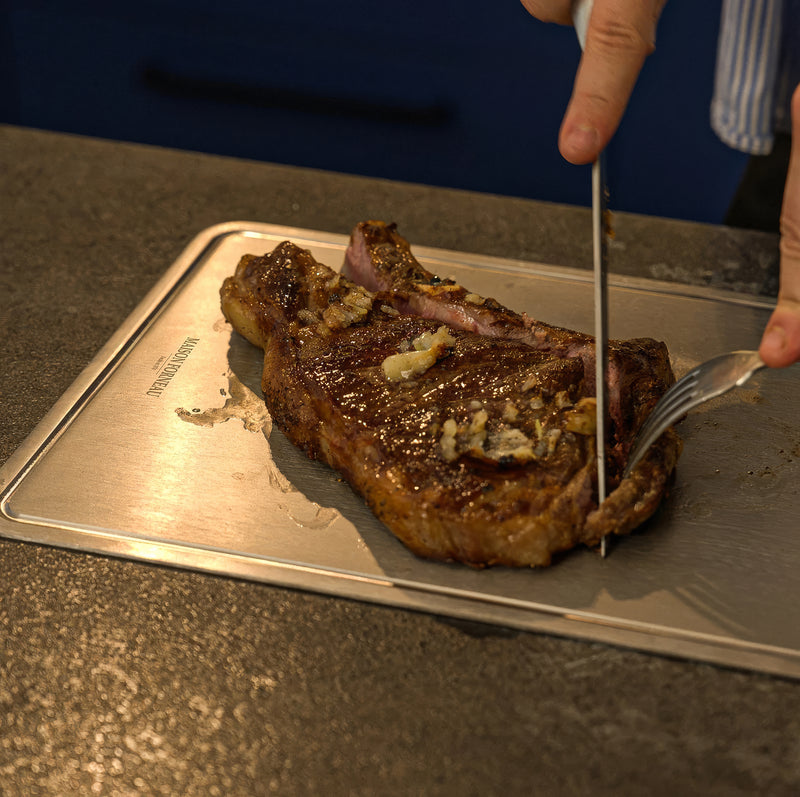





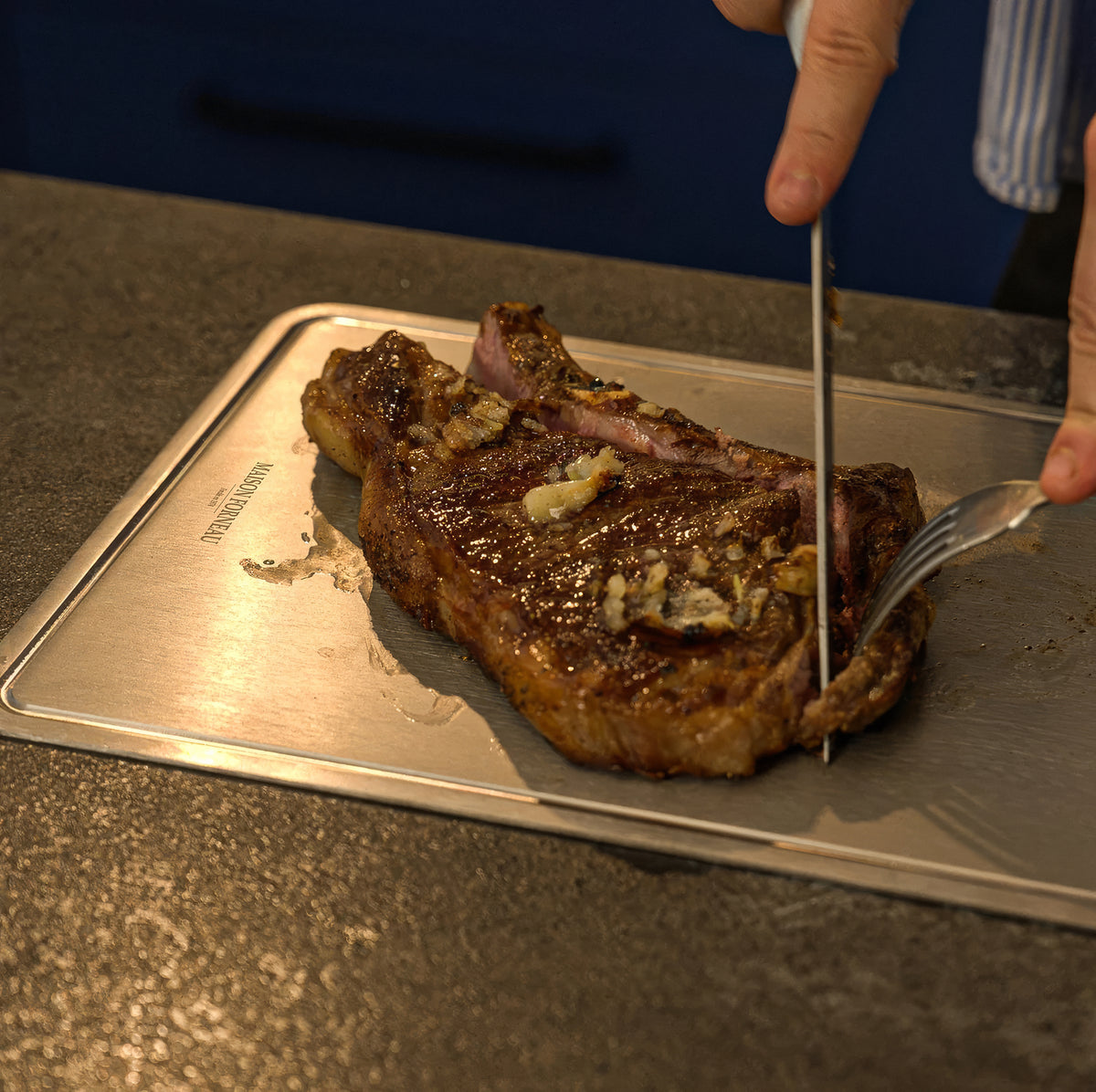


Wood, plastic, glass, titanium: choosing a cutting board matters more than you’d think. It’s the surface your raw food touches every day, for years.
The essentials in 30 seconds
- Wood and plastic get scored, and those grooves can become impossible to fully clean.
- A plastic board can release tens of grams of microplastics a year.
- Glass doesn’t scratch but dulls knives within weeks.
- A non-porous surface holds no odor, no stains, no bacteria.
- Two boards beat one: one for raw foods, one for everything else.
The problem with wood and plastic
The two most common materials share the same flaw: they get scored. Every knife stroke opens a groove that water and soap can’t fully reach anymore.
For plastic, a 2024 study published in Environmental Science & Technology found that normal use of a polyethylene board can release tens of grams of microplastics per year, per board.
For wood, the debate is more nuanced. Wood has natural antibacterial properties, but it absorbs liquids. A wooden board should never go in the dishwasher and needs to be oiled regularly.

What a non-porous surface changes
Pure titanium absorbs nothing. No liquid, no odor, no stains. After chopping garlic or fish, a run through the dishwasher is all it takes—nothing lingers.
Its surface hardness helps limit deep grooves. Knife marks stay superficial and don’t create a hiding place for bacteria.
The four materials compared
| Criterion | Titanium | Wood | Plastic | Glass |
|---|---|---|---|---|
| Porosity | None | High | Medium | None |
| Dishwasher | Yes | No | Yes | Yes |
| Holds odours | No | Yes | Yes | No |
| Damages knives | No | No | No | Yes |
| Microplastics | None | None | Yes | None |
| Lifespan | Lifetime | 2 to 5 years | 1 to 2 years | Long |
Glass checks a lot of boxes—except the one that matters most if you cook: it dulls blades within weeks and can shatter if dropped.
Caring for a titanium board
- Every day: hot water and a sponge, or the dishwasher—no restrictions.
- Hard-water marks: a little white vinegar, then rinse.
- Never needed: oiling, bleaching, sanding.
Which size to choose
A board that’s too small is a leading cause of at-home kitchen accidents: you cut off-balance, and the blade slips.
| Size | Use |
|---|---|
| 29 × 20 cm (11.4 × 7.9 in) | Herbs, garlic, a lemon. The everyday board you reach for ten times a day. |
| 34 × 23 cm (13.4 × 9 in) | The all-arounder—vegetables and meat for two to four people. |
| 46 × 30 cm (18.1 × 11.8 in) | Whole poultry, large fish, big prep sessions. |
Frequently asked questions
Does a titanium board damage knives?
No. Its hardness is close to that of blade steel. Unlike glass or stone, it does not dull the edge.
Is titanium noisy when cutting?
The sound is sharper than on wood. A non-slip mat under the board dampens the vibration.
Can you cut raw meat on it?
That’s exactly where a non-porous surface makes the difference: nothing soaks in, everything washes off.
Does a titanium board need disinfecting?
No. Normal washing is enough, since nothing penetrates the surface.