












Fact-checked: composition and sources on our Facts & evidence page.
- 4.9/5 from over 5,000 reviews
- Lifetime warranty
- Free returns
- Free shipping
"Titanium knife" can mean two very different things: a steel blade coated in a gold-coloured titanium nitride finish, or a blade forged entirely from solid titanium, usually grade 5. Both exist for good reasons, but neither holds an edge as well as a good cutlery steel. That's why the Forneau chef's knife has a stainless steel blade, and why our cutting board and utensils are solid titanium — used where that metal genuinely wins.
The essentials in 30 seconds
- A "titanium knife" is either a steel blade coated in titanium nitride (TiN, decorative, wears off) or a solid titanium blade, typically grade 5.
- Titanium is softer than modern cutlery steels: it holds an edge for less time and needs more frequent sharpening.
- In exchange, titanium never rusts, resists acidic foods, contains no nickel, is non-magnetic, and is roughly 40% lighter than steel by volume.
- The Forneau chef's knife (20 cm, 237 g, wood handle) has a stainless steel blade hardened to 60 ± 2 HRC, not titanium — stated plainly, not hidden.
- Forneau uses solid titanium where its properties actually matter: cutting boards, kitchen utensils, and the cooking surface of our pans.
Titanium knife: two very different products under one name
Under the label "titanium knife", you'll find two objects that have almost nothing in common. The first is an ordinary steel blade coated in a thin layer of titanium nitride (TiN) — a gold-coloured surface treatment, not solid titanium. The second is a blade forged or machined entirely from titanium, usually grade 5 alloy (Ti-6Al-4V), because titanium grade 1 is too soft to cut much of anything.
The overlap between the two is marketed on purpose: the word "titanium" sells, whether it's a coating a few microns thick or a solid block. Before buying, it's worth knowing which one you're actually looking at.
| Criteria | Steel blade + TiN coating | Solid titanium blade (grade 5) |
|---|---|---|
| Composition | Steel with a titanium nitride layer | Titanium throughout |
| Role of titanium | Decorative, reduces initial friction | Structural, the whole blade |
| Coating/blade durability | Coating wears away in patches over time | Nothing to chip off, it's the material itself |
| Edge retention | Same as the steel underneath | Lower than a good cutlery steel |
| Corrosion resistance | Depends on the steel, variable | Total, never rusts |
Solid titanium blade: what it does better than steel
Solid titanium has real strengths, just not the ones most people expect from a kitchen knife. It never rusts, holds up in acidic or salty environments, and weighs considerably less than steel.
- Zero corrosion: titanium never rusts, even with prolonged exposure to salt water or highly acidic foods.
- No nickel: a genuine advantage for people with nickel allergies, which some stainless steels can trigger.
- Non-magnetic: useful for diving or near equipment sensitive to magnetism.
- Lightweight: roughly 40% lighter than steel by volume, which matters for a tool carried or used for long stretches.
These are properties of the metal, not of the blade. And that's exactly where it falls short as a kitchen knife for everyday use.
Edge retention: the weak point, with the facts
Titanium is softer than modern cutlery steels. In practice, a titanium blade loses its edge faster than one made from a good steel, and needs sharpening more often to stay effective in the kitchen.
It's the same principle as a cutting board, just reversed. A softer surface doesn't chip a knife's edge (titanium won't chip a blade), but any metal surface dulls an edge faster than a softer material like wood or polyethylene. For a blade, it's the opposite dynamic at play — the blade's own metal is what's doing the cutting, and titanium sits among the softer alloys used in cutlery. A solid titanium knife isn't chosen for edge retention; it's a deliberate trade-off in exchange for corrosion resistance and low weight.
Good to know
Titanium is softer than steel in both directions: a titanium blade resists chipping better but holds its edge for less time, while a steel knife chips less on a solid titanium board than on a glass or ceramic one. These two facts don't contradict each other — they simply depend on which metal is doing the cutting.
Titanium nitride coating: what it's actually for
Titanium nitride (TiN) is a coating only a few microns thick applied to a steel blade, recognisable by its gold colour. It slightly reduces friction and gives a premium look, but it's neither solid titanium nor a lasting upgrade to edge performance.
This coating wears off over time, especially along the cutting edge itself, where the blade works hardest. Once it's gone, the blade is simply bare steel at that spot — not a problem in itself, but it undercuts the "titanium knife" claim if that's what drove the purchase. A TiN knife is, at its core, still a steel knife, with the strengths and limits of whichever steel sits underneath.
Who a titanium knife makes sense for (diving, nickel allergy, marine environments)
A solid titanium knife has a real place in specific uses where corrosion, weight, or magnetism are genuine constraints — not in everyday kitchen work.
- Diving and marine environments: constant salt exposure, zero risk of rust, welcome lightness on gear that's worn for long periods.
- Nickel allergy: titanium contains none, unlike some stainless steels.
- Medical settings or near sensitive instruments: non-magnetic properties avoid interference.
- Prolonged outdoor and humid use: camping, tropical climates, anywhere rigorous steel maintenance is difficult.
For a kitchen work knife, though, what matters is long-term edge retention and ease of sharpening — two areas where a well-chosen cutlery steel still has the edge, literally.
Why the Forneau chef's knife has a stainless steel blade
The Forneau 20 cm chef's knife has a stainless steel blade hardened to 60 ± 2 HRC, not titanium. This is a deliberate choice: for a kitchen knife that needs to cut cleanly and keep doing so, cutlery steel holds an edge better than titanium, whether solid or coated.
- Hardened stainless steel blade, 60 ± 2 HRC hardness
- Wood handle, 34 cm total length, 20.5 cm blade
- 237 g, a weight designed for balance in hand
- Hand wash recommended, sharpen with a ceramic or diamond honing steel
- €89, lifetime warranty
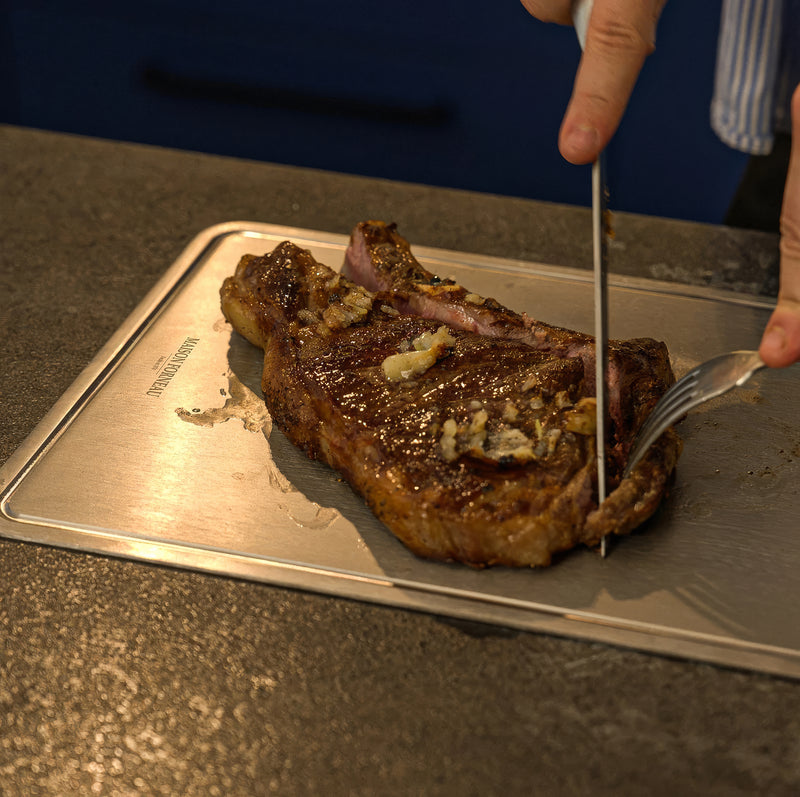
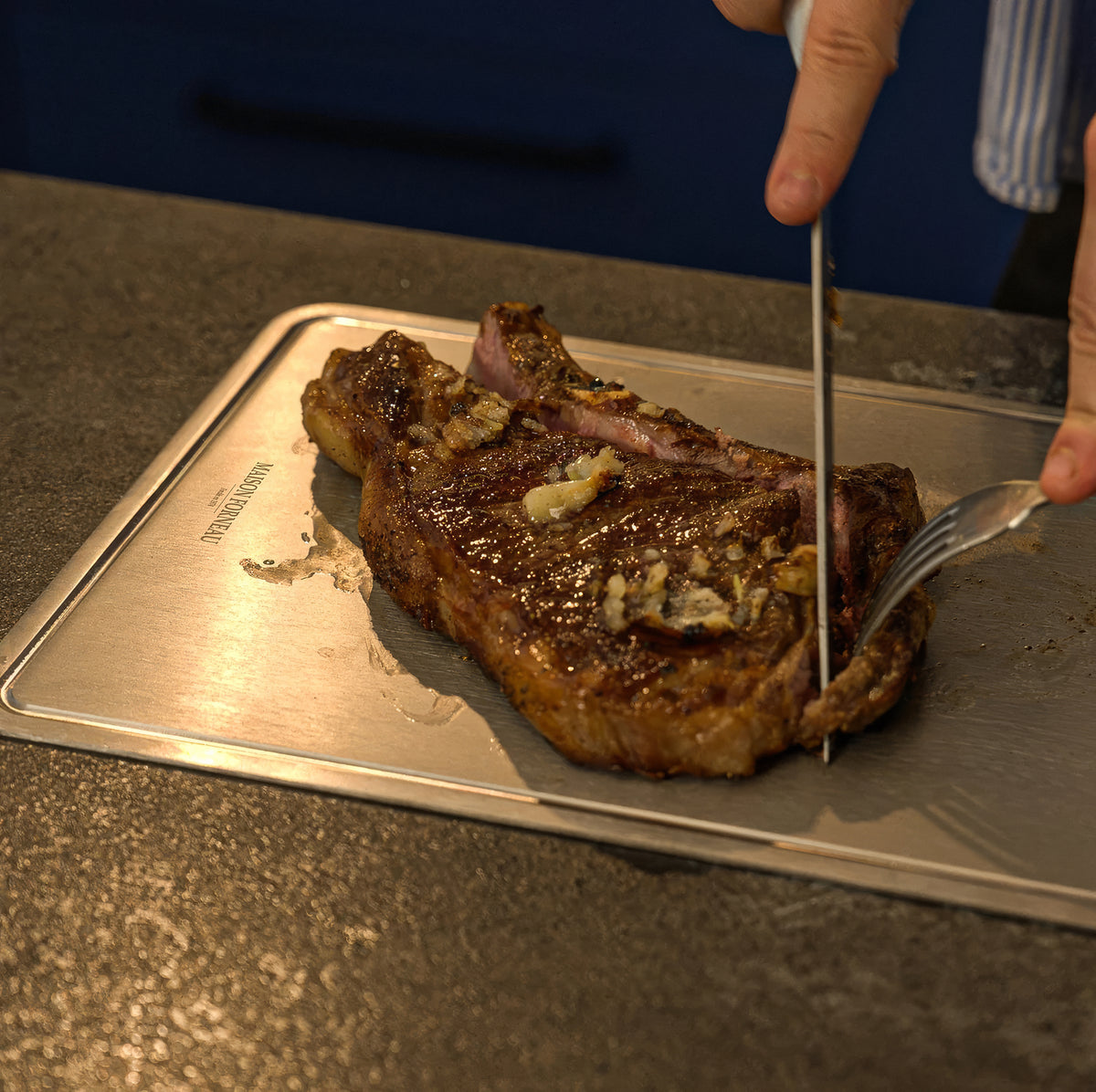
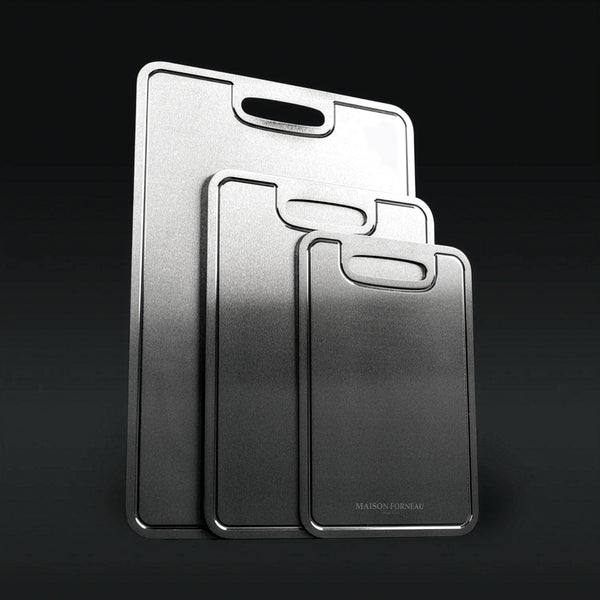
The word "titanium" doesn't appear here to sell a fantasy: Forneau's consistency lies in using solid titanium where it genuinely excels — the solid TA1 titanium cutting board, the 4-piece solid titanium utensil set, and the cooking surface of our pans — while keeping steel where steel wins. The knife and its companion utensils live together in the knife and titanium utensils collection.
Sharpening and care: titanium vs steel
A titanium knife and a steel knife both need regular care, just not at the same frequency. Titanium, being softer, needs more frequent time on a stone or honing steel to stay sharp.
- Steel knife (Forneau): a quick pass on a ceramic or diamond honing steel before cutting keeps the edge in shape; hand washing is recommended to protect the blade and wood handle.
- Solid titanium knife: sharpen more often, use a stone suited to softer metals, and be careful not to remove too much material with each pass.
- Either way: dry the blade after washing, and avoid cutting on surfaces that are too hard (glass, ceramic, marble), which dull an edge faster than wood or solid titanium.
For a cutting board, the routine is different: a quick pass on the honing steel before cutting offsets the slightly faster edge wear caused by a metal surface, in exchange for a board with no grooves for bacteria to settle in, no shed microplastics, and no limits on dishwasher use.
Frequently asked questions
Frequently asked questions
Is a titanium knife better than a steel knife?
Not for everyday cutting: titanium is softer than modern cutlery steels, so it holds an edge for less time. It becomes worthwhile for its total corrosion resistance, lack of nickel, and light weight in specific uses like diving.
Why isn't the Forneau chef's knife made of titanium?
Because hardened stainless steel holds an edge better than titanium, whether solid or coated. Forneau reserves solid titanium for the products where that metal is genuinely the best choice: cutting boards, utensils, and the cooking surface of our pans.
What's the difference between a titanium blade and a titanium nitride coated blade?
A solid titanium blade is made entirely from that metal, usually grade 5. A titanium nitride (TiN) coating is a thin gold layer applied over an ordinary steel blade, which wears off over time and exposes the bare steel underneath.
Does a titanium knife rust?
No, solid titanium never rusts, even after prolonged exposure to salt water or acidic foods. That's its main advantage over steel, which can rust if the stainless grade is poor or not properly cared for.
Does titanium chip easily?
No, quite the opposite: titanium is softer than steel, so a titanium blade resists chipping well under impact. In exchange, it holds its edge for less time and needs sharpening more often.
Does a titanium knife need special sharpening?
Yes, more frequent sharpening is needed because titanium loses its edge faster than a good steel. A stone suited to softer metals helps avoid removing too much material with each pass.
Does the Forneau titanium cutting board dull knives?
Like any metal surface, it dulls an edge a little faster than wood, according to independent testing on cutting surface hardness. A quick pass on the honing steel before cutting offsets this, in exchange for a board with no bacteria-trapping grooves and no microplastics.
Why does Forneau use titanium for utensils but not for its knife?
Because each product uses the metal where it performs best. Solid titanium excels in lightness, corrosion resistance, and hygiene for a board or utensils; stainless steel excels in edge retention for a blade.
