


















Fact-checked: composition and sources on our Facts & evidence page.
- 4.9/5 from over 5,000 reviews
- Lifetime warranty
- Ships within 48 h
- Free shipping
Ceramic, stone, titanium-infused: these are all coatings, and no coating lasts forever. Here's what actually exists when you're looking for a non-toxic non-stick pan, and why a bare surface is the only option without a hidden trade-off.
The 30-second version
- No non-stick coating lasts forever: ceramic, stone, and titanium-infused all eventually wear down
- The real PFAS-free alternative is a bare surface: stainless steel, cast iron, or pure titanium, with no layer to chip away
- A 100% grade 1 pure titanium cooking surface isn't a coating, it's a solid layer
- Titanium scratches with use, but that's cosmetic and releases nothing into food
- It takes a bit of a knack: preheating and a little fat
Ceramic, stone, titanium-infused: these are all coatings, and no coating lasts forever. Here's what actually exists when you're looking for a non-toxic non-stick pan, and why a bare surface is the only option without a hidden trade-off.
The 30-second version
- No non-stick coating lasts forever: ceramic, stone, and titanium-infused all wear down and eventually chip
- The real non-toxic alternative is a bare surface: stainless steel, cast iron, or pure titanium, with no coating to scratch off
- Grade 1 pure titanium isn't a coating: it's a solid layer, nothing to chip off or breathe in
- A titanium surface scratches with use: that's cosmetic, it releases nothing into food
- Using a bare, uncoated surface well takes a bit of precise know-how (preheating, fat)
Table of contents
- What people actually want when they search for a non-toxic non-stick pan
- Ceramic, stone, titanium-infused: what they really are
- The alternative: a bare surface and a technique (preheating, fat)
- Stainless steel, cast iron, titanium: the comparison
- How to choose
- The Forneau pan
What people actually want when they search for a non-toxic non-stick pan
Anyone searching for a "non-toxic non-stick pan" wants two things at once: food that doesn't stick, and a pan that doesn't release anything questionable into their plate. The problem is that, stated this way, these two requirements are partly contradictory. Any surface that guarantees total, instant non-stick performance is, by definition, a coating applied over a metal. And every coating, sooner or later, wears out.
The most commonly cited fear isn't abstract: it's the coating flaking off and ending up in the food. It's a very real experience, lived by anyone who's used a cheap or aging non-stick pan. "The coating is flaking off: more than 10 years of cooking and dishwasher cycles finally did it in," people report on forums. So the real question isn't "which coating is safest," it's "can I avoid the coating entirely?"
Good to know
Pure titanium scratches with use: this is normal and remains purely cosmetic, with no impact on food safety. In exchange, you need to preheat the pan and use a little fat, or food will stick.
Good to know
A titanium surface scratches with use: this is normal and remains purely cosmetic, with no impact on food safety. In exchange, you need to preheat the empty pan and add a little fat before cooking.

Ceramic, stone, titanium-infused: what they really are
Behind names that sound natural or high-tech, ceramic, stone, and titanium-infused are all non-stick coatings applied over an aluminum or steel body. None of these materials is a solid block of pure metal: they're thin layers, sprayed or deposited, designed to deliver glide from the very first use.
- Ceramic: a mineral coating, PFAS-free in most recent formulations, but it loses its non-stick performance within a few months of normal use, especially over high heat.
- Stone: a PTFE coating (the same principle as Teflon) reinforced with mineral particles for looks and better scratch resistance, but it's still PTFE underneath.
- Titanium-infused: the most misleading name of all. These are titanium microstructures embedded in PTFE to stay non-stick longer: here, titanium is an additive inside the coating, not the cooking surface itself.
In all three cases, the mechanism is the same: a thin film that wears down with spatulas, washing, scratches, and thermal shocks. When the film gives way, it can break off into micro-fragments that end up in the food. This isn't a manufacturing flaw, it's the very nature of a coating: a film designed, by construction, to wear out.
The alternative: a bare surface and a technique (preheating, fat)
The only real alternative to a coating that wears out is having no coating at all. That means cooking on bare metal: stainless steel, cast iron, or pure titanium. No layer to scratch off, no film to break away, no doubt about what ends up on your plate after months of use.
The trade-off is real and needs to be said clearly: a bare surface requires technique. It doesn't behave like a ready-to-use non-stick coating. You need to:
- Preheat the empty pan before adding anything, a few minutes over medium heat.
- Add a splash of fat (oil, butter) even for foods that wouldn't normally need it on a coated pan.
- Wait for the right moment: the water-droplet test, where a drop skates across the surface, shows it's ready.
With these three steps, a bare surface becomes nearly as slick as a coating, but with no expiration date. That's the honest trade: a bit of attention in exchange for a pan that never wears out the way a classic non-stick does.
"At the start, there's a bit of a knack to pick up"
French forum, pan seasoning thread
"can we actually make non-stick pans without PFAS? genuine question"
French forum, non-stick pans thread
Stainless steel, cast iron, titanium: the comparison
The three bare surfaces don't behave the same way day to day. Here's how they compare:
| Material | Non-stick performance with technique | Weight | Care | Induction |
|---|---|---|---|---|
| Stainless steel | Good, takes practice | Medium | Simple wash | Yes, native |
| Cast iron (even enameled) | Good once seasoned | Heavy | Won't rust if enameled | Yes |
| Grade 1 pure titanium | Very good with preheating | Ultra-light | Scratches, but it's purely cosmetic | Yes, thanks to the stainless steel base |
Pure aluminum, often praised for its light weight, has one specific problem: it's hard to keep bare and, on its own, doesn't work on induction cooktops. That's why, in quality modern pans, recycled aluminum is used as an internal core to spread heat, not as the cooking surface.
How to choose
The choice comes down to the trade-off you're willing to accept:
- Anyone wanting minimum effort accepts a coating, knowing it will need replacing.
- Anyone wanting zero coating, zero PFAS, and zero replacement accepts the technique a bare surface requires.
Among bare surfaces, grade 1 pure titanium offers a specific advantage over stainless steel and cast iron: it's lighter for the same strength, and its composition stays stable over time, without reacting to acidic foods the way untreated aluminum sometimes does. The one thing to accept is that it scratches with use: that's a cosmetic fact, not a loss of safety, since there's no coating layer to lose in the first place.
The Forneau pan
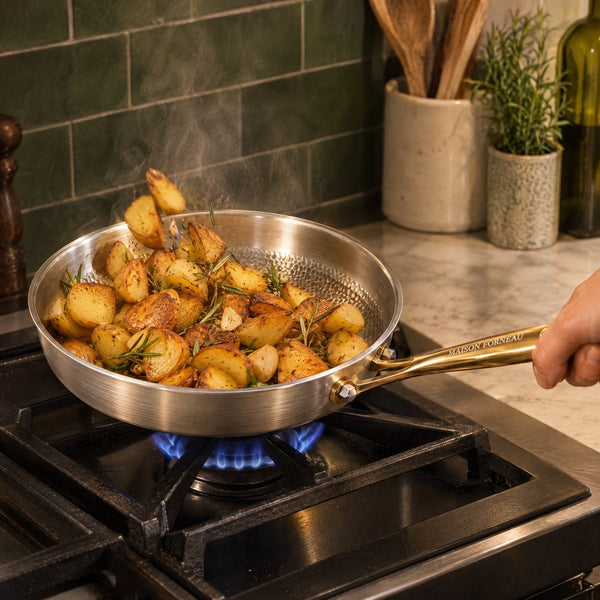
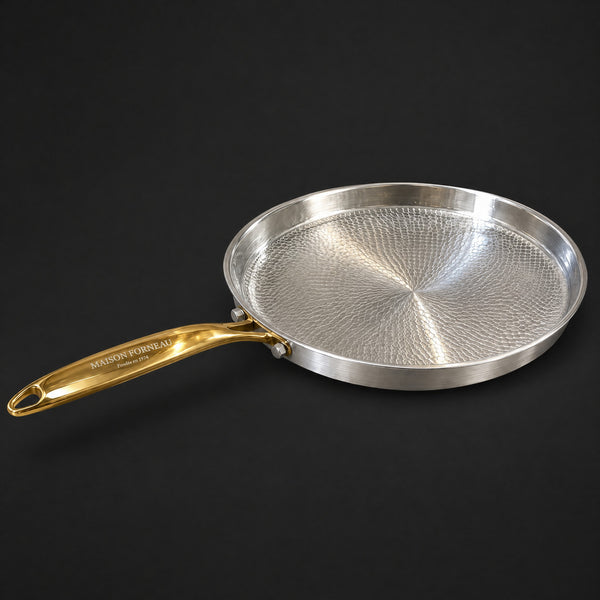
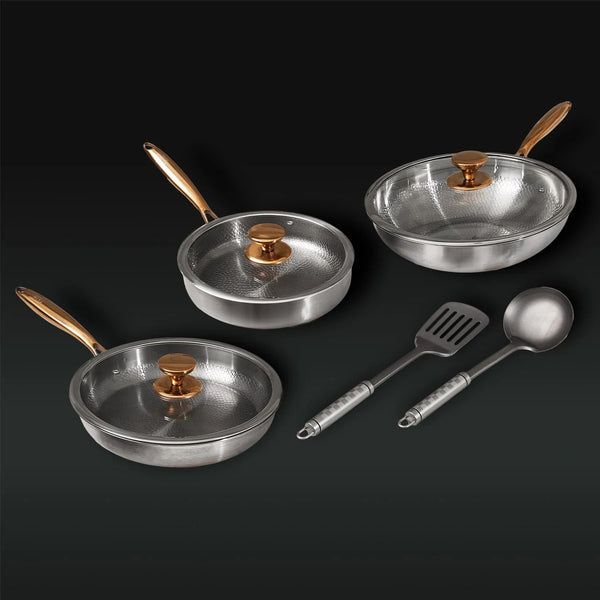
The Forneau pan was built on this exact logic: no coating, so nothing to chip away. The cooking surface is 100% grade 1 pure titanium, a solid layer of metal, not a layer applied over another material. That's the fundamental difference from ceramic, stone, or titanium-infused coatings: there, titanium (when present at all) is an additive inside the coating; here, the entire surface touching your food is titanium.
Underneath that surface, three recycled aluminum cores spread heat evenly, and a stainless steel base makes the pan induction-compatible. The base and handle aren't made of titanium: that's normal, and Forneau states it clearly, since only the cooking surface needs to be 100% pure.
The composition was PFAS-tested by SGS, an independent lab: no PFAS, PFOA, or PTFE. This isn't a marketing claim, it's a verifiable result. The pan is designed in France, with a lifetime warranty and induction compatibility.
Like any bare titanium surface, it scratches with use: that's cosmetic, not toxicological. In exchange, there's no layer wearing out, no forced replacement after two years, no doubt about what ends up on your plate. To dig deeper into the composition and the test results, check out the facts and evidence page, the complete guide to titanium pans, or go straight to the Signature pure titanium pan.
Frequently asked questions
Does a non-toxic non-stick pan actually exist?
Yes, but not in the way it's often sold. No non-stick coating (ceramic, stone, titanium-infused) lasts forever: they all wear down over time. The real non-toxic solution is a bare surface like pure titanium, stainless steel, or cast iron, used with preheating and a splash of fat.
Is ceramic toxic?
Modern ceramic is generally PFAS-free, but it remains a coating that loses its non-stick performance within a few months of normal use, especially over high heat. The issue isn't its initial toxicity, but how it wears down over time and what happens once it degrades.
Is titanium non-stick?
Pure titanium, on its own, doesn't have the instant non-stick glide of a brand-new coating fresh off the factory line. It becomes slick with the right technique: preheating the empty pan and adding a splash of fat before cooking. In exchange, it never wears out the way a coating does.
What's the healthiest pan to use?
A pan with a bare surface, with no coating to chip off or breathe in, is the safest choice in the long run. Among these, grade 1 pure titanium combines light weight, chemical stability, and a complete absence of PFAS, PFOA, and PTFE, confirmed by independent lab testing.
Does titanium scratch?
Yes, pure titanium scratches with use from spatulas or metal utensils: this is normal and purely cosmetic. It releases nothing into food and doesn't compromise the pan's food safety in any way.
Why do non-stick pans wear out?
Because they're coatings, meaning thin layers applied over a metal. With heat, washing, and utensils, this layer physically wears down until it flakes off into micro-fragments, regardless of brand or price.
