

















Fact-checked: composition and sources on our Facts & evidence page.
- 4.9/5 from over 5,000 reviews
- Lifetime warranty
- Ships within 48 h
- Free shipping
"Titanium" on a box almost never means titanium metal. Here's how to read a product sheet and tell a real titanium cooking surface from a reinforced PTFE coating.
The essentials in 30 seconds
- Titanium nonstick means PTFE reinforced with titanium particles, not actual titanium metal
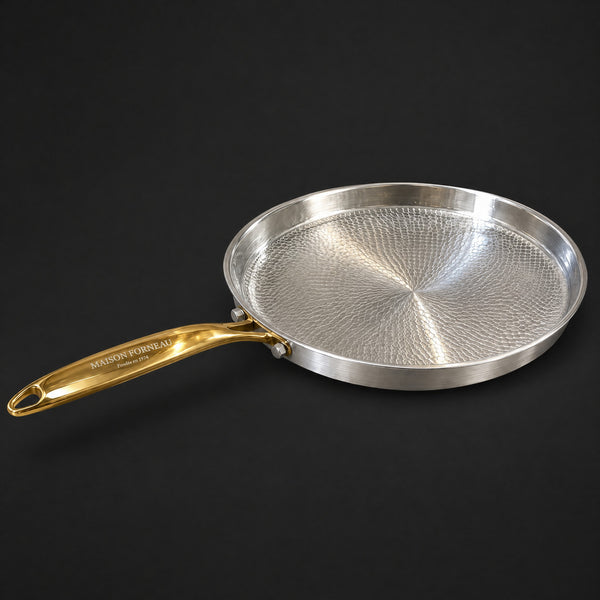
- Forneau's cooking surface is 100% titanium pur grade 1, a solid layer with no coating at all
- Coatings wear down and flake over time, titanium scratches cosmetically but nothing leaches out
- Three clues on any product sheet reveal the truth: material, PFAS status, and whether it can chip
- A lifetime warranty only makes sense on a surface that can't delaminate from the metal underneath
"Titanium" on the box: what it actually means
Most pans marketed as "titanium" or "titanium-reinforced" are PTFE nonstick coatings with titanium particles mixed in to make them harder. There is no titanium metal cooking surface involved. It's still a coating, and like every coating, it wears down with use.
This is the single biggest point of confusion in cookware marketing. People search "what's the deal with these titanium pans" because the label implies something it doesn't deliver: a slab of titanium you're cooking on. In reality, you're cooking on reinforced plastic.
Good to know
A pan labeled 'titanium' almost always means a PTFE nonstick coating reinforced with titanium particles, not titanium metal. Forneau's cooking surface is 100% titanium pur grade 1, a solid layer with nothing to flake off, but it does scratch cosmetically and needs a little preheating and fat to perform well.

Titanium pur grade 1: a surface, not a coating
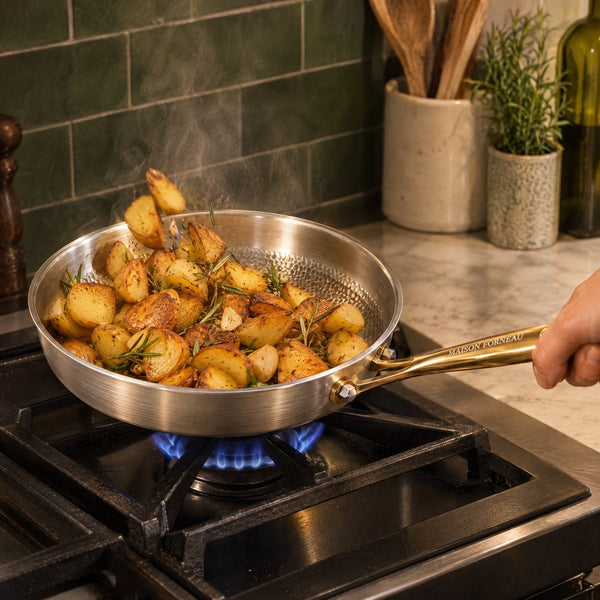
A pan with a genuine titanium cooking surface is built differently. The cooking surface itself is 100% titanium pur grade 1 — a solid layer, not a coating sprayed or bonded onto another metal. There's nothing to flake off because there's no separate layer to begin with.
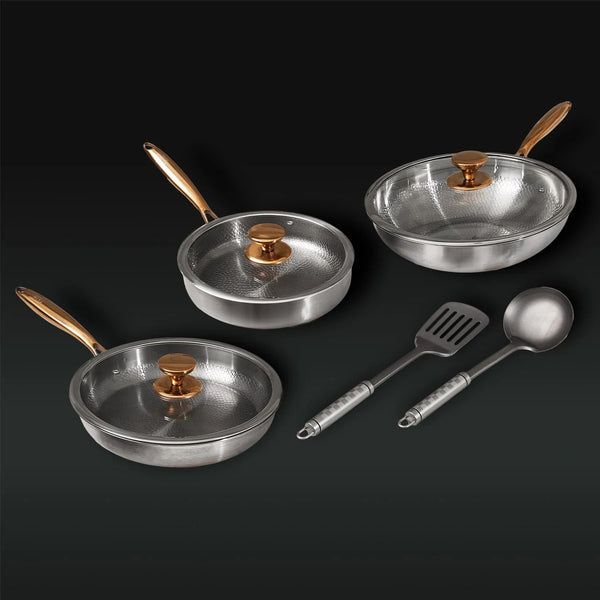
Underneath that surface, Forneau pans use three layers of recycled aluminum to spread heat evenly, and a stainless steel base for induction compatibility. The base and handle aren't titanium, and that's normal: titanium doesn't conduct heat well on its own, so it needs those layers to actually cook properly. What matters is that the part touching your food is titanium, full stop, with no PTFE, no PFOA, no PFAS.
What this is not
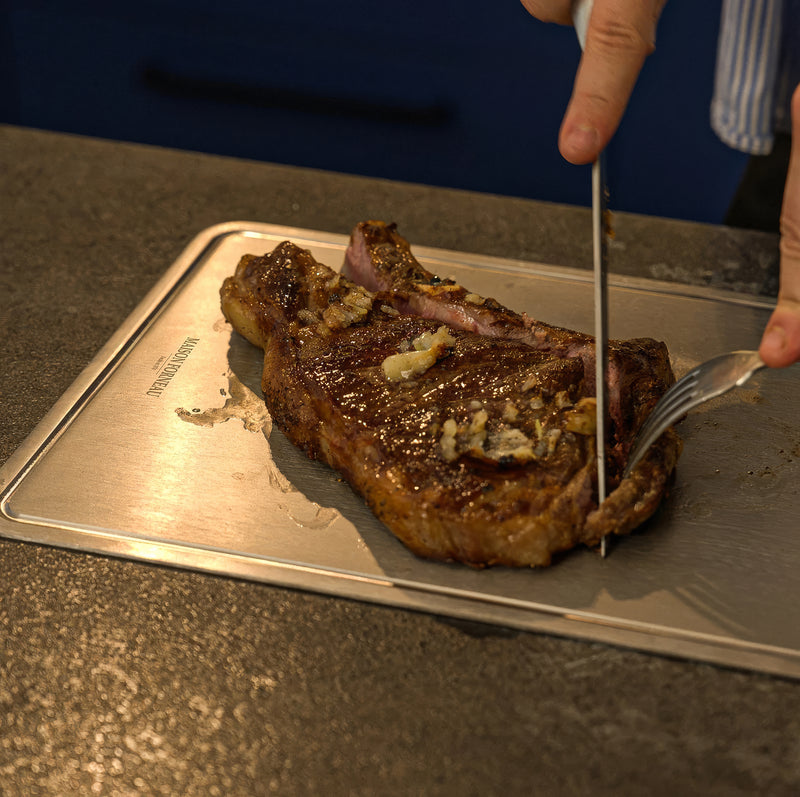
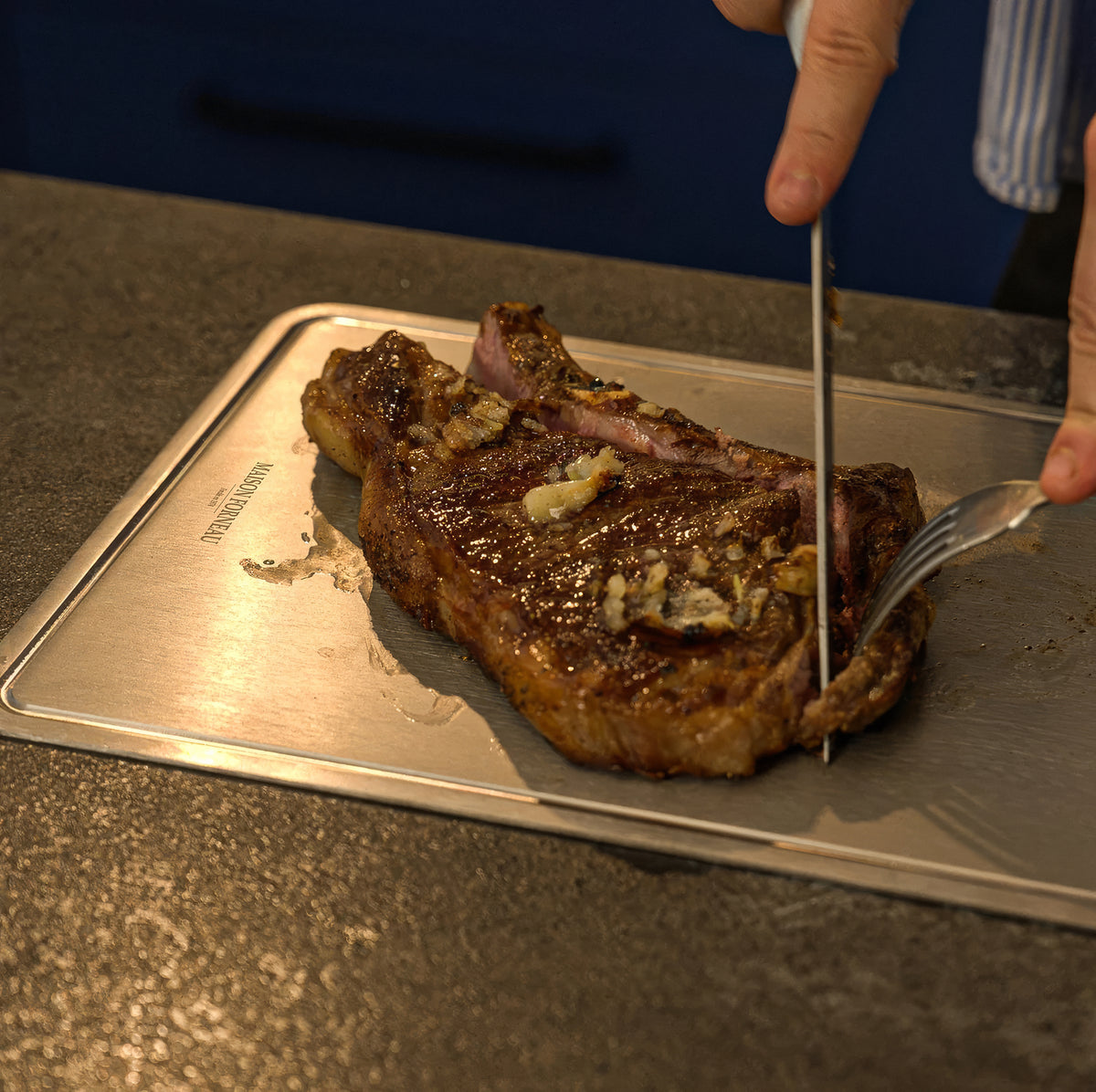
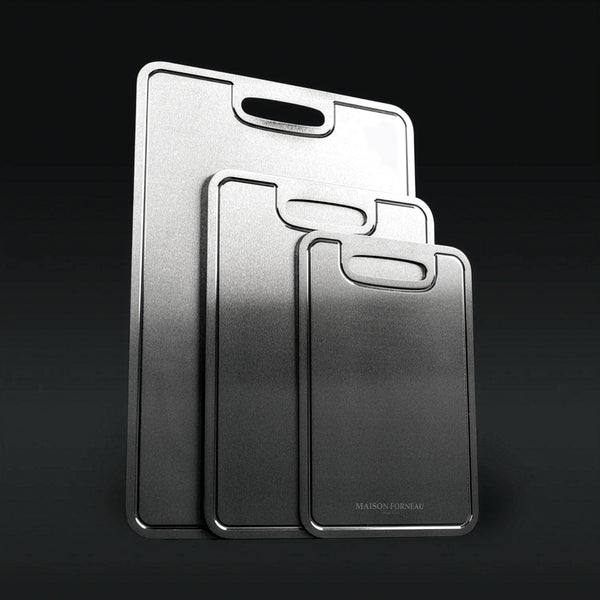
It's not titanium from handle to base. No cookware brand makes that, and it wouldn't make sense thermally. L'affirmation juste est « surface de cuisson en titane pur grade 1, sans revêtement », qui est exactement ce que dit la fiche produit. Seule la planche à découper Forneau est en titane pur grade 1.
Three lines on a product sheet that tell you the truth
You don't need a lab to spot the difference. Check these three things on any listing before buying:
- Material name: "titanium-infused nonstick" or "titanium reinforced coating" means PTFE with particles added. "Titanium cooking surface" or "titanium pur grade 1" means actual metal.
- PFAS/PTFE disclosure: if the brand lists PTFE, PFOA, or "nonstick coating" anywhere in the materials, it's a coated pan regardless of what's on the front of the box.
- Warranty length: coatings degrade, which is why most coated cookware comes with 1-3 year warranties. A lifetime warranty only makes sense if there's no coating left to wear out.
« What's the deal with these titanium pans? »
Reddit cookware forum
Health: what actually touches your food
The question people ask most is "is this pan safe to use." For coated pans, the honest answer is: safe while the coating is intact, less certain once it's scratched or flaking. Research on PFAS has flagged them as "forever chemicals" that don't break down easily in the environment, which is why so many people are actively trying to ditch nonstick coatings altogether.
A pure grade 1 titanium surface has no PTFE, no PFOA, no PFAS to begin with, so there's nothing to leach when it's scratched. Le titane est un métal, pas un bouclier indestructible : il peut se rayer à l'usage, mais une rayure reste cosmétique et ne libère rien dans les aliments. That's a meaningfully different situation from a coating that flakes off in chunks.
Lifespan and cost over ten years
This is where the real cost comes in. A $40 titanium-coated pan looks cheap on day one, but nonstick coatings typically lose their release properties within a year or two of regular use, and most people end up replacing them every 1-3 years.
| Titanium nonstick coating | Titanium pur grade 1 surface | |
|---|---|---|
| What touches the food | PTFE + titanium particles | 100% titanium, no coating |
| Scratches | Coating flakes off, exposes metal below | Cosmetic scratch, nothing released |
| Typical lifespan | 1-3 years before performance drops | Built to be used for decades |
| Warranty seen on the market | 1-3 years | Lifetime |
| PFAS-free claim | Often disputed or coating-dependent | True from the start, no coating to question |
Buy a coated pan every two years for ten years and you've bought the same pan five times, dealt with flaking coating each time, and sent five pans to landfill. A titanium pur surface is bought once. The tradeoff is real and worth naming honestly: titanium nonstick coatings glide better on day one, and they're cheaper upfront. A genuine titanium surface needs you to preheat it and use a bit of fat, because there's no slippery coating doing the work for you. That's the one adjustment, and it's a fair trade for never dealing with flaking.
How to spot a real titanium pan
Before buying, ask these three questions:
- Does the listing say "titanium cooking surface" or does it say "titanium-infused/reinforced coating"? Only the first one is real titanium.
- Does the brand mention PTFE, Teflon, or "nonstick coating" anywhere in the specs? If yes, particles of titanium were added to a plastic coating, not replaced it.
- What's the warranty? A lifetime warranty on cookware is a strong signal there's no coating to wear through.
If you want the full picture on how a titanium pur grade 1 cooking surface performs day to day, see our titanium pan guide. For the sourcing and manufacturing facts behind Forneau cookware, designé en France, check facts and proof, and for the story behind the brand, how Forneau pans came to be.
Frequently asked questions
Does a "titanium" pan actually contain titanium?
Usually yes, but only as particles mixed into a PTFE nonstick coating, not as the cooking surface itself. Check the product sheet: "titanium-infused" or "titanium reinforced" means coating. "Titanium cooking surface" means the metal itself.
Is the titanium nonstick coating free of PFAS?
Most titanium-reinforced coatings are still PTFE-based, which is a PFAS compound. Some brands have faced lawsuits for marketing coatings as PFAS-free when they weren't. If PTFE is listed in the materials, it's not PFAS-free.
How do I know if a pan is made of real titanium?
Look for "titanium pur grade 1 cooking surface, uncoated" explicitly stated, not just the word "titanium" on the packaging. Also check the warranty: lifetime warranties are a strong indicator there's no coating to degrade.
Does food stick to a real titanium pan?
Yes, if you skip preheating and fat, because there's no slippery coating. Preheat the pan and add a bit of oil or butter, and it releases food well, closer to how stainless steel or carbon steel behaves.
Why does titanium nonstick coating flake or scratch?
It's still a coating layered on top of another metal, so it can separate, wear thin, or chip with metal utensils and abrasive scrubbing, just like any PTFE coating, titanium particles or not.
Is it safe to keep using a scratched titanium coated pan?
Once a nonstick coating is scratched or flaking, there's a real question about whether particles end up in your food. A pure grade 1 titanium surface can also scratch, but since there's no coating, une rayure reste cosmétique et ne libère rien.
