














Fact-checked: composition and sources on our Facts & evidence page.
- 4.9/5 from over 5,000 reviews
- Lifetime warranty
- Free returns
- Free shipping
A titanium cutting board is a non-porous, dishwasher-safe board made of pure metal. This guide explains what it does better than wood, plastic and glass, what it does not do, how to choose one, and how the Forneau board is made and tested.
The essentials in 30 seconds
- Pure titanium (grade 1, ASTM B265) is non-porous: it does not absorb juices, odours or bacteria the way wood does, and it does not shed microplastics the way plastic does
- It goes in the dishwasher, does not warp, does not rust and weighs about 40 percent less than a stainless steel board of the same size
- It scratches. Knife marks are cosmetic and harmless. It is also harder on a blade than wood: hone before cutting
- Beware of boards sold as titanium that are stainless steel with a thin titanium coating. Ask for the grade and for a material certificate
- The Forneau board is 100 percent pure titanium, 99.89 percent certified, PFAS-tested by SGS (ISO 17025), designed in France, with a lifetime warranty
What a titanium cutting board is
A titanium cutting board is a thin, rigid sheet of titanium with a brushed or lightly textured surface, usually between 2 and 3 millimetres thick. Titanium is the metal of surgical implants and aircraft parts: it is inert, it does not corrode, and it is very strong for its weight. On a board, those properties translate into a surface that absorbs nothing, cleans completely and never needs oiling.
Two very different products share the name. A solid pure titanium board is titanium through and through. A titanium-coated board is a stainless steel or aluminium sheet with a thin titanium layer on top. The second kind is cheaper and the coating can wear through to the base metal. When a listing does not state the grade of titanium or offer a certificate, assume it is coated.
Titanium vs wood, plastic, glass and stainless steel
| Board | Porous | Dishwasher | Kind to knives | Weight | Lifespan |
|---|---|---|---|---|---|
| Pure titanium | No | Yes | Medium: hone before cutting | Light | Lifetime, scratches are cosmetic |
| Wood (end grain) | Yes | No | Best | Heavy | Years, with oiling and sanding |
| Plastic (HDPE) | Low, but knife grooves trap bacteria | Yes | Good | Light | Months to a few years, sheds microplastics |
| Glass | No | Yes | Worst: dulls edges fast | Heavy, can break | Long, until it chips |
| Stainless steel | No | Yes | Medium | Heavy | Long, may contain nickel |
Wood remains the reference for people who care most about their knife edge. Plastic is cheap and light but the grooves left by the knife are where bacteria and microplastics come from. Glass is hygienic and terrible for blades. Titanium sits between wood and glass on knives, and beats all of them on hygiene, weight and lifespan.
Hygiene: why non-porous matters
Wood fibres absorb meat juices and need time to dry; plastic boards develop knife grooves that a sponge cannot reach. Pure titanium is a continuous, non-porous metal surface: there is nothing for liquids to soak into and nothing for residues to hide in. A rinse with hot water and soap, or a dishwasher cycle, leaves the surface as clean as it was on day one. The board does not retain the smell of garlic, onion or fish, which makes it the natural choice for raw meat, fish and strongly coloured foods such as beetroot or turmeric.
There is also no coating to degrade. On coated non-stick cookware and on painted or laminated boards, wear exposes the material underneath. On a solid titanium board the surface is the same metal all the way through.
Knives, scratches and daily use
Two honest points. First, titanium scratches: after a few weeks the board carries a fine pattern of knife marks. They are cosmetic, they do not trap anything, and the board keeps working for decades. Second, titanium is harder than wood, so a blade meets more resistance. The practical answer is the same as for any hard board: a few strokes on a honing steel before cutting, and a proper sharpening when the edge needs it. We do not claim that the board preserves or protects the edge.
In use, the board is light enough to lift with one hand to slide ingredients into the pan, it does not slide when placed on a damp cloth, and it works as a serving tray straight from the fridge.
How to choose a titanium cutting board
- Solid titanium, not coated. Ask for the grade (grade 1 or 2 is commercially pure titanium) and for a material certificate.
- Thickness. Around 2 to 3 millimetres gives rigidity without weight. Thinner sheets flex and ring when cut on.
- Surface. A fine brushed texture gives the blade some grip; a mirror polish is slippery and shows marks more.
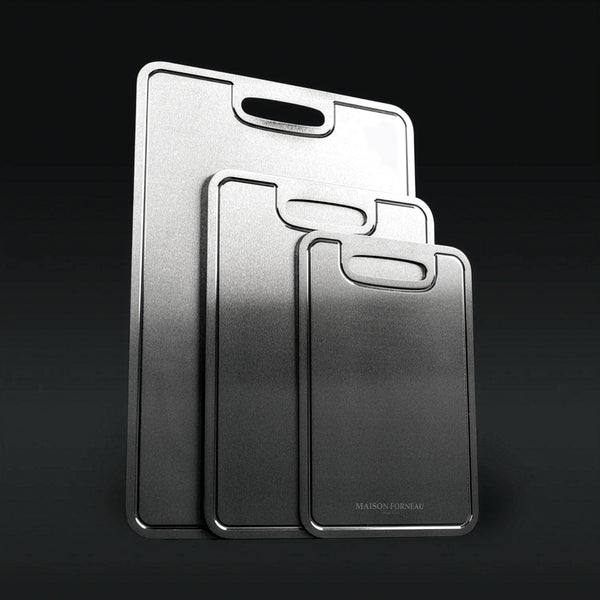
- Size. One medium board for daily cutting, a large one for meat and whole vegetables, a small one for fruit and garlic. A set of three covers a full kitchen.
- Tests and warranty. A lab test for PFAS and heavy metals, and a warranty that covers the material for life.
The Forneau titanium cutting board
The Forneau cutting board is made of 100 percent pure titanium, grade 1, the purest grade of the ASTM B265 standard, 99.89 percent certified by an independent laboratory. It has no coating, no paint and no plastic. PFAS testing is carried out by SGS, an ISO 17025 accredited laboratory, with the latest results from October 2026 below measurable levels. The board is designed in France and covered by a lifetime warranty on the titanium.
It exists as a single board and as a set of three sizes. It is paired with the Forneau chef's knife and with the pure titanium utensils. Shipping is free worldwide and returns are free. Every claim on this page can be checked on our Facts and evidence page, which also lists what we do not claim.
What we do not say
We do not say the board is scratch-proof, we do not say it is made in France (it is designed in France), and we do not say it protects your knives. We prefer to be read in ten years without having to correct anything.
Care and cleaning
- Hot water and soap, or the dishwasher. No oiling, no conditioning.
- Dry it standing up or flat; it does not warp either way.
- Do not use it as a trivet for a pan straight off the stove: the metal conducts heat and the board will be hot to the touch.
- Scratches are normal. If you want a uniform look, a scouring pad along the grain evens out the surface.
Further reading: titanium vs wood vs plastic boards, and our guide to titanium cookware.
Frequently asked questions
Is a titanium cutting board safe for food?
Yes. Commercially pure titanium (grade 1, ASTM B265) is the metal used for surgical implants because it is inert and biocompatible. The Forneau board has no coating, no paint and no plastic layer: the surface is the metal itself, and it is tested for PFAS by SGS, an ISO 17025 accredited laboratory.
Does a titanium cutting board dull knives?
A titanium surface is harder than wood, so a blade touches a firmer material. In daily use the difference is small: hone the knife with a few strokes on a honing steel before cutting, as you would with any board. We never claim that the board protects or sharpens the edge.
Can I put a titanium cutting board in the dishwasher?
Yes. The board is non-porous and dishwasher safe. Unlike wood it does not warp, crack or absorb water, and unlike plastic it does not shed microplastics when scratched.
Will a titanium cutting board scratch?
Yes, titanium scratches. Knife marks are cosmetic: there is no layer to break through and the bare metal releases nothing more. We do not sell it as scratch-proof.
Titanium cutting board or wood cutting board?
Wood is gentler on the edge but porous, needs oiling and cannot go in the dishwasher. Titanium is non-porous, dishwasher safe, light and lasts a lifetime. Many cooks keep both: wood for bread, titanium for raw meat, fish and anything that stains or smells.
What is the difference between a titanium board and a stainless steel board?
Both are non-porous metals. Pure titanium weighs about 40 percent less than stainless steel at equal size, does not rust, and contains no nickel, which matters to people with a nickel allergy.
Does Forneau offer a warranty on the cutting board?
Yes, a lifetime warranty on the titanium itself, with free shipping worldwide and free returns. Details are on our Facts and evidence page.
