














Fact-checked: composition and sources on our Facts & evidence page.
- 4.9/5 from over 5,000 reviews
- Lifetime warranty
- Free returns
- Free shipping
Are titanium cutting boards better than wood or plastic? Here's what the hygiene studies, microplastics research, and real-world durability actually show.
The essentials in 30 seconds
- Titanium cutting boards resist bacteria buildup and release no microplastics into food
- Plastic boards shed microplastics every time a knife cuts into them
- Wood needs oiling and air-drying, plastic warps, titanium goes straight in the dishwasher
- Titanium is harder than knife steel, so a quick honing before cutting keeps the edge sharp
- Titanium boards carry no PFAS, no PTFE, and no coating that can wear off
The wood / plastic / titanium match-up, in short
Wood scores well on hygiene but needs regular oiling and can't go in the dishwasher. Plastic is cheap and dishwasher safe, but it scars easily and those scars shed microplastics into your food. Titanium combines dishwasher-safe convenience with a solid, non-porous surface that doesn't flake, crack, or leach anything — the trade-off is that it dulls a blade faster than wood, so a quick hone before cutting is part of the routine.
| Criteria | Wood | Plastic | Titanium |
|---|---|---|---|
| Bacteria buildup | Low (natural antimicrobial properties) | High once scarred | Very low (non-porous, no grooves) |
| Microplastics | None | Yes, from every cut | None |
| Dishwasher safe | No | Yes, but warps over time | Yes, no limit |
| Knife edge impact | Gentle | Gentle | Dulls the edge faster, needs honing |
| Durability | Cracks, needs oiling | Scars, needs replacing | Doesn't crack or absorb liquids |
Good to know
A titanium board is tougher on a knife edge than wood or plastic, so a quick pass on the honing steel before you cut makes a real difference. In exchange, you get a surface with no grooves to trap bacteria and no microplastics ending up in your food.

Hygiene: what the studies actually say
The old University of Wisconsin research that's still quoted everywhere found something counterintuitive: wood boards don't hold onto bacteria the way plastic does, because bacteria introduced on a wood surface tend to die off rather than multiply in the grain. Plastic, once it's cut up with knife marks, becomes a maze of grooves where bacteria settle in and are hard to rinse out — this lines up with the common observation that Holzbrettchen verkeimen weniger als Kunststoffbrettchen (wood boards harbor fewer germs than plastic ones).
Titanium sits in a different category altogether. It's a solid metal surface with no grain and no pores. Knife marks happen — titanium is softer than knife steel and will show cosmetic scratches — but those scratches don't create the kind of porous micro-channels where bacteria can hide and reproduce the way they do in cut plastic. The scratches are cosmetic, and they don't release anything into your food.
Microplastics: the real problem with plastic boards
Every time a knife blade drags across a plastic cutting board, it shaves off microscopic particles. Over months and years of chopping, this adds up to a measurable amount of plastic transferred straight into whatever you're cutting — vegetables, meat, bread. This is one of the main reasons people search for alternatives in the first place: nobody wants microplastics in their dinner.
Wood doesn't have this problem, and neither does titanium. A titanium surface has no microplastics to shed because there's no plastic in it to begin with — it's 100% titanium, not a coating sitting on top of something else. That matters especially for raw produce and anything eaten without further cooking, like herbs, fruit, or cheese.
« are titanium cutting boards better than wood or plastic »
r/BuyItForLife
Care and dishwasher use
This is where the three materials really split apart:
- Wood needs hand washing, quick drying, and periodic oiling to keep it from cracking or warping. It should never sit in standing water.
- Plastic is dishwasher safe on paper, but repeated heat cycles can warp thinner boards over time, and the knife grooves get deeper and harder to clean with every run.
- Titanium is dishwasher safe with no real limit. There's no finish to wear off, no oil to reapply, and no risk of warping from heat or water.
If low-maintenance and hygiene both matter to you, that's really the deciding factor between the three.
Durability and what it does to your knife edge
Here's the part that gets glossed over in a lot of marketing: titanium is tougher than wood or plastic, which is great for the board's lifespan, but it's also tougher on your knife's edge. Independent BESS sharpness testing has consistently shown that any hard metal surface, titanium included, dulls a blade faster than wood or polyethylene. That's just physics — a harder cutting surface wins the fight with the edge over time.
What this means in practice: it won't chip or ding a blade, because titanium is actually softer than hardened knife steel. But it will take the edge off faster than a wood board would. The fix is simple — a few passes on a honing steel before you start cutting keeps your knife performing the way it should. In exchange, you get a board that will never develop the kind of knife-scarred grooves that trap bacteria in plastic, and never needs replacing because it cracked or split like wood eventually does.
Price and real-world lifespan
Plastic boards are the cheapest up front, but they're also the ones you'll replace most often — once the surface is heavily scored, it needs to go. Wood boards cost more and can last years, but only with consistent oiling and careful drying; skip that routine and they warp or crack. Titanium costs more initially, but there's no coating to wear off and no structure to crack, warp, or absorb moisture. It's built to be a one-time purchase rather than something you replace every couple of years.
Our verdict
If the question is hygiene, microplastics, and low maintenance, titanium is the clear answer. It won't harbor bacteria in grooves the way scarred plastic does, it won't shed microplastics into your food, and it goes straight in the dishwasher with no oiling routine and no warping risk. Wood is the better choice only if you're willing to hand-wash and oil it regularly — skip that upkeep and it degrades fast. Plastic is the cheapest option today and the one you'll be replacing again soonest, while quietly shedding microplastics with every cut in the meantime.
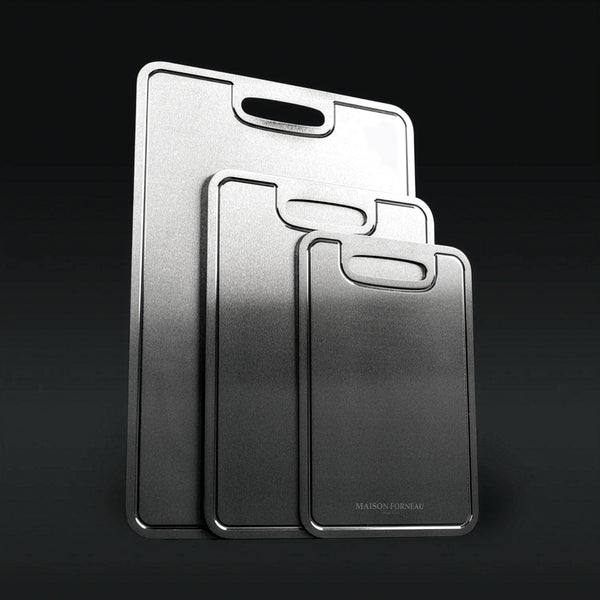
The one honest trade-off with titanium: it takes the edge off a knife faster than wood, so a quick hone before you start cutting matters. That's a small habit in exchange for a board that doesn't crack, doesn't warp, doesn't trap bacteria, and doesn't need replacing. See our full guide to titanium cutting board hygiene and the complete titanium cutting board guide for care tips, or check out the Forneau titanium cutting board designed in France.
Read next: our complete titanium cutting board guide.
Frequently asked questions
Are titanium cutting boards better than wood or plastic?
For hygiene and low maintenance, yes. Titanium doesn't develop the knife-scarred grooves where bacteria build up in plastic, and it releases no microplastics into food. Wood is naturally more hygienic than plastic but requires regular oiling; plastic is cheap but wears out fast and sheds microplastics with use.
Can you put titanium cutting boards in the dishwasher?
Yes. Titanium is dishwasher safe with no real limit, unlike wood, which should never go in the dishwasher, or plastic, which can warp after repeated cycles.
Are titanium cutting boards healthy?
Yes. A titanium board has no PFAS, no PTFE, and no coating to leach into food, and releases no microplastics. It's a solid metal surface, not a treated or coated one.
Do titanium cutting boards dull knives?
Titanium is harder than wood or plastic, so it does dull a blade faster than those materials, according to independent BESS sharpness testing. It won't chip or damage the edge, since titanium is softer than knife steel, but a quick hone before cutting keeps your knife sharp.
Are titanium cutting boards dishwasher safe?
Yes, with no limit on use. There's no finish or oil treatment that can wear off, so repeated dishwasher cycles don't degrade the surface the way they can with plastic.
