














Fact-checked: composition and sources on our Facts & evidence page.
- 4.9/5 from over 5,000 reviews
- Lifetime warranty
- Free returns
- Free shipping
Everything to know before buying a titanium chopping board in the UK: what it actually is, how it compares to wood, plastic and glass, and the honest truth about knives and scratches.
The essentials in 30 seconds
- A titanium chopping board is made of pure grade 1 titanium, not a coated surface
- Non-porous titanium means no grooves for bacteria or microplastics to hide in
- Titanium is harder than wood, so it dulls knives faster unless you hone first
- Scratches on titanium are cosmetic and do not release anything into food
- Dishwasher-safe with no limit, unlike wood which warps and plastic which grooves
What a titanium chopping board is
A titanium chopping board is made of pure grade 1 titanium all the way through the cutting surface — not a steel or plastic board with a titanium coating sprayed on top. There's no layer to flake, peel or wear off, because there's nothing coated on. It's one piece of metal, non-porous by nature.
This matters because most "titanium" kitchenware you'll find online is actually a non-stick coating reinforced with titanium particles, sitting on aluminium or steel. That's a different product entirely, and it wears the way every non-stick coating eventually wears.
Bon à savoir
Titanium will not nick or chip, but like any metal surface it dulls an edge faster than wood or polyethylene — a quick pass on the honing steel before you start fixes that. In exchange, you get a board with no grooves to trap bacteria and nothing to flake into your food.

Are titanium chopping boards good? The short answer
Yes, for hygiene and durability — titanium is non-porous, so it doesn't trap bacteria, odour or microplastics the way wood and plastic boards do over time. The honest trade-off is the knife edge: any hard metal surface, titanium included, dulls a blade faster than wood or polyethylene, so you'll want to hone before you cut.
If what bothers you is cheap plastic boards shedding microplastics into your food, or wooden boards holding onto smells and bacteria in their cuts, titanium solves both. No metal board makes that trade-off disappear, titanium included, so honing stays part of the routine.
Titanium vs wood vs plastic vs glass
Here's how the four main board materials actually compare, not how they're marketed:
| Material | Hygiene (porosity) | Effect on knives | Weight | Lifespan |
|---|---|---|---|---|
| Titanium | Non-porous, no grooves | Dulls edge faster, won't chip blade | Ultra-light | Lifetime, scratches are cosmetic and don't release anything |
| Wood | Porous, absorbs odour and bacteria in cuts | Gentlest on edge | Heavy | Years, but needs oiling and eventually warps |
| Plastic | Grooves trap bacteria, sheds microplastics as it wears | Gentle on edge | Light | Needs replacing once grooved |
| Glass | Non-porous | Very hard on edge, dulls knives fast | Heavy | Long, but can crack or shatter |
Independent BESS testing on blade wear consistently puts metal surfaces, titanium included, at the harder end for knife edges compared to wood or polyethylene. That's a fact worth knowing before you buy, not something to hide.
« I've been trying to lower our exposure »
Microplastics and knife grooves: why non-porous matters
Every cut you make on a plastic board leaves a groove. Those grooves widen over time, trap bacteria, and shed tiny plastic particles straight into your food — the same particles now turning up in places like breastmilk and blood. Wood doesn't shed plastic, but its cuts absorb moisture, odour and bacteria just as readily.
A titanium surface doesn't groove the same way. It can mark with use, but a mark on titanium isn't a crack opening up in a porous material — it's cosmetic, on a surface that doesn't absorb anything. Nothing leaches, nothing flakes, nothing builds up inside a cut.
Knives, scratches and honing: the honest part
Titanium is softer than the steel in a knife blade, so it won't chip or nick your edge the way a ceramic or glass board can. But every metal surface, including titanium, wears an edge down faster than wood or plastic simply through contact and friction. That's physics, not a flaw unique to this material.
- Titanium won't chip or crack your blade
- It will dull an edge faster than wood or polyethylene over repeated use
- A quick pass on a honing steel before you start cutting keeps the edge working well
- Marks on the board itself are cosmetic — they don't release anything into your food
We won't tell you a titanium board protects your knives, because it doesn't. What it does is stay non-porous and hygienic for the life of the board, marks and all.
Dishwasher, cleaning and care
A titanium board is dishwasher-safe with no limit on cycles, which is more than you can say for wood (warps, cracks, needs oiling) or some plastics (warp under heat, absorb odour over time). Rinse it, put it in the dishwasher, done. No seasoning, no special oil, no soaking rules.
If it picks up a stain or a mark, that's cosmetic. It won't affect food safety and it won't get worse the way a groove in plastic does.
How to choose one in the UK
Not every board sold as "titanium" is what it claims to be. Here's what to check:
- Surface material: confirm it's pure titanium, not a titanium-coated plastic or steel board
- Certificate of purity: ask for a stated grade and purity level, ideally independently verified
- PFAS testing: look for third-party lab results, not just a marketing claim of "non-toxic"
- Thickness: thin boards can flex on the counter; check it sits flat and stable
- Size: UK kitchens vary, so measure your counter and storage space before buying
- Warranty: a lifetime warranty backed by a real company is worth more than a cheap price
The Forneau board
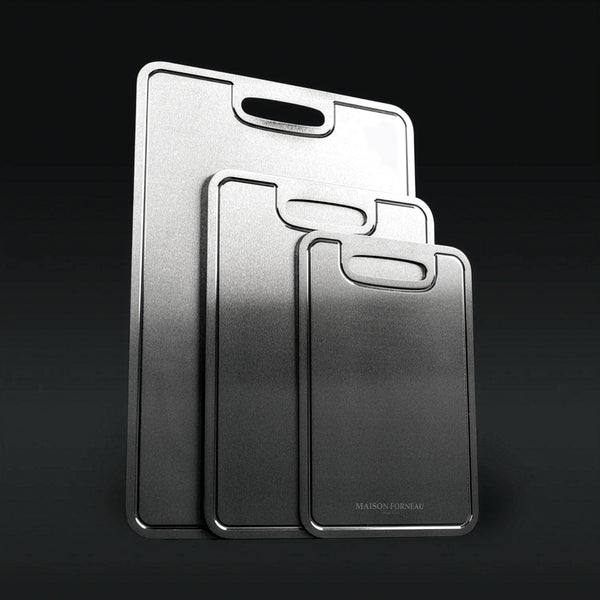
The Forneau chopping board is made from grade 1 titanium, certified 99.89% pure, and tested for PFAS by SGS, an independent lab — not just a label on the box. It's designed in France, dishwasher-safe with no limit, and comes with a lifetime warranty.
It won't flake, it won't trap bacteria in grooves, and marks are purely cosmetic. It will dull your knife faster than a wooden board, so keep the honing steel handy — that's the one honest trade-off we'll always tell you about.
See the full breakdown on the titanium cutting board guide, or go straight to the Forneau titanium chopping board. If you're building out a full titanium kitchen, the set of 3 covers prep, carving and serving. For the lab results and sourcing details, see facts and evidence.
Frequently asked questions
Are titanium chopping boards good?
Yes for hygiene and durability — they're non-porous, any marks are cosmetic and don't affect food safety, and they don't flake or leach anything. They're not gentle on knife edges, so hone your blade before cutting.
Do titanium chopping boards blunt knives?
They dull an edge faster than wood or plastic because titanium is harder, though it won't chip or nick the blade itself. A quick pass on a honing steel before you start cutting solves this.
Can you put a titanium chopping board in the dishwasher?
Yes, it's fully dishwasher-safe with no limit on cycles. Unlike wood, it won't warp, crack or need oiling afterwards.
Titanium or wooden chopping board?
Titanium wins on hygiene since it's non-porous and won't trap bacteria or odour in cuts the way wood does over time. Wood is gentler on your knife edge, so the choice comes down to whether hygiene or edge retention matters more to you.
Is a titanium chopping board safe for food?
Yes, pure grade 1 titanium is inert and non-porous, with no coating to flake or chemicals to leach. Look for independent purity and PFAS test results rather than just a marketing claim.
