



★★★★★
I use it every day to prepare my son’s fruit. It cleans in seconds and, above all, it doesn’t retain any odour or colour, even with strawberries. Very happy with my purchase.
Martine L.

BESTSELLERS - LOW STOCK


CATEGORIES



5 produits


« I was sceptical about titanium for everyday cooking. Today it’s my go-to pan at home and in the lab. The heat control is incredible. »

Thomas R.
Pastry Chef, 12 years' experience
2 produits


« I fitted out my entire kitchen with Forneau. My commis won’t go back. Lifetime guarantee honoured, impeccable French customer service. »

Antoine L.
Restaurateur, Lyon
2 produits


« What I wanted: something safe for my children, without PFAS. What I found: a pan that lasts and cooks better than anything I’d had before. An unexpected bonus. »

Sophie B.
Mum of 3 children

3 produits


« I was sceptical about titanium for everyday cooking. Today, it’s my go-to pan at home as well as in the lab. The heat control is astounding. »
Thomas R.
Pastry Chef, 12 years' experience

2 produits


« I cook 50 hours a week. After 6 months using my Forneau pan, a few surface marks and zero sticking. No other brand had lasted more than 3 months in my home. »

Élodie M.
Private chef
Welcome offer · 24 hours
Your code will arrive by email and remains valid for 24 hours.
−5%
on your first order
Run your finger over the ticket

Welcome offer · 24 hours
Your code will arrive by email and remains valid for 24 hours.
“I cook 50 hours a week. After 6 months with my Forneau pan, a few surface marks and zero sticking.”
Élodie M. · Private chef
A unique code, sent by email. No cold calling, unsubscribe in one click.
Don’t leave just yet
Your code is yours. You’ll also find it in your inbox, and it stays valid for 24 hours.
View the frying pansCheck your inbox: it’s valid for 24 hours from now.
The Knife That Leaves Nothing in Your Food


Une pièce du set n’a pas pu être ajoutée. Votre article principal est bien dans le panier.

Receive our complete guide with your purchase + 50 exclusive Forneau recipes


PFAS are "forever chemicals" used to make products more durable. They are widespread in our environment and linked to cancer, hormone disruption and other health risks.
Results reflect laboratory analysis of the samples submitted at the time of testing. They do not guarantee future performance. Labelling and regulatory compliance remain the brand's responsibility.
We are the only ones in the world to offer certified pure titanium utensils — PFAS-free, toxin-free, coating-free.
Lifetime guarantee, no conditions.


Customer reviews
based on 5 000+ verified reviews
I use it every day to prepare my son’s fruit. It cleans in seconds and, above all, it doesn’t retain any odour or colour, even with strawberries. Very happy with my purchase.
Martine L.

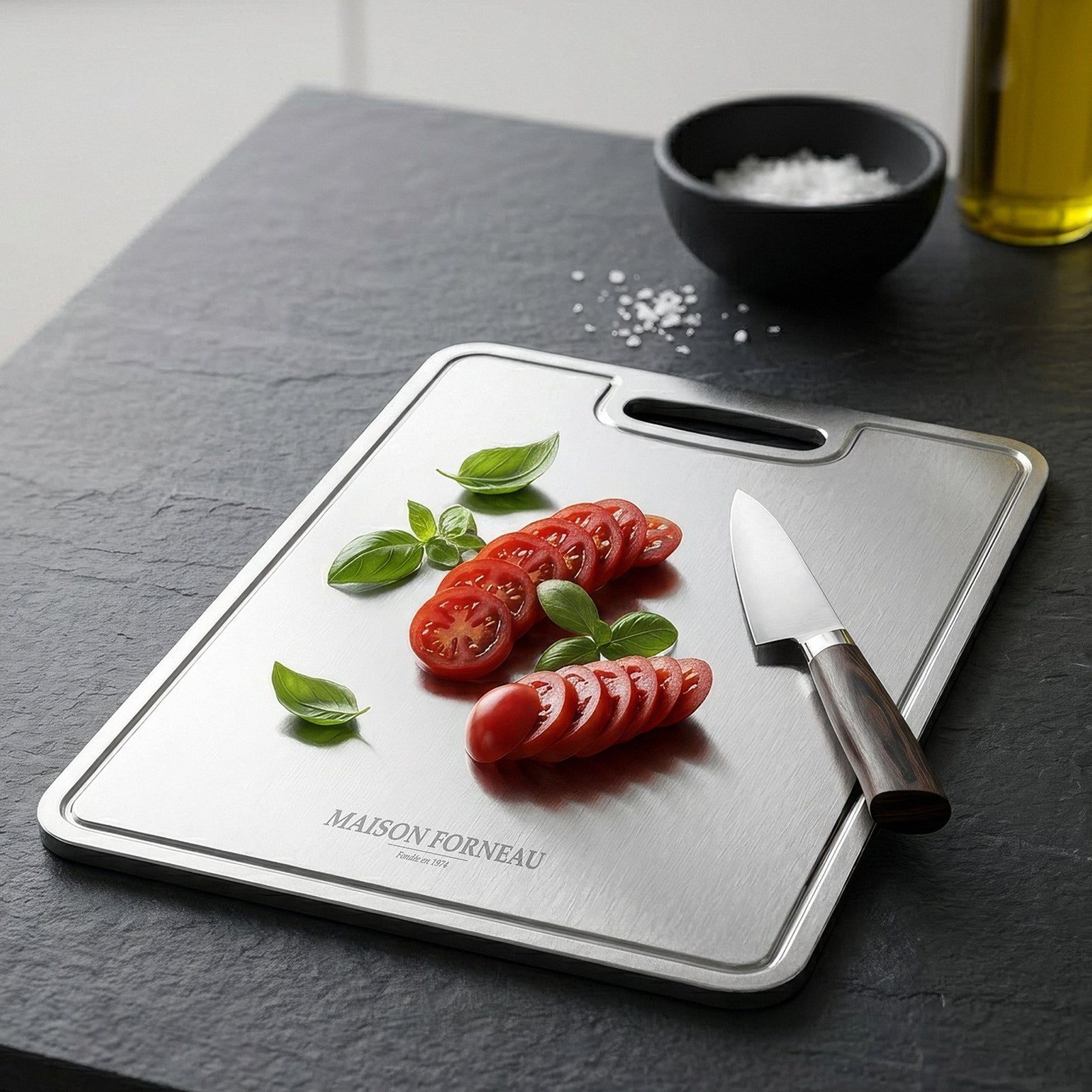
Super practical for everyday use: I hang it directly in my kitchen and it takes up hardly any space. It’s much thinner than my old boards and yet it really does feel solid.
Gérard P.

On s’en sert même directement pour l’apéro maintenant. Fromage, charcuterie, fruits… c’est joli sur la table et après un passage au lave-vaisselle elle ressort impeccable.
Sylive I.

Cadeau de mes enfants et franchement excellente surprise. Je cuisine énormément avec les légumes du jardin et je préfère largement cette planche à celles en plastique que j’utilisais avant. Simple, solide et facile à nettoyer.
Catherine H.

Très belle surprise dès l’ouverture du colis. La présentation est vraiment soignée, avec le pochon et le petit guide. Ça fait tout de suite produit de qualité, parfait aussi pour offrir.
Sophie B.

Ce qui m’a le plus surpris c’est la finition. Le titane est fin, légèrement brossé et beaucoup plus agréable en vrai que ce que j’imaginais. Après plusieurs semaines d’utilisation, rien à signaler.
Philippe R.
 Designed in France
 PFAS-free certified

Custom-made cookware set
Three questions, and we’ll suggest the pieces suited to your kitchen. The more you add, the bigger the discount.

Contains BPA and other harmful chemical compounds that leach into your food with every cut of the knife. A direct risk to your hormones, your microbiome and your brain.

Not hygienic. Wood is porous: it absorbs raw juices and moisture. The grooves left by the knife trap bacteria, making sterilisation almost impossible. Mould and contamination are almost inevitable over time. Wood also absorbs odours and stains easily.

Same risks as solid wood, only worse: these boards are assembled from small blocks glued together with an industrial adhesive containing formaldehyde, a carcinogenic compound. Not just unhygienic — genuinely dangerous.

These materials are extremely hard and blunt your knives very quickly. Very heavy to handle and impractical for everyday use.
Unlike competitors who use cheap, toxic alloys, at Forneau® we use only the purest option for your safety. Each product is made from Grade 1 Titanium (laboratory-certified at 99.98%) — the purest form available, also known as medical-grade titanium. It also complies with food-contact standards.
Your safety is guaranteed with Forneau®

The Forneau® 20 cm chef’s knife is designed in France for versatile everyday prep: slicing, chopping and carving meat, fish, vegetables and herbs. The 20 cm format suits regular home cooks as well as anyone wanting one main knife that feels balanced and is easy to maintain. PFAS-free and without any coating, it fits a more direct approach to cooking aligned with searches for PFAS-free cookware and non toxic cookware.
Use a stable board and a rocking motion (tip anchored, heel coming down) for chopping. For precision, work in small sections rather than forcing the blade. Avoid twisting in hard foods (squash, bones): cut progressively instead.
Wash and dry after use. Titanium can show surface marks: fine traces may appear, with no flaking and nothing migrating. To keep a clean edge, hone regularly with a suitable steel or use a stone, depending on your routine. Dishwasher use is possible but not recommended to preserve the edge and reduce micro-impacts.
Is the blade exactly 20 cm?
Yes, the blade length is 20 cm, a versatile chef’s size for most prep tasks.
Can it go in the dishwasher?
It’s possible, but hand washing is recommended to protect the edge and avoid impacts with other cutlery.
Does titanium scratch?
Titanium can show surface marks with use. These marks remain superficial, nothing flakes and there is no coating that could detach.
What sharpening method should I use?
Regular maintenance with a honing steel (depending on the edge) and/or a whetstone works well. The aim is to maintain sharpness rather than wait until it becomes blunt.
What does “lifetime guarantee” mean?
It covers material or manufacturing defects under normal use. Edge wear from sharpening and everyday marks are not considered defects.


"Cooking is an underestimated source of toxins.
Forneau titanium is the only material I
recommend without reservation to my patients."
"15 years telling my patients to ditch Teflon. No material really delivered — until Forneau. I now recommend it in consultations."

@camille_naturoNaturopath
— 15 years’ experience
Each generation passes down know-how. Ours is absolute high standards at the table. At Forneau, our chef embodies this tradition — hands that have learnt to respect fire, metal, and what we put on the plate. Titanium isn’t a marketing choice. It’s the only material worthy of this cuisine.


From risks of toxins and bacteria to demanding upkeep, these “outdated” cookware materials simply don’t measure up.

The worst pan coating there is. Teflon and most non-stick coatings release PFAS, these “forever chemicals” linked to cancer and liver damage. The coating flakes over time, can’t withstand high temperatures, and exposes your food to toxins.

Requires lots of oil to stop food from sticking, and reacts with acidic foods — which alters the taste and can release metals in low-end pans. Difficult to clean and demanding to maintain.

Ceramic coatings are very fragile. Once chipped, they expose the toxic aluminium base. Most last only 1–2 years before losing their non-stick properties. Costly to replace, unreliable in the long run.

Incredibly heavy and demanding to maintain. Cast iron rusts easily without regular seasoning and doesn’t tolerate acidic foods, which damage the surface and affect flavours.

Contains BPA and other harmful chemical compounds that leach into your food with every cut of the knife. A direct risk to your hormones, your microbiome and your brain.

Not hygienic. Wood is porous: it absorbs raw juices and moisture. The knife marks trap bacteria, making sterilisation almost impossible. Mould and contamination become nearly inevitable over time. Wood also absorbs odours and stains easily.

Same risks as solid wood, but worse: these boards are assembled from small glued blocks using an industrial adhesive containing formaldehyde, a carcinogenic compound. Not just unhygienic — genuinely dangerous.

These materials are extremely hard and blunt your knives very quickly. Very heavy to handle and impractical for everyday use.

Plastic spatulas have a very low melting temperature and release toxic compounds with every use. Serious health risks: digestive imbalances, hormonal disruption, cancer.

Even high-end silicone eventually breaks down with heat and releases toxic compounds. Most silicone spatulas sold online or in supermarkets contain dangerous additives such as BPA and phthalates, which become toxic during cooking.

Not hygienic. Wood allows bacteria to settle into grooves and cracks, even invisible ones, which can contaminate your food over time. It also absorbs odours and stains easily.

Most are made from low-grade alloys that release heavy metals such as chromium and nickel into your food when heated. They’re also heavy and damage the surface of your cookware.

Rusts easily, requires constant seasoning and reacts with acidic foods like tomato, pepper or lemon — damaging the surface and affecting the taste. Not non-stick, not low-maintenance, and clearly not built to last.

The worst water bottle you could possibly choose. Even “BPA-free” models release hormone-disrupting compounds, especially when exposed to heat. Moisture around the mouthpiece is ideal ground for the growth of bacteria and mould.

Strong, but stainless steel isn’t antibacterial like titanium. The bacteria from your mouth grow inside. Frequent cleaning is essential: studies show 87% of these bottles contain harmful bacteria such as E. coli.

Aluminium bottles are systematically coated with synthetic linings to prevent the metal reacting with the liquid. These linings degrade and release chemical compounds into your water. Like the others, they also encourage the growth of bacteria and fungi.

Glass doesn’t release chemicals, but it offers no antibacterial protection. The bacteria from your mouth still multiply in it. And it remains fragile: breaks easily, not practical for day-to-day use.