

















Fact-checked: composition and sources on our Facts & evidence page.
- 4.9/5 from over 5,000 reviews
- Lifetime warranty
- Ships within 48 h
- Free shipping
Which pan actually performs well on induction without a nonstick coating? The base, the material, and the technique explained, with an honest comparison between stainless steel, cast iron, carbon steel, and titanium.
The 30-second version
- On induction, a pan needs a flat, magnetic base to heat evenly without sticking
- A nonstick coating glides at first but wears out after a few years of heavy use
- Without a coating, preheating and doing the water-drop test keeps food from sticking
- Using the boost setting on an empty or too-thin pan can warp it over time
- Forneau is the only 100% pure grade 1 titanium cooking surface, SGS-certified, free of PFAS
Which pan actually performs well on induction without a nonstick coating? Here's the base, the material, and the technique you need to know, with an honest comparison between stainless steel, cast iron, carbon steel, and titanium.
The 30-second version
- A pan on induction needs a flat, magnetic base to heat evenly without sticking
- A coating wears out over the years, a 100% pure titanium cooking surface doesn't flake
- Preheating on medium heat and doing the water-drop test prevents sticking without a coating
- Forneau is the only 100% pure grade 1 titanium cooking surface, not a reinforced coating
- Using the boost setting on an empty or too-thin pan can warp it over time
Why induction asks more of a pan
Induction works through a magnetic field that heats only the base of the pan, not the hob itself. In practice, the pan needs a flat, magnetic base — usually stainless steel — otherwise it won't heat, or it will heat unevenly. The thicker and flatter this base is, the more evenly the heat spreads, and the fewer hot spots there are to cause sticking.
On gas or standard electric, a slightly uneven base is somewhat forgiving. On induction, it isn't: the heat arrives highly concentrated, and a pan that isn't perfectly flat can even start to vibrate or rattle on the hob.
Good to know
A pan without a coating needs a short adjustment period: preheating and adding a bit of fat. In return, you get a cooking surface that never flakes and never needs replacing.
Good to know
A pan without a coating takes a bit of getting used to at first: preheating and adding a little fat before cooking. In return, there's nothing that can flake or peel off over time.

Coated or not on induction: what's left after two years
A nonstick coating glides beautifully for the first few months, but on induction — where heat rises fast and in a concentrated way — it wears out faster than on gas. After a few years, you start seeing scratches, discoloration, and eventually the coating starts to flake off.
This is exactly what a lot of people experience: you buy a new pan, cook worry-free for two or three years, then the coating starts peeling away bit by bit. A pan without a coating — stainless, cast iron, carbon steel, or a solid titanium surface — doesn't have this problem, simply because there's nothing to wear through.
- Coated: glides perfectly at first, but it's a consumable that eventually gets replaced.
- Uncoated: takes a short adjustment period (preheating, a bit of fat), but the cooking surface itself doesn't change over time.
Stainless, cast iron, carbon steel, titanium: an induction comparison
Every uncoated material behaves differently on induction. Here's an honest comparison, without presenting each option as "a valid choice" — because in the long run, only one cooking surface doesn't wear out.
| Material | Behavior on induction | Over the long run |
|---|---|---|
| Stainless steel | Reacts quickly, can stick without the right technique | Stays intact, but stains and cooking marks are stubborn |
| Cast iron | Holds heat for a long time, heats up slowly | Heavy, needs regular seasoning, prone to rust |
| Carbon steel | Reacts quickly, fairly lightweight | Needs regular maintenance against rust |
| Nonstick coating (common brands) | Glides very well when new | Wears, scratches, and eventually flakes after a few years |
| Pure grade 1 titanium (Forneau) | Reacts well thanks to the aluminum cores beneath the titanium | The cooking surface is one solid layer, nothing to flake |
Some brands that talk about a "titanium pan" are actually using a nonstick coating reinforced with titanium particles, not a 100% pure titanium cooking surface. That coating wears out the same way any other one does, over time.
"even a simple scratch on a nonstick pan can release toxins"
forum
"the coating peels off: more than 10 years of cooking and dishwasher cycles did it in"
forum
Cooking without sticking on induction, no coating
Without a coating, it's the pan itself, combined with heat and a bit of fat, that does the job a nonstick coating would normally do. That's not a drawback, it's just a different way of cooking, and there's a short learning curve at the start.
- Preheat: place the empty pan over medium heat, never straight to high.
- Water-drop test: drop a bit of water into the pan. If it rolls around like a bead (the Leidenfrost effect), the pan is ready. If it evaporates instantly, it's not hot enough yet.
- Add the fat: only once the right temperature is reached, add a bit of oil or butter.
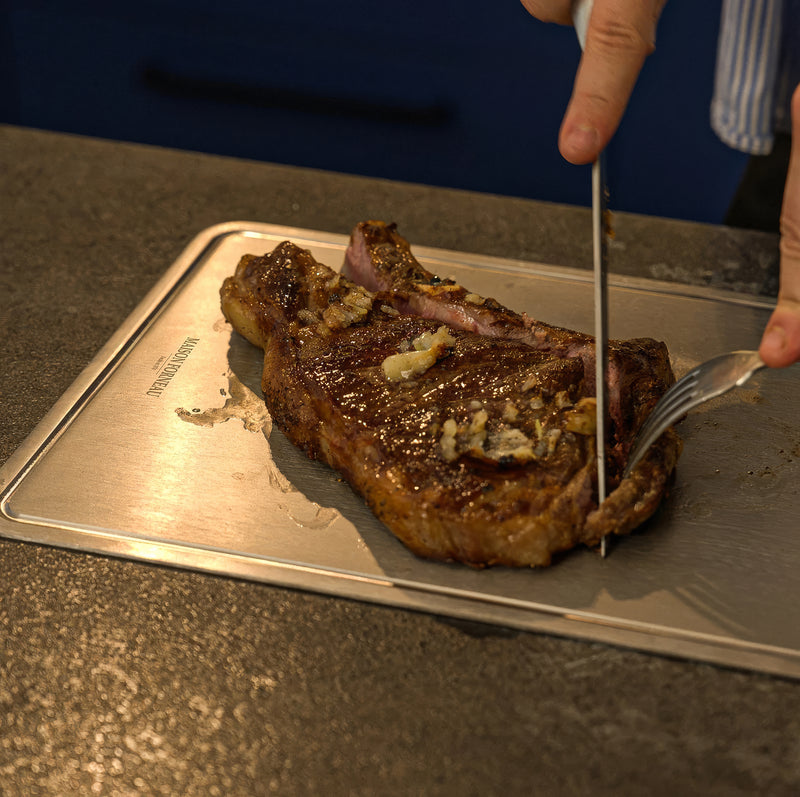
- Patience with meat and fish: let the food release on its own, don't force it. It naturally lifts off once a crust forms.
These steps apply to any uncoated pan, whether it's stainless steel, cast iron, or titanium. It's a short adjustment period, but after a few tries, the motion becomes second nature.
Boost mode, warping, clanking noises: pitfalls to avoid
The boost function on an induction hob delivers extreme heat within seconds. On an empty or too-thin pan, this can expand the base too quickly in localized spots, which eventually causes it to warp. A warped pan no longer sits flush on the hob and can start to vibrate or make noise.
- Never use the boost setting on an empty pan, always start with a bit of fat or liquid.
- Choose a pan with a base that's thick enough and properly flat — the thinner the material, the greater the risk of warping.
- Clanking noises usually signal a base that's no longer perfectly flat.
A pan with a thick, multilayer base — for example, several aluminum cores beneath a stainless steel base for induction — spreads boost heat more evenly and resists warping better.
Which size pan for your hob
On induction, the pan's diameter matters: it needs to match the cooking zone, otherwise the edge won't heat up and you lose efficiency. A 24-28 cm pan suits most standard zones, a small 20 cm pan is handy for eggs or sauces.
- Everyday use: a 24-26 cm pan for vegetables, meat, and fish.
- Large families: 28-30 cm for several portions at once.
- Sautéing and wok cooking: a sauté pan or wok with high sides, provided the base is flat enough for induction.
A pan that covers the entire cooking zone heats up faster and uses less energy — something that matters on induction, where efficiency is already good but can still be optimized by choosing the right size.
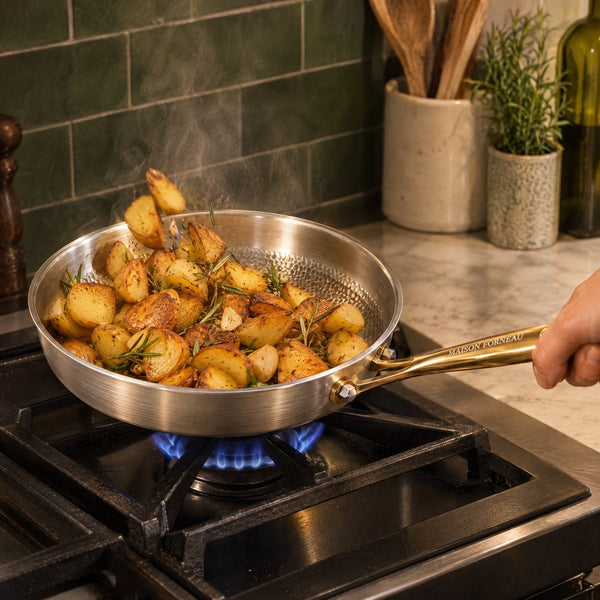
The Forneau titanium pan on induction
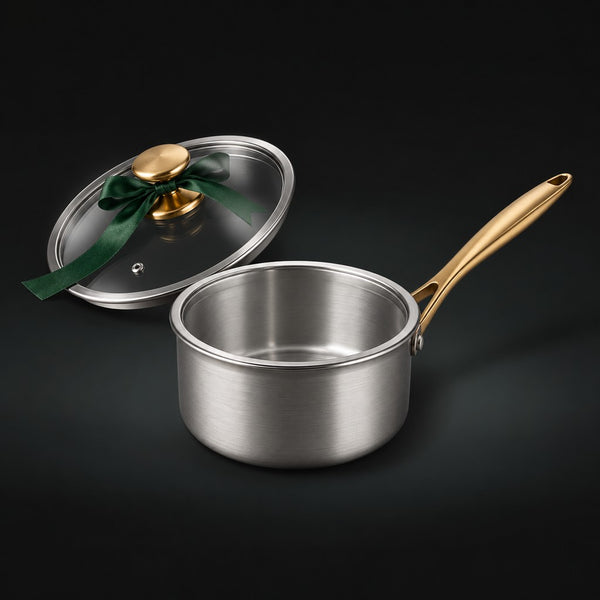
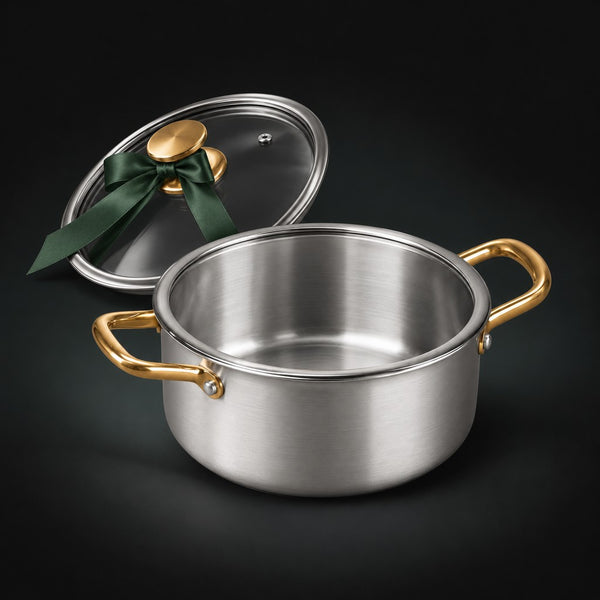
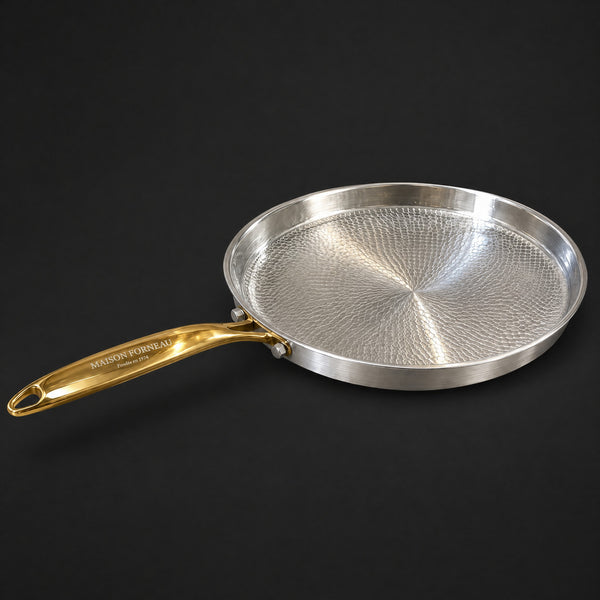
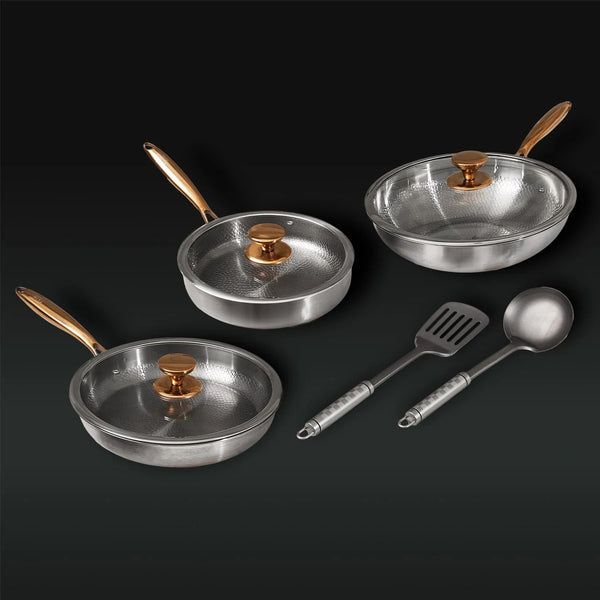
The cooking surface of Forneau pans is 100% pure grade 1 titanium — one solid layer, not a coating. So there's nothing that can flake off, and no PFAS, PFOA, or PTFE in the mix. Beneath this surface, three recycled aluminum cores ensure fast, even heat distribution, and a stainless steel base makes the pan induction-compatible.
Titanium is harder than most metals, but it isn't indestructible: the pan can get scratched. This is purely cosmetic and has no impact on food safety — there's no coating that could come loose in the first place. As with any uncoated pan, there's a short adjustment to make: preheat on medium heat, do the water-drop test, and add a bit of fat before cooking.
Unlike pans branded "titanium" that are actually a reinforced nonstick coating, this cooking surface is SGS-certified as 100% pure grade 1 titanium — the only one of its kind on the market. That's the difference between a layer that always ends up wearing out and needing replacement, and a cooking surface that stays exactly as it is. Backed by a lifetime warranty, because there's simply nothing that can wear out the way a coating does.
Want to learn more about the pan itself? Check out the titanium pan, the full titanium pan collection, or the detailed evidence on the facts and proof page.
Frequently asked questions
What's the best pan for induction?
A pan with a thick, flat, magnetic base performs best on induction. Stainless steel, cast iron, carbon steel, and titanium with the right base all work well, as long as the base is thick and flat enough to spread heat evenly.
Does a titanium pan work on induction?
Yes, as long as the pan has a magnetic base, usually stainless steel beneath the titanium cooking surface. Titanium alone isn't magnetic, so it's the base that makes the pan induction-compatible.
Why does my pan stick on induction?
Most of the time it's because the pan wasn't preheated enough before adding food, or because there isn't enough fat. Without a coating, the pan needs to come up to temperature first — the water-drop test tells you when it's the right moment.
Can a pan warp on induction?
Yes, especially when the boost function is used on an empty or too-thin pan. The fast, concentrated heat can expand the base unevenly. A thicker base with several layers resists this risk better.
Is an uncoated pan harder to clean?
Not necessarily harder, just different. Cooking marks on stainless steel or titanium usually come off with a bit of hot water and time, or a non-abrasive sponge. There's no risk of a layer coming loose the way there is with a coating.
How long does an uncoated pan last?
In theory, a lifetime, since there's no layer that can wear out. With a 100% pure titanium cooking surface, the pan stays functionally the same even after years of use — any scratches remain purely cosmetic.
