











Fact-checked: composition and sources on our Facts & evidence page.
- 4.9/5 from over 5,000 reviews
- Lifetime warranty
- Free returns
- Free shipping
A titanium cookware set isn't a marketing gimmick, but the label hides two very different products. Between solid titanium right through (which barely exists in cookware) and "titanium" non-stick coatings that wear down like any other coating, the real difference sits in what each piece is actually made of. This guide breaks down what's really inside a titanium pan, sauté pan or wok, how many pieces to choose for your household, and compares Forneau's sets so you can find the right size at the right price.
The essentials in 30 seconds
- A genuine "titanium set" has a cooking surface that's 100% pure grade 1 titanium — a solid layer, not a coating that eventually chips or flakes.
- At Forneau, underneath that surface: three recycled aluminium cores for heat diffusion, plus a stainless steel base for induction. The base and handle aren't titanium, and that's normal.
- Titanium does scratch, but the marks are cosmetic and release nothing; no PFAS, PFOA or PTFE involved.
- For a household of 2 to 4 people, 6 to 8 pieces cover most everyday cooking; beyond that, a fuller collection avoids gaps in your kit.
- Forneau sets range from £199 (starter) to £899 (full kitchen), with discounts of −10% to −20% when you build your own set.
What a titanium cookware set actually is (solid vs coated)
Two very different products share the "titanium" label: cookware with a 100% pure titanium cooking surface, and non-stick coatings reinforced with titanium particles that remain, underneath, ordinary coatings. This isn't a cosmetic difference — it determines how long the piece will actually last.
Cookware made entirely of solid titanium barely exists, because titanium alone conducts heat poorly and is expensive in solid form. What does exist, and makes sense, is a cooking surface in solid pure titanium — a genuine layer of metal, not a deposited film — paired with inner layers that provide conductivity and induction compatibility. That's the structure you find at Forneau: nothing to chip on the cooking surface, because there's no coating in the traditional sense, just titanium.
By contrast, many pans sold as "titanium" are actually aluminium with a non-stick coating reinforced with titanium particles. That coating glides beautifully out of the box, but it wears like any non-stick surface: deep scratches, reduced glide, eventual flaking. The word "titanium" on packaging tells you nothing about the real build until you check whether it's a solid layer or a coating.
Good to know
To check whether a pan is genuinely solid titanium rather than a reinforced coating, look for the explicit phrase "100% pure titanium cooking surface" or "grade 1". If the product page only mentions "titanium technology" or "titanium particles", it's most likely a standard non-stick coating.
What a Forneau piece is made of (pure titanium surface, aluminium cores, stainless base)
Every Forneau pan, sauté pan, wok or saucepan has a cooking surface that's 100% pure grade 1 titanium: a solid layer of metal, with no PFAS, PFOA or PTFE. Underneath, three recycled aluminium cores diffuse heat evenly, and a stainless steel base gives induction compatibility.
In practice, the build reads as three functional layers:
- The cooking surface: pure grade 1 titanium, in direct contact with food. There's nothing but titanium here — it isn't a coating applied over something else.
- The core: three recycled aluminium cores, which make the piece conductive and lightweight. Titanium alone would conduct heat poorly; the aluminium compensates.
- The base: stainless steel, needed so the pan works on an induction hob.
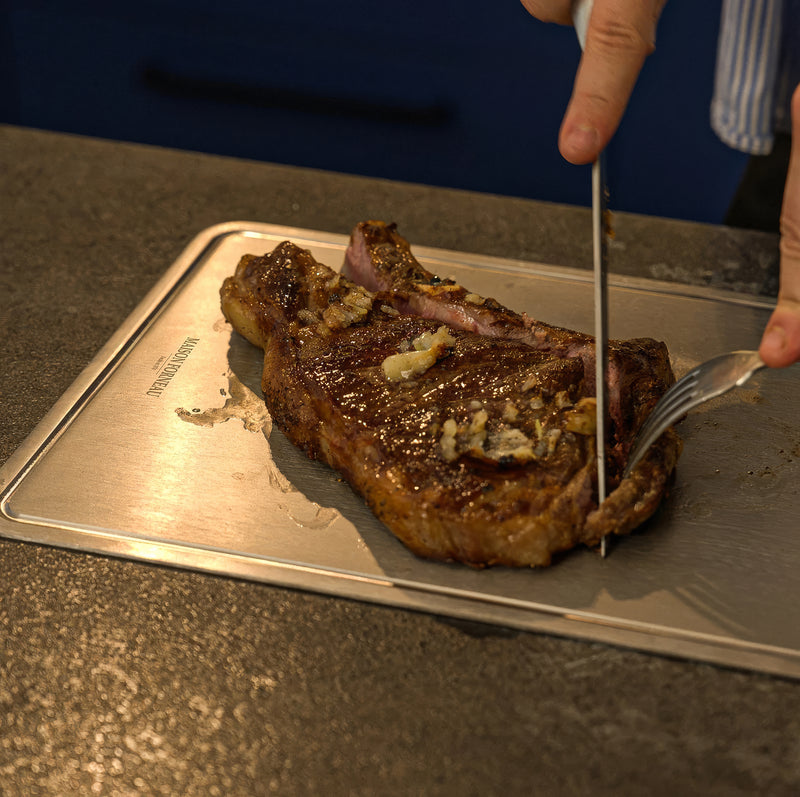
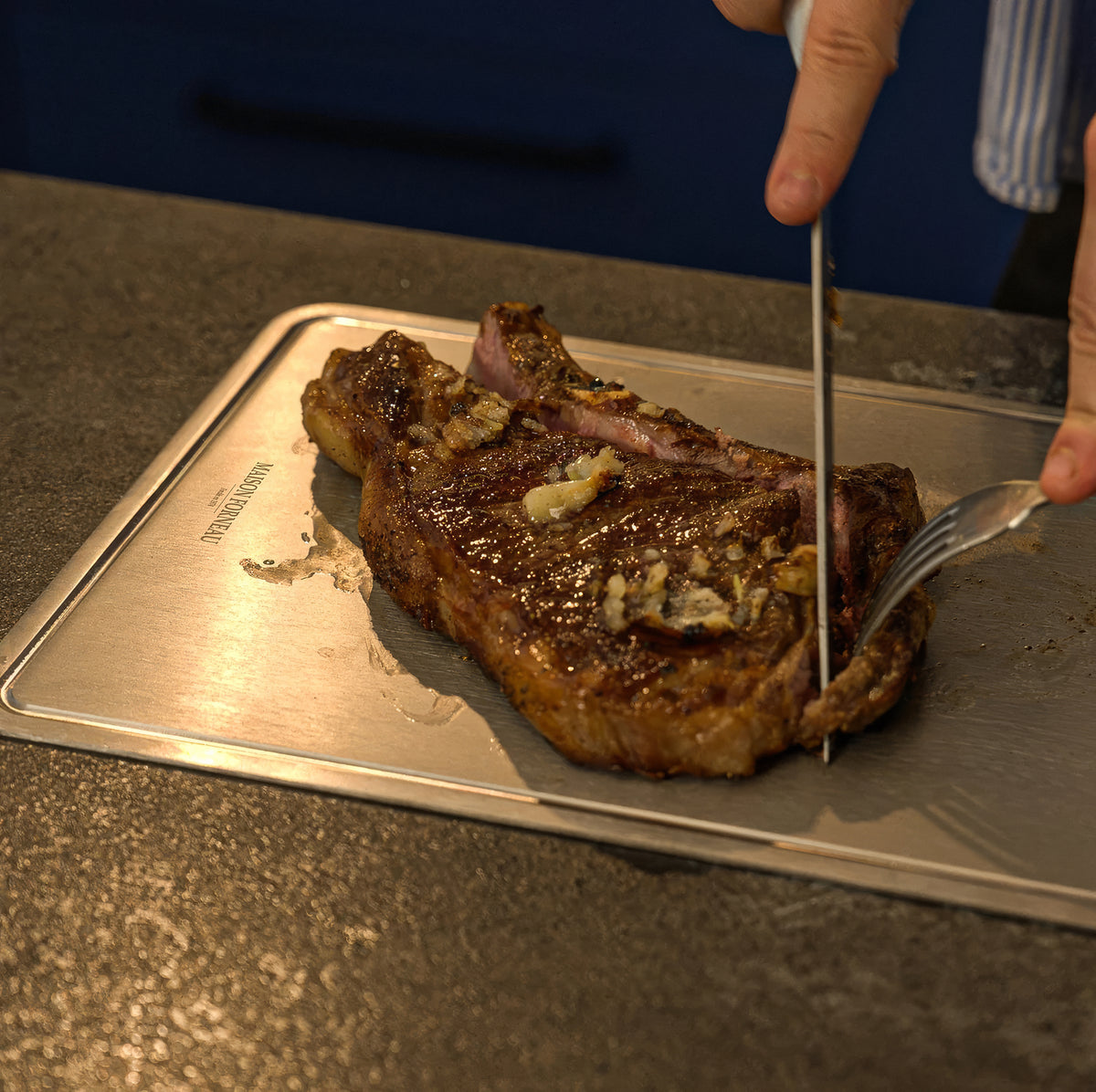
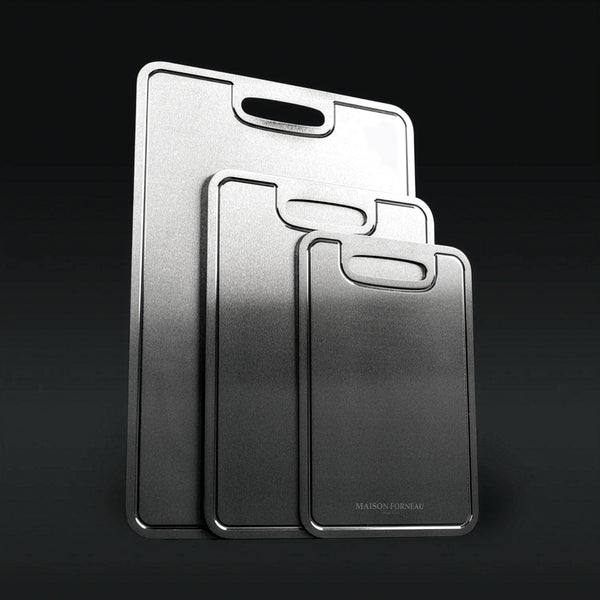
The base and handle aren't titanium, and that's normal: they're structural elements, not the cooking surface. The cutting board and utensils (spatulas, tongs), on the other hand, are solid pure titanium throughout, since they don't need thermal conductivity. The overall weight stays ultra-light thanks to the internal aluminium, and every piece is dishwasher-safe where the board is concerned.
Titanium, stainless, cast iron, ceramic, Teflon: the comparison table for a full set
Every material has a known weak point: cast iron is heavy, stainless steel sticks without fat, ceramic loses its glide within months, Teflon flakes and raises PFAS questions. Pure grade 1 titanium needs a bit of technique when preheating, but it doesn't flake, because there's nothing to flake.
| Material | Durability | Weight | Care | Weak point |
|---|---|---|---|---|
| Pure grade 1 titanium (Forneau) | No coating to wear through, lifetime warranty | Ultra-light | Preheat + a little fat | Scratches (cosmetic, releases nothing) |
| Stainless steel | Very durable | Medium to heavy | Preheating essential | Sticks badly without fat |
| Cast iron | Very durable | Heavy | Seasoning, dry immediately | Weight, demanding upkeep |
| Ceramic | Glide fades within months | Light | No thermal shock, soft utensils only | Fast loss of non-stick properties |
| Teflon / PTFE | Flakes over time | Light | Low heat, soft utensils only | Coating degrades, PFAS |
For a complete set, the right approach is to check the build of each piece rather than trust the material printed in large letters on the box. For a more detailed pan-by-pan comparison, see our articles.
How many pieces do you really need, by household
For someone living alone or a couple, a pan and a sauté pan cover most needs. For a family or anyone cooking nearly every day, aim for 6 to 8 pieces including a saucepan, a wok and a board, so you're not forced back to non-titanium utensils for lack of choice.
- 1 to 2 people, occasional cooking: a 28cm pan is enough to start, perhaps with a board.
- 2 to 3 people, daily cooking: pan + sauté pan + board + basic utensils, so 5 to 6 pieces.
- Family, varied cooking (stews, woks, sauces): 8 pieces to cover pan, sauté pan, wok, saucepan, board and utensils.
- Heavy cooking or several hob sizes: a full 14-piece collection avoids gaps (small and large pans, multiple saucepans).
The "Build Your Set" configurator lets you fine-tune piece by piece based on your actual habits, with a discount that grows with the number of pieces chosen.
Forneau sets compared
Forneau offers seven formats, from the £199 starter set to the £899 full kitchen set. The right choice mostly depends on household size and cooking frequency, not just budget.
| Set | Contents | Best for | Price |
|---|---|---|---|
| Discovery Set | Entry piece to try titanium | First purchase, occasional cooking | £199 |
| Everyday Duo | 6 pieces | Couple, simple daily use | £299 |
| Essential Set | 28cm pan + M board + utensils | Everyday cooking, compact format | £399 |
| Signature Set | 8 pieces | Family, varied cooking | £549 |
| Heritage Signature Set | 28cm Heritage pan with olive wood handle + XL board + utensils | Daily cooking with a premium finish | £649 |
| Master Collection | 14 pieces | Heavy cooking, several hob sizes | £799 |
| Full Kitchen Set | Complete equipment | Equip a whole kitchen in one go | £899 |
If none of the sets exactly matches your needs, the configurator lets you build your own set with progressive discounts: −10% from 2 pieces (code SET10), −15% at 3 pieces (SET15), −20% at 4 pieces and above (SET20). This is often the better option for anyone who already owns one or two Forneau pieces and wants to add to the collection without paying full price again. See the full range on the titanium cookware collection.
Cooking with a titanium set: preheating, fat, induction
Pure titanium needs a bit of technique: preheat the piece on medium heat before adding a little fat, then only the food. That's the one genuine trade-off of a 100% titanium cooking surface, and it's what guarantees lasting glide with no non-stick coating to eventually replace.
A few pointers to get started:
- Preheating: 1 to 2 minutes on medium heat before any cooking, so the surface reaches an even temperature.
- Fat: a thin layer of oil or butter is enough, but it is necessary — bare titanium without fat will stick.
- Induction: every Forneau piece is induction-compatible thanks to the stainless steel base.
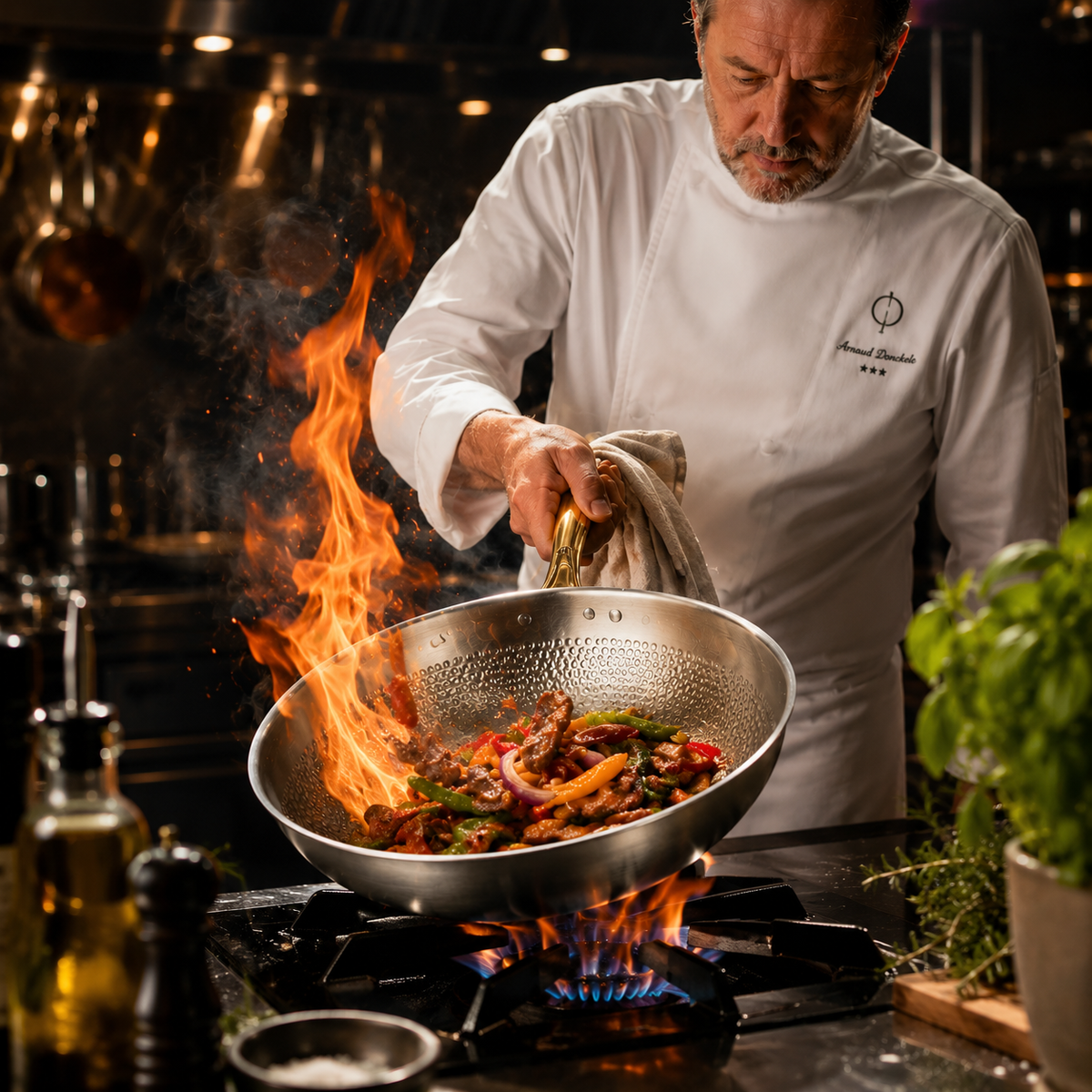
- Utensils: since pure titanium isn't a fragile coating, metal utensils don't risk causing flaking.
This preheating step sometimes surprises people coming from standard non-stick cookware, where food can go in cold. With titanium, the habit forms after a few cooking sessions and quickly becomes second nature.
Care, lifetime warranty, cost over 10 years
A Forneau pan is easy to clean, the board is dishwasher-safe, and the set comes with a lifetime warranty. Over ten years, the real cost compares favourably with a string of non-stick pans replaced every 2 to 3 years.
Titanium does scratch with use — a fork here, the wrong utensil there — but these marks stay cosmetic and release nothing into food, unlike a non-stick coating that flakes and ends up as particles in your plate. That's a difference in kind, not just degree.
- Daily care: warm water, non-abrasive sponge; the board goes in the dishwasher without restriction.
- Warranty: lifetime on all Forneau pieces, with no time limit.
- Cost comparison: a non-stick pan replaced every 2–3 years often costs more over 10 years than a titanium piece bought once.
For more on everyday care, see our dedicated article in Forneau's articles.
Frequently asked questions
Does a truly 100% titanium cookware set exist?
Yes, but at the level of the cooking surface: at Forneau, that surface is 100% pure grade 1 titanium, a solid layer with no coating. Underneath, aluminium cores and a stainless steel base provide conductivity and induction compatibility — the base and handle aren't titanium, which is normal for a functional piece of cookware.
Does titanium scratch easily?
Titanium can scratch with use, like any metal surface. These marks stay cosmetic and release nothing into food, unlike a non-stick coating that flakes over time.
How many pieces should I choose to equip a family kitchen?
For a family that cooks regularly, 6 to 8 pieces (pan, sauté pan, wok, saucepan, board, utensils) cover most needs. Beyond that, a 14-piece collection avoids gaps for more varied cooking.
What's the difference between a "titanium" pan and a pure titanium one?
Many pans labelled "titanium" are actually aluminium with a non-stick coating reinforced with titanium particles, which wears like any other non-stick surface. A 100% pure grade 1 titanium cooking surface is a solid layer of metal, with nothing to flake.
Is titanium cookware compatible with induction hobs?
Yes, Forneau pieces are induction-compatible thanks to a stainless steel base built in beneath the aluminium cores. Titanium alone wouldn't be sufficient for induction, hence this multi-layer construction.
Do you need oil in a titanium pan?
Yes, preheating on medium heat followed by a little fat is needed before each cooking session. That's the one trade-off of a 100% titanium surface with no non-stick coating.
Which Forneau set should I choose to get started?
The £199 Discovery Set lets you try titanium with a single entry piece, while the £399 Essential Set (28cm pan, M board, utensils) covers everyday cooking from the start.
Can I build my own set instead of buying a fixed one?
Yes, the "Build Your Set" configurator lets you choose piece by piece with progressive discounts: −10% at 2 pieces, −15% at 3, −20% at 4 pieces and above.
