

















Fact-checked: composition and sources on our Facts & evidence page.
- 4.9/5 from over 5,000 reviews
- Lifetime warranty
- Ships within 48 h
- Free shipping
No, titanium pans aren't non-stick in the Teflon or ceramic sense — there's no coating at all. Here's what actually happens on a titanium cooking surface, and how to get good food release without one.
The essentials in 30 seconds
- Titanium pans are not non-stick the way Teflon or ceramic coatings are
- A pure titanium surface has no coating, so release depends on technique, not chemistry
- Preheating and a bit of fat are what actually make food release on titanium
- Ceramic-titanium coated pans are a different product and wear out like any coating
- Titanium works on induction thanks to a stainless steel base, not the titanium layer
Are titanium pans non-stick: the short answer
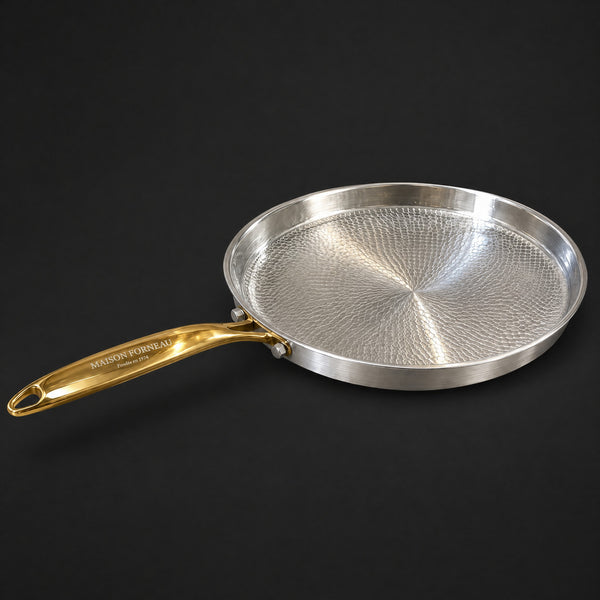
No, not in the way people usually mean it. A titanium pan with a pure grade 1 titanium cooking surface, uncoated, has no non-stick coating — no Teflon, no ceramic, nothing to spray on or bake on. It's a pure grade 1 titanium cooking surface, uncoated, period. Food release comes from technique (preheating, a bit of fat), not from a slick coating doing the work for you.
If you're expecting a fried egg to slide around cold, straight out of the box, that's not how a titanium surface behaves. If you're fine learning a quick technique in exchange for a surface that can't flake its way into your food, keep reading.
Good to know
A titanium cooking surface has nothing to flake off because there's no coating to begin with — it's a pure grade 1 titanium cooking surface, uncoated, not a layer on top of something else. That also means it won't release food like a non-stick pan until you preheat it and add a little fat.

Why titanium behaves differently from Teflon or ceramic coatings
Teflon (PTFE) and ceramic coatings are built to be slick from the first use. They're a separate layer applied over a metal base, engineered specifically for low friction. That's exactly why they also wear down: every scratch, every metal utensil, every trip through the dishwasher chips away at that layer until the coating starts flaking.
Titanium pur grade 1 isn't a coating sitting on top of metal — it is the cooking surface, all the way through. There's no separate non-stick layer to apply, so there's also nothing to flake off into your food. The tradeoff is that titanium doesn't have the artificial slickness of a fresh Teflon or ceramic pan. It releases food the way stainless steel or carbon steel does: with heat and fat, not chemistry.
For more on why food seems to grip a new titanium pan at first, see what causes sticking on a titanium pan.
What actually makes food release from a titanium pan
Three things, and they're the same three things that make food release on any bare metal pan:
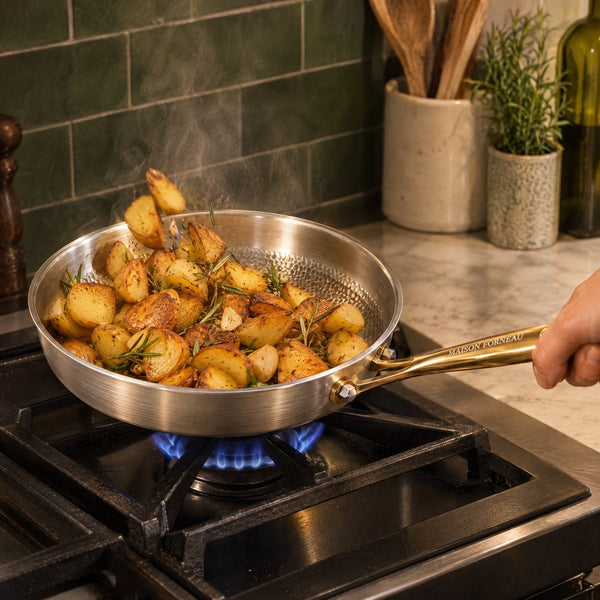
- Preheat before adding food. A titanium surface needs to come up to temperature first. Add protein to a pan that's still cold and it will grab.
- Use a bit of fat. Oil or butter fills the microscopic texture of the metal and creates the barrier that lets food slide. This isn't optional seasoning, it's just how metal pans work.
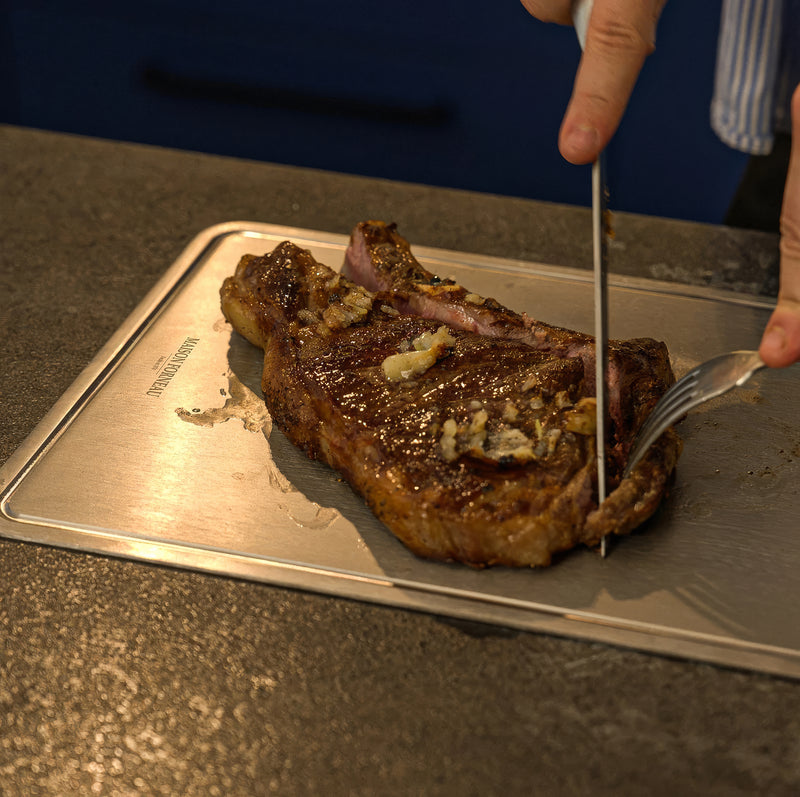
- Let the food release itself. With eggs, fish, or a seared steak, the food naturally lets go of the surface once a crust forms. Pulling at it too early is what tears it and leaves residue behind.
None of this is seasoning in the cast iron sense — titanium doesn't build up a polymerized oil layer over time, and it doesn't need one. It's closer to the water bead test people run on stainless steel: once the pan is hot enough, the behavior changes completely. For the full method, see how to use an uncoated pan in three steps.
« Everything sticks to it, no matter what I do. »
Titanium vs ceramic-titanium coated pans: not the same product
This is where a lot of confusion comes from. "Titanium pan" gets used for two very different products, and only one of them is actually titanium where it touches your food.
| Feature | Pure titanium cooking surface | Ceramic-titanium coated pan |
|---|---|---|
| What touches the food | Pure grade 1 titanium cooking surface, uncoated | A ceramic coating, sometimes infused with titanium particles for marketing |
| Can it flake or wear through? | No coating to flake, it can only get cosmetic scratches | Yes, ceramic coatings degrade and lose non-stick properties over time, like any coating |
| Fresh-out-of-the-box slickness | Low, needs preheat and fat | High at first, fades with use |
| PFAS/PFOA/PTFE | None, by design | Varies by brand, worth checking directly |
A ceramic-titanium pan is a ceramic pan with a marketing name. It will feel non-stick the way any new ceramic pan does, and it will lose that slickness the way any coating does — through scratches, heat cycles, and time. If you've seen people ask "is ceramic titanium pan safe," the honest answer is: it depends on what's actually in that ceramic layer, and that's a different question from whether a pure titanium cooking surface is safe, which it is, since there's no coating to begin with. For a deeper comparison, see uncoated pans vs titanium pans.
What to expect the first few cooks
Be honest with yourself about the learning curve. The first few times you cook on a titanium surface, expect some sticking if you skip preheating or use it dry. That's not a defect, it's just bare metal behaving like bare metal.
- Preheat for a minute or two before adding oil.
- Add oil or butter, let it heat, then add food.
- Don't force food to release early — let the crust form.
- Expect cosmetic scratches over time. They're purely cosmetic and don't release anything into your food, and there's no coating underneath to expose.
Once you've got the rhythm, a titanium pan isn't gimmicky — it's a bare metal pan that happens to be non-toxic by default, and built to outlast a coated pan's non-stick properties fading over a few years.
Frequently asked questions
Are titanium pans non-stick like Teflon?
No. Titanium has no coating, so it doesn't have Teflon's out-of-the-box slickness. Food release comes from preheating and a bit of fat, not from a non-stick layer.
Why does food stick to my titanium pan?
Usually because the pan wasn't preheated, there wasn't enough fat, or the food was moved before it naturally released. These are technique issues, not a flaw in the pan.
Do titanium pans need seasoning?
No. Titanium doesn't build up a seasoning layer the way cast iron or carbon steel does. A quick preheat and some oil before cooking is all it needs, every time.
Is a ceramic-titanium pan the same as pure titanium?
No. A ceramic-titanium pan has a ceramic coating, sometimes with titanium added to the mix, and it wears down like any coating. A pure titanium pan has a pure grade 1 titanium cooking surface, uncoated, with no coating to wear through.
Do titanium pans work on induction?
Yes. The cooking surface is titanium, but underneath it there's a stainless steel base that makes the pan induction-compatible.
