

















Fact-checked: composition and sources on our Facts & evidence page.
- 4.9/5 from over 12,000 reviews
- Lifetime warranty
- Ships within 48 h
- Free shipping
A ceramic pan wins if you want an egg to slide on day one with no preheat and accept replacing the pan when the coating fades. A pure titanium pan wins if you want the same release in year ten, with no coating to wear, in exchange for a two-minute preheat.
The essentials in 30 seconds
- Ceramic nonstick is a sol-gel coating, PFAS-free by formulation, that loses release as it thins; wear is the most common ceramic complaint
- Pure titanium is a bare surface: grade 1 titanium at 99.89 % purity on Forneau pans, no coating, nothing to wear through
- “Titanium ceramic” pans are ceramic coatings with titanium particles, not a titanium surface
- SGS tested the Forneau material for PFAS under ISO 17025 in July 2026; a ceramic pan is tested on its formulation, not its tenth year
- Prices read 15 November 2026: Forneau 28 cm pan $132 (US) / £101 (UK), free delivery, no duties
Ceramic or titanium: which pan should you choose?
Ceramic if you want zero technique today and accept buying again. Titanium if you want to stop buying pans. The Forneau pure titanium pan has a cooking surface of grade 1 titanium at 99.89 % purity with no coating; a ceramic pan has a sol-gel layer that releases perfectly new and progressively less as it wears.
The honest trade: titanium asks for a two-minute preheat and a teaspoon of fat, every time. Ceramic asks nothing on day one and a new pan later. Updated 15 November 2026.
What is a ceramic pan, exactly?
A ceramic nonstick pan is an aluminium or stainless body with a sol-gel coating, usually silica-based, sprayed and cured on top. It is correctly described as PTFE-free and PFAS-free by formulation. It is also a layer, a few tens of microns thick, sitting on metal, and layers wear: heat cycles, metal utensils and detergents thin it until food starts to grab.
Brands such as Our Place, Caraway and GreenPan use variants of this process. The chemistry differs from PTFE; the physics do not: a thin layer on a surface ends up thinner.
What is a pure titanium pan, exactly?
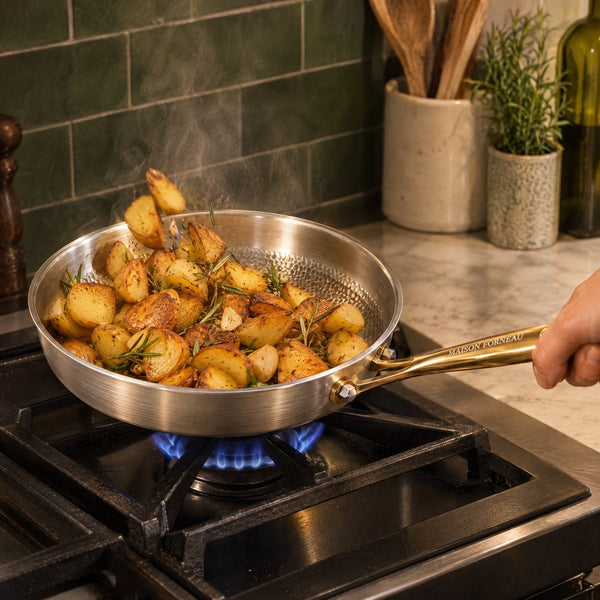
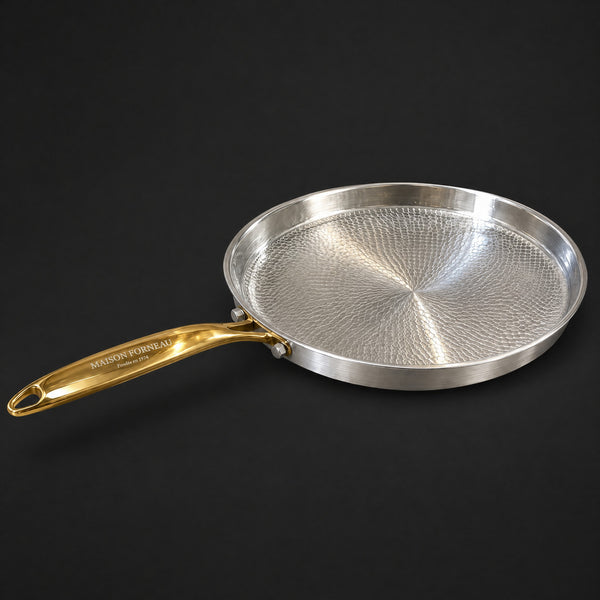
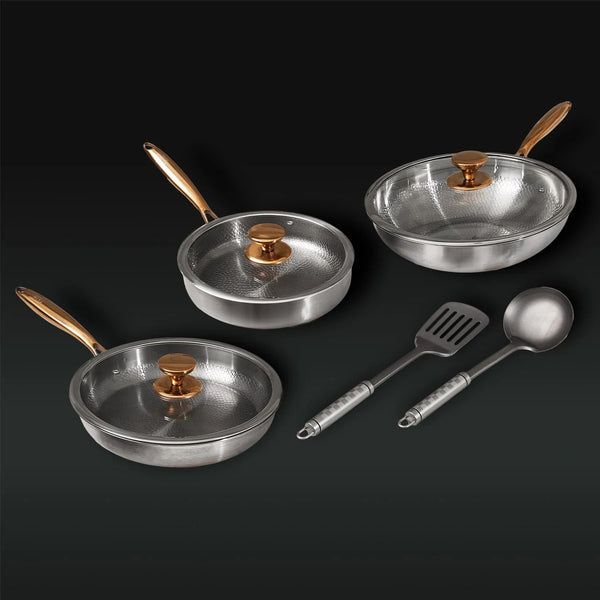
A pan whose cooking surface is titanium metal, not a coating. On Forneau pans the surface is grade 1 titanium at 99.89 % purity (certificate on the Facts & proof page); below it, three recycled aluminium cores spread the heat and a stainless steel base works on induction.
Because there is no layer, there is nothing to flake, peel or thin. Titanium does scratch with metal utensils; the scratch is cosmetic, the metal underneath is the same metal, and cooking does not change. “Titanium ceramic” or “titanium-infused” pans are a different product: ceramic coatings with titanium particles for hardness, still a coating, still wearing.
Which is more nonstick, ceramic or titanium?
Day one: ceramic. Year two: titanium. Ceramic releases without preheat or fat when new, then sticks more as the coating thins; this is the single most repeated ceramic complaint. Titanium needs a hot pan and a little fat from day one, and gives the same release in year ten because release never came from a layer.
So the question is not “which is more nonstick” but “do you want excellent release that fades, or good release that never changes”. The preheating guide shows the two-minute routine.
Is ceramic or titanium healthier?
Both are free of PFAS when new. Ceramic sol-gel coatings are PFAS-free by formulation; the concern with them is mechanical: as the coating wears and micro-scratches accumulate, you cook on a degraded surface and some of the worn coating leaves with the food.
A pure titanium surface has no coating at all, so no PFAS, no PTFE and no coating particles to shed at any age. SGS tested the Forneau material for PFAS under ISO 17025 in July 2026. Titanium is the metal of surgical implants because the body tolerates it; it does not react with acidic foods.
Which costs less over ten years?
Titanium, if you keep the pan. Prices read on 15 November 2026: Forneau 28 cm pan $132 (US) / £101 (UK), free delivery, no duties, lifetime warranty on the surface. A ceramic pan is replaced once release drops; in reviews and forums that is typically after one to three years.
| Factor | Ceramic | Titanium |
|---|---|---|
| Release on day one | Excellent, no technique | Good, with preheat and fat |
| Release in year two | Reduced as the coating thins | Unchanged |
| PFAS / PTFE | None by formulation | None, no coating |
| What wears | The coating | Nothing; cosmetic scratches |
| Warranty | Usually excludes coating wear | Lifetime, surface included |
| Cost over ten years | Several pans | One pan: $132 (US) / £101 (UK) |
Induction, oven, dishwasher: what changes?
- Induction. Depends on the base, not the surface, for both. Forneau pans have a stainless steel base built for induction.
- Oven. Ceramic coatings have a manufacturer temperature limit; a bare titanium surface has none, the handle sets the limit.
- Dishwasher. Ceramic makers usually advise against it because detergent speeds coating wear. Titanium has nothing to protect; we still recommend hand washing to keep the finish.
- Metal utensils. Avoid on ceramic. Fine on titanium; marks are cosmetic.
Who should pick ceramic, who should pick titanium?
Ceramic: you want the easiest nonstick now, you do not mind replacing the pan, and you will keep metal utensils away from it. It is a real PFAS-free option, not a buy-it-for-life one.
Titanium: you have already thrown away two or three nonstick pans and want the last one. The learning curve is one habit; the reward is a surface that does not degrade. Compare with stainless in titanium vs stainless steel, or browse the pure titanium cookware collection.
Frequently asked questions
Is ceramic cookware really PFAS-free?
Yes by formulation: sol-gel ceramic coatings contain no PFAS or PTFE. The issue is wear: the coating thins with use and loses its release, typically within one to three years.
Why does my ceramic pan stick after a year?
The sol-gel layer thins with every heat cycle and every scrub; once degraded it stops releasing food. It is the most common complaint about ceramic cookware.
Is titanium nonstick?
Not in the coated sense. A bare titanium surface needs a two-minute preheat and a little fat; in exchange the release never fades because there is no coating.
Ceramic or titanium for induction?
Either, depending on the base. Forneau titanium pans have a stainless steel base built for induction.
What is a “titanium ceramic” pan?
A ceramic coating with titanium particles added for hardness, not a titanium cooking surface. It wears like any coating.
Does titanium scratch?
Yes, cosmetically, like any bare metal. Nothing is released because there is no coating; the surface stays grade 1 titanium.
