

















Fact-checked: composition and sources on our Facts & evidence page.
- 4.9/5 from over 5,000 reviews
- Lifetime warranty
- Ships within 48 h
- Free shipping
A straight, verifiable answer to the question everyone is asking: what grade 1 titanium actually is, how it behaves in a kitchen, and why it's not the same thing as a "titanium-reinforced" nonstick coating.
The essentials in 30 seconds
- Grade 1 titanium is solid commercially pure metal, not a coating sprayed onto another base
- Titanium isn't naturally non-stick — it needs preheating and fat, just like stainless steel
- Scratches on a pure titanium cooking surface stay cosmetic and release nothing into food
- Titanium alone doesn't conduct heat well, so induction pans need aluminum and steel layers underneath
- A pure titanium cooking surface contains no PFAS or PTFE by definition, since it's a metal, not a polymer
What is grade 1 titanium
Grade 1 titanium is commercially pure titanium (CP titanium), the softest and most ductile of the four "commercially pure" grades. In cookware, it's used as a solid cooking surface — not a thin layer sprayed or bonded onto another metal, but a full layer of titanium itself. That distinction matters: a surface described as "titanium-infused" or "titanium-reinforced" is usually a nonstick coating with titanium particles mixed in, which is a completely different product from a pure grade 1 titanium cooking surface, uncoated.
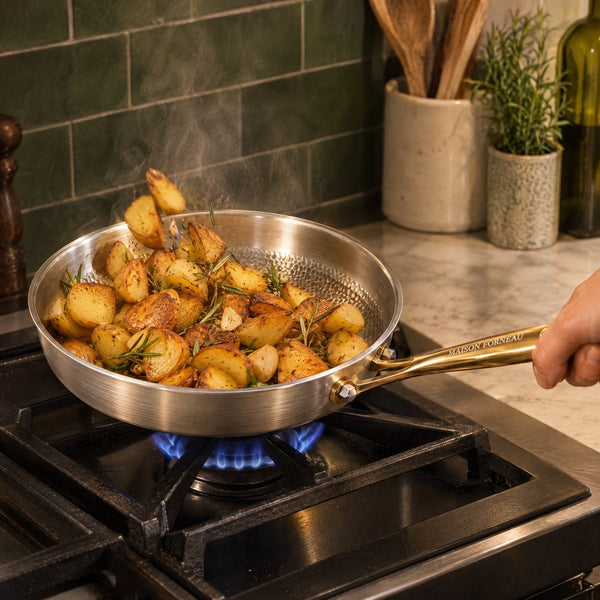
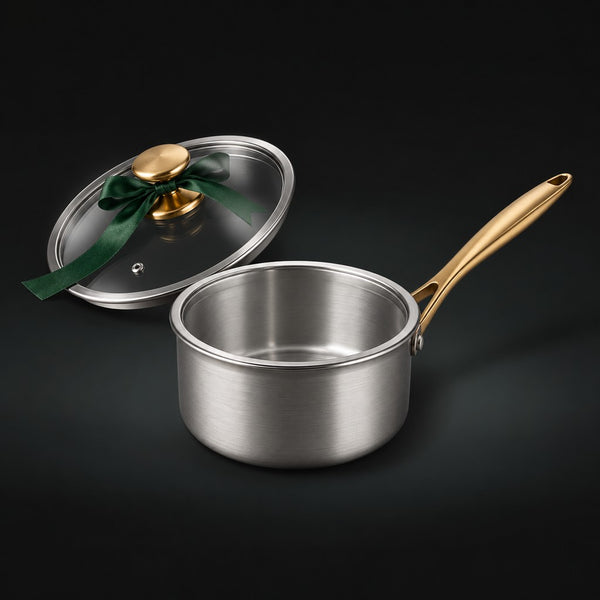
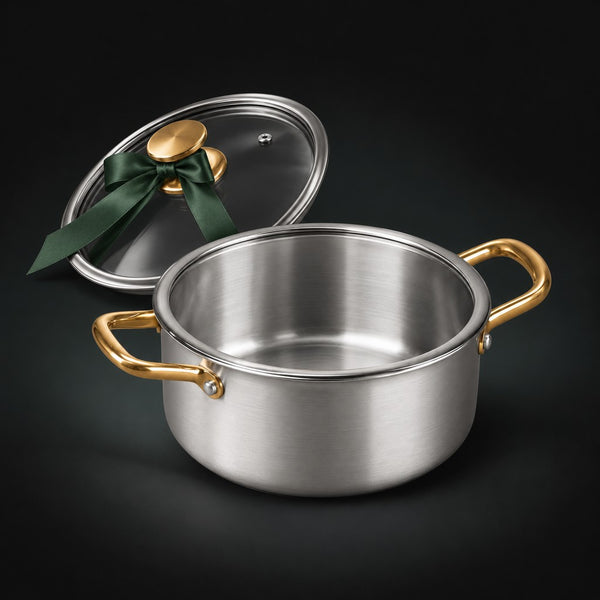
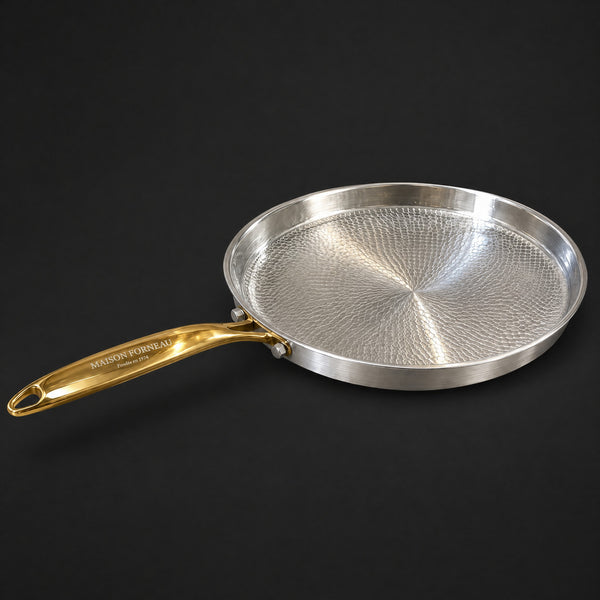
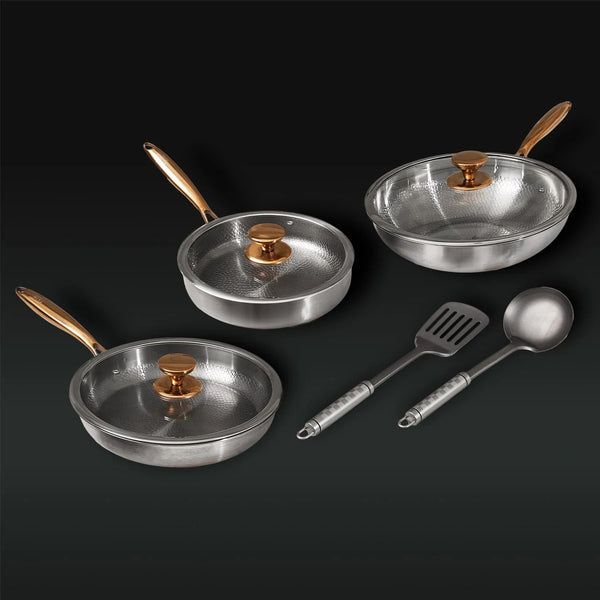
At Forneau, the cooking surface of our pans, sauté pans, woks and saucepans is a pure grade 1 titanium cooking surface, uncoated. Underneath, three layers of recycled aluminum spread heat evenly and a stainless steel base makes the pan induction-compatible. The base and handle aren't titanium, and that's normal: titanium doesn't conduct heat well on its own, so it needs those layers to actually cook food properly.
Good to know
Titanium is not naturally non-stick, so preheating the pan and adding a bit of fat makes all the difference. Scratches on a pure grade 1 titanium cooking surface, uncoated, are purely cosmetic, since there's no separate coating underneath to wear through.

How titanium differs from stainless steel, cast iron and carbon steel
Titanium is lighter than stainless steel and cast iron, doesn't need seasoning the way cast iron or carbon steel does, and has no iron content to react with acidic food. Unlike cast iron, there's no "seasoning keeps flaking off" problem to manage, and unlike raw carbon steel, it won't rust if you leave a drop of water on it overnight.
- Stainless steel: food sticks without enough fat and the right preheat; very durable, no seasoning needed.
- Cast iron: needs ongoing seasoning, heavy, reacts with acidic food if seasoning is thin.
- Carbon steel: gets better with use but demands real upkeep and can rust.
- Titanium (pure grade 1 cooking surface): no seasoning, no rust, no PFAS — but needs preheating and a bit of fat, like stainless steel.
For a direct side-by-side, see titanium vs stainless steel pans.
Is titanium naturally non-stick
No. Titanium is not naturally non-stick — it's reactive to heat and food in the same way stainless steel is, meaning food can stick if the pan isn't preheated or if there's not enough fat. This is the honest answer, and it's also what makes a bare titanium surface credible: there's no slippery coating to wear off, because there's no coating at all.
In practice, preheating the pan before adding food and using a reasonable amount of oil or butter solves most sticking issues — the same technique that works on a stainless steel pan. This is the trade-off Forneau is upfront about: a bare titanium surface asks for a bit of technique in exchange for never flaking, never releasing a coating into food.
« Best Nonstick Pan Without PTFE That's Actually Easy to Cook With? »
Is titanium compatible with all heat sources
Grade 1 titanium cookware with the right base construction is compatible with induction, gas, electric and ceramic cooktops. The titanium surface itself doesn't conduct heat well, which is exactly why pans built with a pure grade 1 titanium cooking surface, uncoated, need aluminum core layers underneath to diffuse heat and a stainless steel base to work on induction.
If a pan is only titanium with no added core or base layers, expect uneven heating and poor induction performance — that's a construction problem, not a property of titanium that can be wished away.
Does titanium release particles or heavy metals
Grade 1 titanium is widely described as biocompatible and inert — it's the same material used in medical implants and surgical instruments, chosen specifically because the body tolerates it well. A pure grade 1 titanium cooking surface, uncoated, has no PFAS, no PTFE, and nothing to flake into food, because there's no coating layered on top of a different base metal.
This is different from a nonstick coating that is scratched and "flaking off in chunks," where microscopic pieces of the coating itself can end up in food. On a pure grade 1 titanium cooking surface, scratches are cosmetic and don't release anything into food — the surface is titanium at every depth at that point, so there's no separate layer to chip away. For more on the toxicity question specifically, see titanium pans, PFAS and health.
Does titanium scratch
Yes, titanium scratches — like any solid metal cooking surface, including stainless steel and cast iron. Metal utensils, abrasive scrubbers and daily use will leave marks over time, and those marks are purely cosmetic.
The important nuance: scratches on a pure grade 1 titanium cooking surface, uncoated, are cosmetic. They don't expose a different material underneath and they don't release anything into food, because the surface is titanium at every depth, not a thin layer over something else. That's the real difference between "it scratches" (true, physically unavoidable) and "it's unsafe once scratched" (false, for a pure titanium cooking surface).
Glossary of technical terms
- Seasoning: a layer of polymerized oil built up on cast iron or carbon steel to create a semi-non-stick surface. It requires maintenance and can flake off if neglected — not a concern on titanium, which has no seasoning layer to maintain.
- Patina: the color and texture change carbon steel develops with use and seasoning over time; titanium doesn't develop a patina in the same way since it has no iron to oxidize that way.
- PFAS: "forever chemicals," a large family of synthetic compounds used in many nonstick coatings, criticized for not breaking down in the environment or the body.
- PTFE: the specific polymer behind the Teflon brand name; manufacturers argue solid PTFE is chemically inert, but the debate centers on what happens when it's scratched, overheated, or degrades over years of use.
- Grade 1 titanium: one of four commercially pure titanium grades, the softest and most workable, used for cookware, implants and some industrial applications.
- Coating vs. solid surface: a coating is a thin layer applied over a different base metal and can wear through; a pure grade 1 titanium cooking surface, uncoated, like Forneau's, is the same material through its entire thickness — there's nothing underneath to wear down to.
Frequently asked questions
What is grade 1 titanium cookware?
It's cookware where the cooking surface is made of a solid layer of commercially pure grade 1 titanium, not a titanium-infused coating. On Forneau pans, that pure grade 1 titanium cooking surface sits above recycled aluminum core layers and a stainless steel base for heat diffusion and induction compatibility.
Is titanium a toxic metal?
No — grade 1 titanium is considered biocompatible and inert, which is why it's used in medical implants. A pure grade 1 titanium cooking surface, uncoated, has no PFAS, no PTFE and nothing to flake off into food.
Can you use a titanium pan on an induction cooktop?
Yes, if the pan is built with an induction-compatible base. Titanium alone doesn't conduct heat well or respond to induction, so pans need a stainless steel base layer underneath the titanium cooking surface to work on induction stoves.
Does titanium scratch other utensils or scratch itself?
Titanium does scratch, like any solid metal surface, including from metal utensils or abrasive scrubbers. On a pure grade 1 titanium cooking surface, uncoated, those scratches stay cosmetic and don't release anything into food, since the material is titanium at every depth.
What's the difference between titanium and stainless steel in cooking?
Both require preheating and fat to avoid sticking, since neither is naturally non-stick. Titanium is lighter and considered highly biocompatible, while stainless steel is a well-known, time-tested standard — the real difference in cookware often comes down to construction quality and whether the "titanium" is a pure cooking surface or just a coating additive.
Does titanium contain PFAS or PTFE?
No. A pure grade 1 titanium cooking surface is a metal, not a polymer coating, so it contains no PFAS and no PTFE by definition. Be careful with products marketed as "titanium nonstick" — many are PTFE coatings with titanium particles added for hardness, which is a different material from a pure grade 1 titanium cooking surface, uncoated.
