













Fact-checked: composition and sources on our Facts & evidence page.
- 4.9/5 from over 12,000 reviews
- Lifetime warranty
- Ships within 48 h
- Free shipping
A titanium wok gives you a cooking surface with nothing to flake off and no PFAS, while still handling the high heat a proper stir-fry needs. Here's what actually changes versus carbon steel or cast iron, and how to use one without food sticking to it.
The essentials in 30 seconds
- Cooking surface is 100% pure grade 1 titanium, a solid layer with nothing to flake off
- Three recycled aluminum cores spread heat evenly under the titanium cooking surface
- Stainless steel base makes the wok compatible with induction, gas, and electric
- No seasoning ritual needed, but preheating and using fat still matters every time
- Scratches from metal utensils are cosmetic and don't release anything into food
A titanium wok isn't a gimmick flex — it's a cooking surface that's 100% pure grade 1 titanium, a solid layer with nothing to flake off, no coating, no PFAS/PFOA/PTFE. Under that surface, three recycled aluminum cores spread the heat and a stainless steel base makes it work on induction. That's the whole trade: you get real high-heat searing without the "forever chemicals" question, but bare titanium needs a bit of technique — preheat it, use fat, and it rewards you.
Why a titanium wok instead of carbon steel or cast iron
Carbon steel and cast iron need ongoing seasoning to stay nonstick, and that seasoning is fragile — it strips with high heat, acidic sauces, or an aggressive scrub, and then you're reseasoning again. A titanium wok skips that cycle entirely: there's no seasoning layer to protect, because the cooking surface itself is pure grade 1 titanium, uncoated, not a coating sitting on top of steel.
That matters because so much of the frustration with cookware comes down to coatings that wear down or flake. People try the "perfect" stainless steel method and still get a crust that sticks and fuses to the pan. With nonstick sets, the coating wears down, staining sets in, and the nonstick properties fade — then you're shopping for a replacement again. With titanium, there's no coating to wear down in the first place. It does scratch with metal utensils over time, and that's honest — but a scratch is cosmetic, it doesn't release anything into your food, unlike a flaking nonstick layer.
- No PFAS, PFOA, or PTFE in the cooking surface — nothing to off-gas at high heat
- No coating that can flake or chip into your stir-fry
- No seasoning ritual to maintain, unlike cast iron or carbon steel
- Lifetime warranty, because there's no coating clock ticking down
Good to know
Bare titanium needs a quick preheat and some fat before food goes in, or it will stick — that's the one real trade-off. In exchange, there's no seasoning to maintain and no coating that can flake into your stir-fry.

Heating up and heat distribution
A wok needs to get properly hot before anything hits the surface — that's non-negotiable for a good sear and for stir-frying without steaming your vegetables. Titanium itself doesn't conduct heat well on its own, which is exactly why Forneau builds the wok with three recycled aluminum cores underneath the titanium cooking surface: the aluminum spreads the heat evenly across the base and up the sides, while the titanium surface stays what you actually cook on.
In practice this means you preheat the empty wok, run the classic water-drop test — a bead of water should skate across the surface instead of sitting and sputtering — and only then add your oil and food. Skip the preheat and you'll get sticking no matter how good the metal is underneath. This is the one honest caveat with bare titanium: it's not instant, it asks for that one extra step before you throw the garlic in.
Induction, gas, open flame: what actually works
The stainless steel base under the aluminum cores is what makes the wok induction-compatible, on top of working on gas and high open flame the way a traditional wok is meant to. That base layer is doing a specific job: titanium alone wouldn't trigger an induction coil, so the stainless disc at the bottom is what completes the stack.
| Heat source | Works with a titanium wok | What to watch |
|---|---|---|
| Induction | Yes | Stainless steel base reacts to the coil normally |
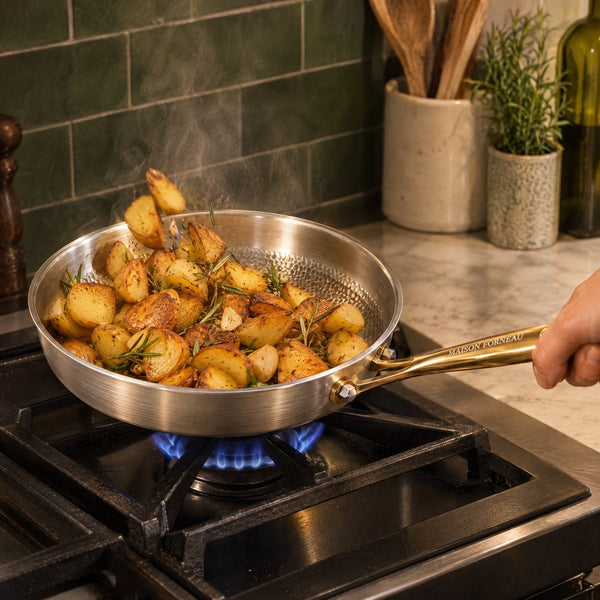
| Gas | Yes | Handles direct open flame on the wok sides |
| Electric / ceramic glass | Yes | Preheat gradually to avoid hot spots |
| Camping stove / outdoor burner | Yes | Lighter than cast iron, easier to carry |
If you're setting up a full kitchen around one heat source, our guide on titanium pans on induction, gas, and in the oven covers the same stack in more detail for flat pans.
« the coating wears down, staining sets in, and the nonstick properties fade »
Reddit, r/BuyItForLife
Seasoning or no seasoning: what changes for a wok
Carbon steel woks are built around seasoning — that's the whole point of the material, and skipping it means everything sticks. A titanium wok works differently: there's no porous metal surface for oil to polymerize into, so there's nothing to "build up" over months of cooking. What you're doing instead is simpler — preheat, add fat, cook — every single time, not a one-time ritual you have to protect afterward.
This is the direct trade-off people run into: carbon steel rewards patience and gets better (or worse) depending on how it's treated, scrubbed, or left wet. A titanium wok starts at the same baseline every time you cook, because there's no seasoning layer that can get scrubbed off by accident, go rusty from a damp sponge, or get stripped by an acidic sauce. If you're comparing the two materials side by side on durability and daily use, our titanium vs cast iron comparison breaks down where each one actually wins.
Cleanup after high-heat searing
High heat is exactly where coated pans suffer — burnt sugar, soy sauce, or oil residue breaks down a nonstick coating faster than anything else. A titanium cooking surface doesn't have that weak point: there's no coating to overheat or degrade, so you can push the wok as hot as a stir-fry demands without worrying about what the heat is doing to the surface itself.
After cooking, let the wok cool slightly, then wash by hand with warm water and a non-abrasive sponge. Stuck-on bits release more easily than people expect, because there's no porous seasoning layer for them to bond into. If food does stick during cooking — usually a sign the wok wasn't hot enough before the oil went in — our breakdown of why food sticks to a titanium pan covers the fixes. For daily care and storage habits that keep the surface in good shape long-term, see our guide to everyday titanium pan maintenance.
Quick-sear recipes that suit a titanium wok
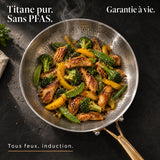
- Classic beef and broccoli stir-fry: preheat the wok until the water-drop test passes, add oil, sear the beef in batches so it doesn't steam, then toss the broccoli in fast over high heat.
- Garlic shrimp, high heat, 90 seconds a side: the even heat from the aluminum cores means the shrimp sears instead of simmering in its own liquid.
- Fried rice with a real wok hei crust: push rice up the sides of the wok where it's hottest, let it sit a few seconds before tossing, to get that slightly charred edge without anything sticking.
- Charred vegetables with soy and sesame: high heat caramelizes the edges fast; a quick splash of oil before each batch keeps things moving.
In every case, the method is the same: hot wok first, fat second, food third, and don't crowd the surface. That sequence does more for a clean sear than the material alone ever will.
Frequently asked questions
Does a titanium wok get hot enough?
Yes. The titanium cooking surface itself isn't what conducts the heat — three recycled aluminum cores underneath do that job, spreading heat evenly so the wok reaches proper stir-fry temperatures on gas, induction, or electric.
Do you need to season a titanium wok?
No, not in the carbon-steel sense. There's no porous surface for oil to polymerize into, so there's no seasoning layer to build or protect. What you do instead every time: preheat the empty wok, run the water-drop test, then add fat before the food.
Does a titanium wok work on an induction cooktop?
Yes. The stainless steel base underneath the aluminum cores is what makes it induction-compatible, the same construction used across Forneau's induction-ready cookware.
What's the real difference versus a carbon steel wok?
Carbon steel needs ongoing seasoning that can strip with high heat, acid, or scrubbing, and it can rust if left wet. A titanium wok's cooking surface is pure grade 1 titanium, uncoated, with nothing to flake, chip, or season — the trade-off is that it still needs a proper preheat and some fat, it just doesn't ask for a maintenance ritual afterward.
Will a titanium wok scratch?
Yes, titanium is a metal and metal utensils will mark it over time. Those scratches are cosmetic and don't release anything into food — unlike a flaking nonstick coating, which is a different problem entirely.
Is a titanium wok heavy?
No, it's built to be ultra-light compared to a cast iron wok, which makes the toss-and-sear motion easier to control, especially for home cooks not used to swinging heavy cast iron around.