

















Fact-checked: composition and sources on our Facts & evidence page.
- 4.9/5 from over 5,000 reviews
- Lifetime warranty
- Ships within 48 h
- Free shipping
What actually makes a pan healthy, the materials to look for, the ones to avoid, and how to pick a pan that won't stick and won't break down over the years.
The 30-second takeaway
- A healthy pan has a bare cooking surface, free of PTFE and PFAS, that won't flake off over time
- Teflon stops being non-stick after a few years, once the coating wears through
- Stainless steel and cast iron are healthy choices, but they take a bit of practice: preheating and some fat
- Solid-core pure titanium is nothing like a titanium coating applied over a non-stick layer
- Forneau uses grade 1 pure titanium on the cooking surface, tested PFAS-free by the SGS laboratory
What actually makes a pan healthy, the materials to look for, the ones to avoid, and how to pick a pan that won't stick and won't break down over the years.
The 30-second takeaway
- A healthy pan has a bare cooking surface, free of PTFE and PFAS, that holds up to daily use
- A scratched Teflon pan won't leak plastic into your food, but the surface can no longer be trusted over time
- Stainless steel and cast iron are solid options once you learn to preheat and use some fat
- Solid-core pure titanium has nothing in common with a titanium coating applied over a non-stick layer
- Forneau uses grade 1 pure titanium on the cooking surface, tested PFAS-free by the independent SGS laboratory
Table of contents
- What actually makes a pan healthy
- Non-stick coatings: what's really in them
- Stainless steel, cast iron, titanium: comparison
- Nickel, aluminum, PFAS: what ends up on your plate
- How to cook without a non-stick coating
- How to choose a healthy pan
- The Forneau pure titanium pan
What actually makes a pan healthy
A healthy pan has a bare cooking surface, free of PTFE and PFAS, that doesn't flake off or break down under heat. It's not just about avoiding Teflon: it's about any material that could shed particles or metals into your food, day after day, over high heat, or after a bit too much scrubbing with a sponge.
In practice, that narrows the real options down to three families: stainless steel, cast iron (or carbon steel), and pure titanium on the surface. Each one has its own way of being used, but none of them rely on a non-stick layer that scratches and eventually ends up in the food.
Good to know
Titanium scratches with use, like any metal, but those marks are cosmetic and don't release anything into food. What really makes the difference is preheating the pan and adding a bit of fat before cooking.
Good to know
Titanium scratches with use, like any metal, but those marks are cosmetic and don't release anything onto your plate. Just preheat the pan and add a bit of fat before cooking.

Non-stick coatings: what's really in them
Teflon is PTFE, and most classic non-stick pans have contained PFOA or another PFAS at some point in manufacturing, even when the label says "PFOA-free." The issue isn't just the chemical name: it's that this layer scratches and wears down over the years, and that's when the doubt really sets in.
- New Teflon doesn't stick, but that advantage doesn't last: many people notice that after 2-3 years, "the coating comes off" and the pan starts sticking again.
- Ceramic coatings promise to be healthier, but they often lose their non-stick effect within months.
- Once scratched, the surface can no longer be trusted, even without proven immediate risk from each individual scratch.
The pattern that keeps coming up in forums is simple: a non-stick pan doesn't last a lifetime, and that's something to accept before buying one.
Stainless steel, cast iron, titanium: comparison
None of these three materials have a coating that can flake off. The real difference comes down to care, weight, and what happens with actual use, year after year.
| Material | Does it stick? | Care | Real-world durability |
|---|---|---|---|
| Stainless steel | Yes, if the pan isn't properly preheated | Regular washing, no special care needed | High, doesn't degrade |
| Cast iron / carbon steel | Barely, once seasoned | Initial seasoning, dry thoroughly, avoid harsh soap | Very high, nearly indestructible |
| Pure titanium surface | Barely, with a bit of fat and preheating | Regular washing, no seasoning needed | High, scratches but doesn't flake |
Cast iron has its fans, people who don't mind the seasoning and the upkeep against rust. Stainless steel is healthy, but requires some technique so nothing sticks. Pure titanium combines both: no seasoning like cast iron, and less sticking than stainless steel when you use a bit of fat.
« can we make non-stick pans without PFAS? genuine question »
Reddit forum
« can we make non-stick pans without PFAS? genuine question »
Reddit forum
Nickel, aluminum, PFAS: what ends up on your plate
Not every risk comes from non-stick coatings. Some lower-grade stainless steel (not 18/10) can release more nickel than expected, worth watching if you have a nickel allergy. Uncoated, unprotected aluminum can also leach when in contact with acidic food.
- PFAS/PFOA/PTFE: present in nearly all classic non-stick coatings, even some labeled "PFOA-free" that still contain other PFAS.
- Nickel: mainly a concern with lower-grade stainless steel or for people with a specific allergy.
- Aluminum: safe when coated or sandwiched between other layers, as in multi-layer pans.
Grade 1 pure titanium, on the other hand, doesn't react with food or acids, and contains no PFAS at any stage of manufacturing. It's one of the most inert metals available for cooking.
How to cook without a non-stick coating
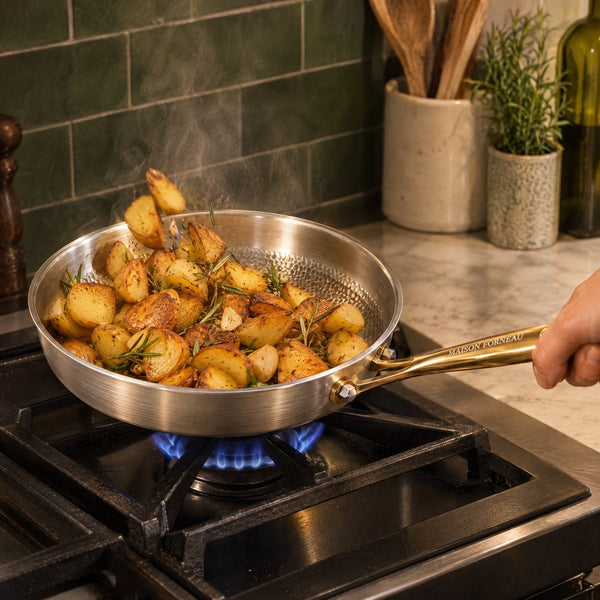
The biggest change when you leave Teflon behind isn't the material: it's the technique you need to pick up. Without a non-stick coating, you need to preheat the pan before adding fat, and wait until it's hot before putting food in. That goes for stainless steel just as much as titanium.
- Preheat over medium heat for a few minutes before cooking.
- Add a spoonful of oil or butter once the pan is hot, never on a cold pan.
- Avoid moving the food before it releases on its own: that's the sign it has properly seared.
- Avoid metal utensils if you want to limit visible scratches, even though it won't change anything safety-wise.
It takes a bit of attention to temperature at first, but it's a technique you pick up after a few uses. It's exactly what people who switched from Teflon to cast iron or stainless steel describe.
How to choose a healthy pan
Before buying, here's what to check:
- Is the cooking surface a solid material, or an applied coating?
- Are there independent tests or certifications guaranteeing the absence of PFAS?
- What happens if it gets scratched? Does something come off, or is it purely cosmetic?
- Is the warranty real, not just "lifetime" on paper?
- Is it induction-compatible, if that's what you use at home?
Most "titanium" pans on the market are actually steel with a titanium coating applied over a non-stick layer, not pure titanium across the entire cooking surface. That distinction changes everything: a coating, even one with titanium in the name, is still a layer that wears out.
The Forneau pure titanium pan
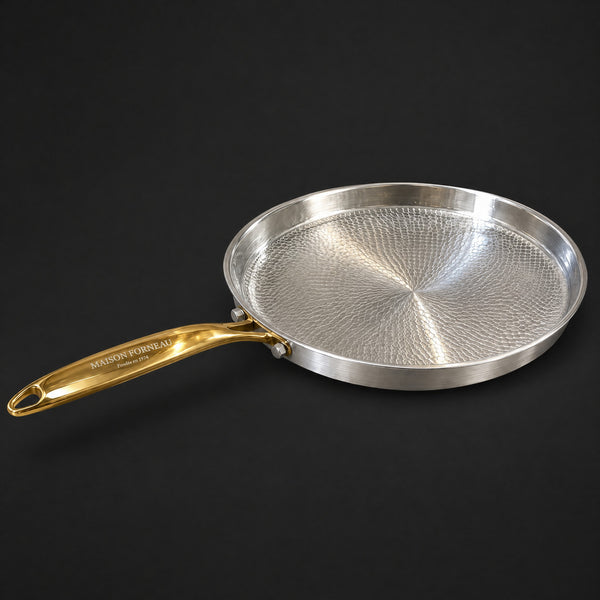
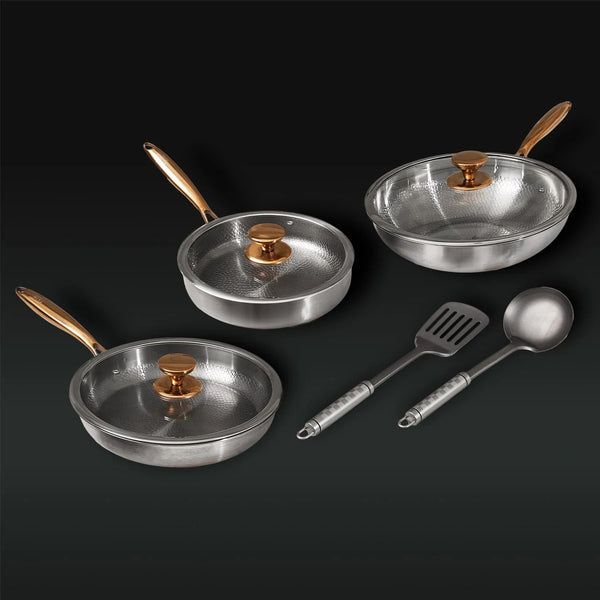
The cooking surface of Forneau pans is 100% grade 1 pure titanium: a solid layer, not a coating. There's nothing to flake off or peel away, because there's no non-stick layer underneath: it's titanium from edge to edge of the cooking zone.
Beneath that surface, the body combines three recycled aluminum cores that spread heat evenly, and a stainless steel base that makes it induction-compatible. The base and handle aren't titanium, and that changes nothing essential: the part that touches your food is 100% titanium.
Titanium scratches with use, like any metal, but those marks stay cosmetic and don't release anything into food. The pan has been tested against PFAS by SGS, an independent laboratory. It's ultra-light for its size and comes with a lifetime warranty.
To get the most out of it, preheat it before adding fat, exactly like with stainless steel. That's the only extra step we ask for, in exchange for a surface that doesn't break down over the years.
To go further: the full guide to Forneau titanium, the product page for the Signature pure titanium pan, and the independent test results.
Frequently asked questions
What is the healthiest pan?
One whose cooking surface has no applied non-stick coating: stainless steel, cast iron, or solid-core pure titanium. None of these options flake off with use, unlike Teflon or ceramic, which lose their coating over time.
Are titanium pans healthy?
It depends on the titanium: if it's pure titanium across the entire cooking surface, yes, because it's an inert metal free of PFAS. If it's a "titanium coating" applied over a classic non-stick layer, it's really that non-stick layer with titanium added, which wears out like any applied coating.
Which pans are non-toxic?
Those made with no PTFE or PFAS in their manufacturing: good-quality stainless steel, cast iron, carbon steel, and grade 1 pure titanium. It's better to look for independent testing rather than trust the "PFOA-free" label alone.
Is stainless steel safe for health?
Yes, as long as it's good quality (18/10) and used with the right technique: preheating before adding fat and food. The risk of nickel leaching stays low, except with lower-grade stainless steel or for people with a specific nickel allergy.
Why does my non-stick pan start sticking after a few years?
Because the coating wears down with repeated cooking and dishwasher cycles: that's the normal wear of a non-stick layer, which always ends up coming off eventually. A coating-free surface, like stainless steel, cast iron, or pure titanium, doesn't have this problem because there's nothing to wear through.
Do you need to season a titanium pan like a cast iron one?
No, pure titanium doesn't need seasoning. Just preheat it and add a bit of fat before cooking, a simpler technique to pick up than the regular upkeep cast iron requires.
