

















Fact-checked: composition and sources on our Facts & evidence page.
- 4.9/5 from over 5,000 reviews
- Lifetime warranty
- Ships within 48 h
- Free shipping
When food sticks, we blame the pan. Nine times out of ten, it is the temperature. Here is the step that fixes the problem, and how to get it right without a thermometer.
The essentials in 30 seconds
- Food placed in a cold pan sticks before it sears.
- The test: a drop of water that rolls like a bead means it is time.
- Oil goes in after preheating, never before.
Why food sticks
Placed in a cold pan, food bonds to the metal before it has had time to sear. Its proteins bind directly to the surface.
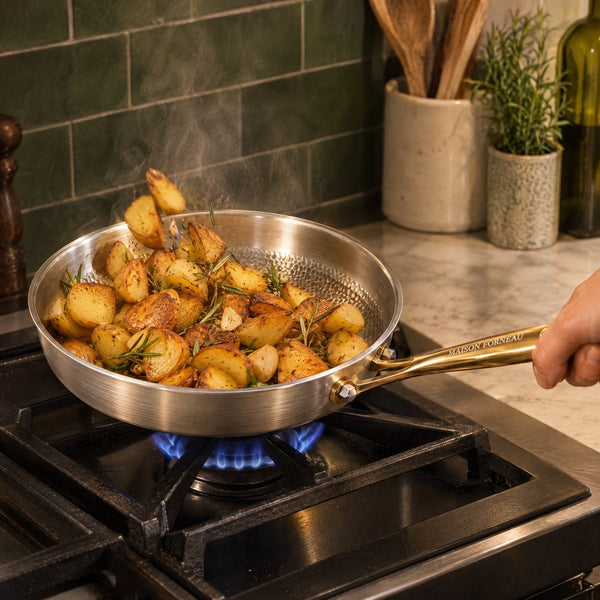
Placed in a properly hot pan, the surface of the food caramelises within seconds. That crust forms a barrier: the food then releases on its own, often without you having to do anything.
Non-stick coatings hid this reflex for decades. A bare metal puts it back at the centre, and the cooking gains in flavour.

The water drop test
Drop a single drop of water into the empty, hot pan.
| What the drop does | What it means |
|---|---|
| It sizzles and evaporates at once | Too early. Wait a little longer. |
| It forms a bead that rolls around | Now. Pour in the oil. |
| It vanishes in a cloud of steam | Too hot. Take it off the heat for thirty seconds. |
This phenomenon has a name: the Leidenfrost effect. A thin layer of steam forms under the drop and makes it hover above the metal.
The right order
- Heat the empty pan over medium heat for one to two minutes.
- Do the water drop test.
- Add the fat, and only now. Oil poured into a cold pan degrades all the way up to temperature.
- Place the food and leave it alone. It will release by itself once the crust has formed.
The three most common mistakes
High heat under an empty pan
Pointless, and on a non-stick pan it is the very thing that degrades the coating.
Moving the food too soon
If it resists, it is not ready. It will let go on its own.
Overcrowding the pan
Too much food drops the temperature: instead of searing, it releases its water and boils.
Frequently asked questions
How long should I preheat?
One to two minutes over medium heat on most hobs. The water drop test remains more reliable than a timer.
Which oil should I use?
For searing, an oil with a high smoke point: high-oleic sunflower, grapeseed, peanut. Extra virgin olive oil suits gentle cooking.
Does titanium need more preheating?
About one minute more than steel, because it conducts heat more gradually. In return, the temperature stays steadier when you add cold food.
