




















Fact-checked: composition and sources on our Facts & evidence page.
- 4.9/5 from over 5,000 reviews
- Lifetime warranty
- Ships within 48 h
- Free shipping
A clear look at what peer-reviewed studies actually measured on microplastics from cutting boards — plastic, wood, and titanium compared on this one specific question.
The essentials in 30 seconds
- Studies confirm plastic cutting boards shed microplastic particles with every knife stroke
- Particle counts vary widely by study, board hardness, and cutting pressure used
- Wood sheds fewer microplastics but raises separate concerns about bacteria in grooves
- Titanium is a hard metal surface that scratches cosmetically without shedding particles
- Long-term health effects of ingested microplastics remain an open scientific question
What the scientific studies actually say about cutting board microplastics
Yes, plastic cutting boards release microplastics into food — this has been measured directly, not just theorized. Researchers who cut vegetables on polyethylene and polypropylene boards and then analyzed the food found plastic particles consistently present afterward. The mechanism is simple: a knife edge under pressure shaves off microscopic fragments of the board's surface, and those fragments end up mixed in with whatever you just chopped.
What the studies don't support is blanket panic. The particle counts differ a lot depending on board type, how dull or sharp the knife is, how hard you press, and how many cuts you make. Some studies report noticeably higher shedding than others. This is an active area of research, not a settled number you can quote with full confidence.
Good to know
Cutting on plastic mechanically grinds the surface into particles that end up in your food, confirmed by multiple published studies. Titanium scratches cosmetically but doesn't break down into particles, because it's a metal, not a polymer.

How many particles per cut: the published ranges
Published research has estimated millions of microplastic particles can be generated per year of normal cutting board use, with wide variation between studies depending on methodology. Some researchers count particles per single cut; others extrapolate to annual or lifetime exposure based on average household use.
- Particle counts scale with the number of cuts and the pressure applied
- Softer plastics (polyethylene) tend to shed more than harder ones in some tests
- New boards with visible fresh grooves shed differently than heavily worn ones
- Wet versus dry cutting surfaces also change particle release in lab conditions
The honest takeaway: the exact number varies by study, and no single figure should be treated as the definitive answer. What's consistent across the literature is the direction — plastic boards do shed, every study that looked for particles found them.
Why plastic degrades under the blade (the physical mechanism)
A knife edge concentrates enormous force onto a very thin line of contact. On a polymer surface like plastic, that force doesn't just leave a visible scratch — it physically tears tiny fragments loose from the board's structure. Plastic is a relatively soft, flexible material at the molecular level, which is exactly what makes it easy on your knife edge, but also what makes it easy to shave apart.
Every cut leaves a groove. Each groove is physical evidence of material that used to be part of the board and is no longer there. Over months of use, those grooves multiply, deepen, and trap food residue and bacteria along with the microplastic debris already generated. This is simple physics, not speculation: a soft polymer under a sharp, repeated edge sheds material.
« Microplastics are in breastmilk, semen, placentas »
r/ZeroWaste
Wood: fewer microplastics, but what other risks come with it
Wood sheds far fewer plastic particles than polyethylene or polypropylene boards, for the obvious reason that it isn't plastic. If microplastics are your only concern, wood performs better than plastic on that single axis.
But wood introduces a different set of trade-offs that matter for kitchen hygiene:
- Wood is porous, and knife grooves create channels where bacteria can survive between washes
- Wood cannot go in the dishwasher, which limits how thoroughly it can be sanitized
- Wood requires regular oiling to prevent cracking and warping
- Cross-contamination risk from raw meat is a documented concern specifically because of those grooves
So wood solves the microplastics question reasonably well, but it opens the door to a different hygiene conversation — one that matters just as much in a real kitchen.
Titanium grade 1: a surface that doesn't break down into particles
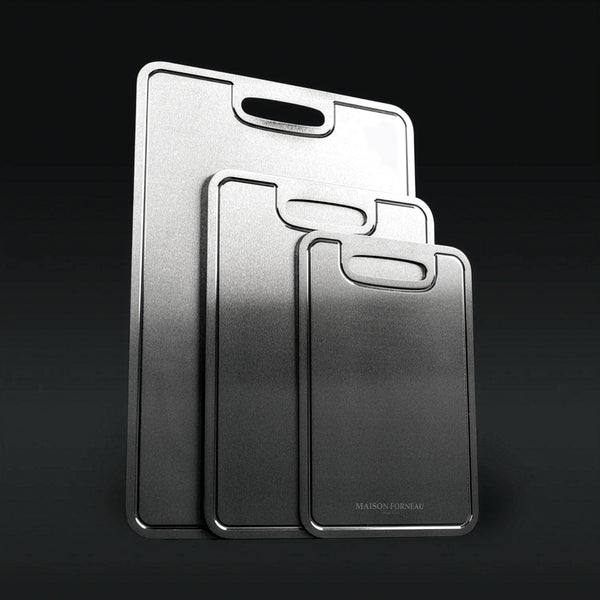
Titanium is a metal, not a polymer, and that distinction is the whole story here. A plastic board sheds because a blade shaves off pieces of a soft polymer structure. Wood sheds less, but it's still an organic material with grain and texture. Titanium grade 1 doesn't degrade the same way under a blade — there's no polymer to fragment, no plastic particles to generate.
Titanium does scratch — it's not scratch-proof, and we say so plainly. A knife edge will mark the surface over time, and that's an honest, expected part of using it. But a scratch on this metal surface is cosmetic — a mark on the surface, not a fragment released into your food. This is different from plastic, where the scratch is the particle release mechanism. It's also why titanium is dishwasher safe with no microplastics concern raised by repeated washing, unlike wood, which can't be run through a dishwasher at all.
Our titanium cutting board uses titanium grade 1 for exactly this reason: no coating to wear off, no polymer to shave into your food, and no PFAS in the material itself. One honest trade-off: titanium is harder than wood or plastic, so it dulls a knife edge faster than a wood or polyethylene surface does. A quick pass on a honing steel before cutting keeps that in check. In exchange, you get a surface with no grooves to trap bacteria and no particles released from normal use — see our full guide to titanium cutting boards for more on how that works day to day.
What we still don't know (limits of current research)
Science hasn't settled every question here, and it's important to say so plainly:
- Long-term health effects of ingested microplastics in humans are still being studied — correlation with specific diseases is not yet established with certainty
- Most particle-count studies use lab conditions that may not perfectly match how people actually cut food at home
- There's no standardized testing method across studies, which is why published numbers vary so much
- How much microplastic from cutting boards contributes to total daily exposure compared to packaging, water, and air is still being quantified
Anyone claiming a precise, universally agreed number for 'microplastics per cut' is overstating what the current research actually supports. The direction of the evidence is clear — plastic sheds, metal and wood shed less — but the exact magnitude is still being refined.
How to reduce your exposure starting today
You don't need to panic, but a few concrete changes make a real difference:
- Replace heavily scored, visibly grooved plastic boards first — the most-used ones are the biggest contributors
- Switch to wood or titanium for boards used daily, keeping plastic (if any) for lower-frequency tasks
- Wash boards promptly rather than letting food residue sit in grooves, especially with wood
- Replace plastic boards on a schedule rather than waiting until they look obviously damaged
- Choose a board you can run through the dishwasher safely with no microplastics shed from that washing itself
For related reading on how PFAS and other persistent chemicals show up elsewhere in the kitchen, see our guide to forever chemicals in cookware.
Frequently asked questions
Do plastic cutting boards really release microplastics?
Yes. Multiple studies have directly measured plastic particles transferred to food after cutting on polyethylene and polypropylene boards. The exact quantity varies by study and cutting method, but the presence of particles is consistently confirmed.
Is wood completely safe when it comes to avoiding microplastics?
Wood sheds far fewer microplastics than plastic, but it isn't risk-free overall. Its grooves can trap bacteria, it can't go in the dishwasher, and it needs regular oiling — different trade-offs, not zero trade-offs.
Can titanium break down into microparticles?
Titanium is a metal, so it doesn't degrade into particles the way a polymer does. It can scratch cosmetically with use, but that's a surface mark, not material being shaved off into your food.
Should I throw away my plastic cutting boards right away?
Not necessarily in a panic, but prioritize replacing the most-used, visibly grooved ones first. Those are the ones shedding the most particles into your daily food.
Are kitchen microplastics actually dangerous to health?
Researchers have found microplastics in human tissue, including breastmilk, semen, and placentas, but long-term health effects are still being studied. The honest answer is that the science isn't fully settled yet, even though reducing exposure where it's easy to do makes sense.
Is a titanium cutting board dishwasher safe with no microplastics concern?
Yes. Because titanium has no coating and no polymer structure, it can be washed in the dishwasher without shedding particles, unlike wood, which can't go in the dishwasher at all.
