


















Fact-checked: composition and sources on our Facts & evidence page.
- 4.9/5 from over 5,000 reviews
- Lifetime warranty
- Ships within 48 h
- Free shipping
Our Place calls its line "Titanium Pro," but it's ceramic coated cookware, not a pure titanium cooking surface. Here's the real material difference, and why it matters for how long your pan actually lasts.
The essentials in 30 seconds
- Our Place Titanium Pro is ceramic infused with titanium particles, not solid titanium
- Forneau's cooking surface is 100% pure grade 1 titanium, a solid layer, not a coating
- Ceramic coatings wear down over time and eventually lose their non-stick properties
- Titanium scratches cosmetically but nothing flakes off into your food
- Forneau carries a lifetime warranty; ceramic coatings are consumables that get replaced
Our Place Titanium Pro vs a pure titanium cooking surface: not the same material
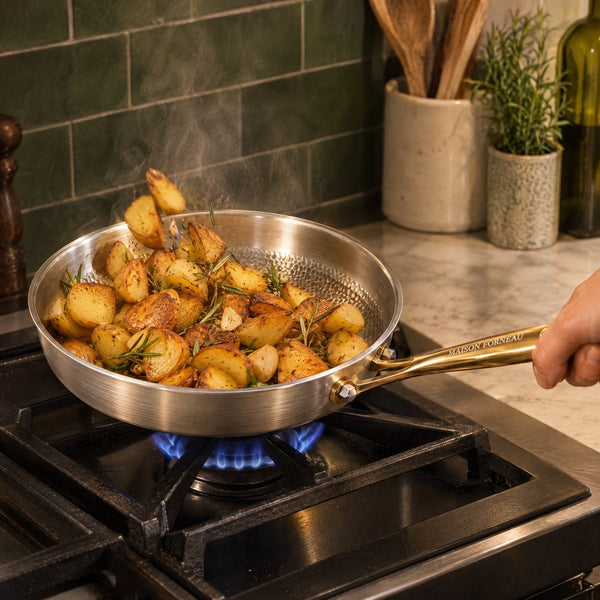
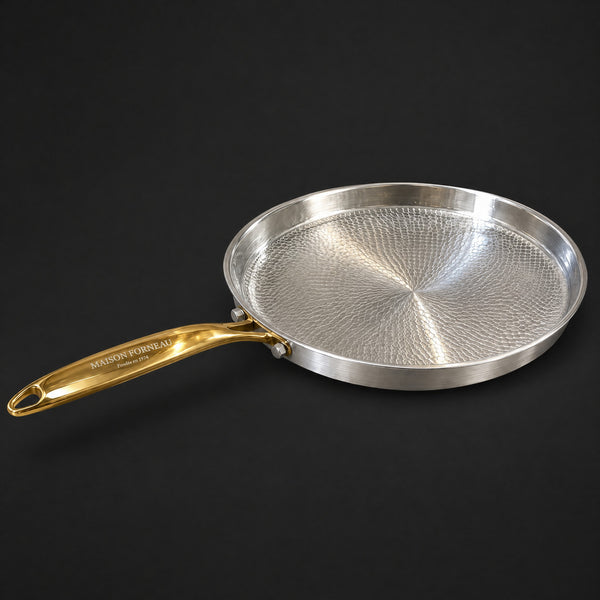
Our Place's "Titanium Pro" pans are ceramic coated cookware with titanium particles infused into the coating. A Forneau pan has a cooking surface that is 100% pure grade 1 titanium, uncoated, not a coating sprayed onto a base metal. The word "titanium" shows up in both names, but what's actually touching your food is completely different.
This isn't a nitpick. It changes how the pan behaves on day one and how it behaves five years from now. A coating, however advanced, is a layer applied to a surface. A solid surface is the surface itself. There's nothing underneath it to expose once it wears.
Good to know
A pure grade 1 titanium cooking surface isn't non-stick out of the box — it needs preheating and a bit of fat, just like stainless steel. In exchange, there's no coating to wear down and nothing to flake off into your food.

Real composition: ceramic infused with titanium vs grade 1 titanium
Ceramic cookware, including Our Place's titanium line, works by applying a sol-gel ceramic coating (sometimes with added titanium dioxide or titanium particles for hardness) onto an aluminum or stainless base. It's PTFE-free, which is a real point in its favor over old-school Teflon. But it's still a coating, meaning it can degrade, lose its non-stick properties, and eventually needs replacing.
Forneau pans are built differently from the inside out:
- Cooking surface: 100% pure grade 1 titanium, uncoated. No PFAS, no PFOA, no PTFE.
- Core: three layers of recycled aluminum that spread heat evenly.
- Base: stainless steel, for induction compatibility.
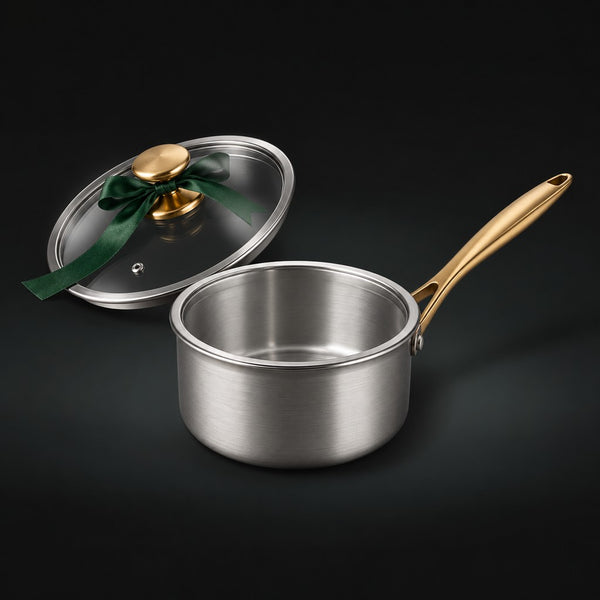
So when we say "it's just titanium" on the surface, we mean the part that touches your food, your spatula, your eggs. The core and handle aren't titanium, and they don't need to be. That's a normal, honest construction, not a marketing shortcut.
Durability and wear resistance over time
This is where the real difference shows up. Ceramic coatings, like any non-stick coating, wear down with use. Metal utensils, high heat, and dishwasher cycles all speed this up. Reddit threads are full of this exact complaint: "the coating wears down, staining sets in, and the nonstick properties fade." Even brands marketed as premium and non-toxic eventually lose their food release and need replacing.
A pure grade 1 titanium cooking surface, uncoated, doesn't have a coating to lose. It will scratch with use, titanium is a real metal that marks over time, but those scratches are cosmetic. There's no sub-layer being exposed, because there's no sub-layer. Nothing flakes into your food, because there's nothing to flake.
| Our Place Titanium Pro | Forneau | |
|---|---|---|
| Cooking surface | Ceramic coating with titanium particles | 100% pure grade 1 titanium, uncoated |
| PFAS / PTFE | PTFE-free, PFAS status varies by claim | None, by material design |
| Wears down over time | Yes, coating degrades with use | Scratches cosmetically, nothing flakes |
| Warranty | Limited | Lifetime |
| Induction compatible | Yes | Yes |
« the coating is already flaking off in chunks »
PFAS and PTFE safety: a factual comparison
Our Place has faced real scrutiny here, including a class action lawsuit alleging its "Always Pan" products contained PFAS despite "non-toxic" and "metal utensil safe" marketing claims. That's not an opinion, it's public litigation. Whatever the final legal outcome, it shows how blurry "non-toxic" claims can get when the underlying material is a coating whose exact formulation isn't fully visible to the buyer.
Forneau's surface is pure grade 1 titanium, uncoated. There's no coating recipe to question, no PTFE, no PFAS, no PFOA, because there's no coating at all. What you see on the surface is the material, full stop.
Price and positioning
Our Place sits in the mid-to-premium ceramic cookware bracket, competing with Caraway, GreenPan, and Always Pan on the same basic promise: a nice-looking coated pan that's easier on the conscience than Teflon. Forneau isn't playing in that category. A cooking surface in pure grade 1 titanium is a different material tier entirely, built to be the last pan you buy for that specific piece, not a coated pan you replace every few years.
The honest tradeoff: ceramic coatings often glide beautifully when brand new. A pure titanium surface takes a bit of technique, preheat, a little fat, before it releases food well. That upfront learning curve is the price of never having a coating to lose.
Induction, oven, and care
Both lines work on induction thanks to their stainless steel bases. Both are oven-safe within their rated limits. Where they differ is daily care: ceramic coatings need gentler utensils and lower heat to slow down degradation. A pure titanium cooking surface tolerates metal utensils and high heat without a coating to protect, because there's no coating. Hand washing is still recommended to keep any cookware looking its best over the long run.
Which one should you actually choose
If you want a pan with no coating to wear out, no PFAS, PFOA, or PTFE question marks, and a lifetime warranty backing a material that doesn't disappear with use, that's a cooking surface in pure titanium, not a ceramic one marketed under a titanium name. Our Place's Titanium Pro is a well-designed coated pan, and coated pans wear down. That's not a flaw unique to Our Place, it's physics for any coating, ceramic or otherwise.
Forneau's cooking surface is 100% pure grade 1 titanium, uncoated. It scratches cosmetically over years of real use, and nothing from those scratches ends up in your food. That's the actual difference between a titanium-named coating and a titanium surface.
For more on how coatings compare to pure titanium surfaces, see our HexClad vs titanium comparison, our titanium pan reviews and tests, and our deep dive on titanium cookware and PFAS safety.
Frequently asked questions
Our Place Titanium Pro pans are made of what material?
They're ceramic coated cookware, a sol-gel ceramic coating applied over an aluminum or stainless base, with titanium particles added to the coating for hardness. It's not a pure titanium cooking surface.
Is Our Place cookware actually non-toxic?
Our Place markets its cookware as non-toxic and PTFE-free, but it has also faced a class action lawsuit alleging PFAS presence despite those claims. The coating itself isn't fully transparent to buyers, which fuels that kind of doubt.
What is the difference between ceramic and pure titanium cookware?
Ceramic cookware is a coating applied to a base metal; it can wear down, lose its non-stick properties, and eventually needs replacing. Pure titanium cookware, like Forneau's, has a cooking surface that is 100% pure grade 1 titanium, uncoated, with nothing underneath to expose as it ages.
Does Our Place cookware contain PTFE?
Our Place states its products are PTFE-free. Separately, a lawsuit has alleged PFAS presence in some of its pans, which is a different family of chemicals than PTFE. Forneau's surface has no PTFE, no PFAS, no PFOA, by material design, not by formulation.
Which lasts longer, Our Place or pure titanium?
A ceramic coating, however well made, degrades with repeated use and heat cycles. A pure titanium cooking surface has no coating to lose, so it doesn't face that same wear curve. It scratches cosmetically over time, but the material itself doesn't disappear.
