


















Fact-checked: composition and sources on our Facts & evidence page.
- 4.9/5 from over 5,000 reviews
- Lifetime warranty
- Ships within 48 h
- Free shipping
A titanium pan can show cosmetic marks over time, but that's something entirely different from a coating that flakes off in chunks. Here's the real difference, no marketing spin.
The essentials in 30 seconds
- Titanium can get cosmetic scratches, but nothing flakes off into your food
- The cooking surface is 100% titanium grade 1, uncoated, not a coating
- Scratches never release anything toxic, unlike coating that chips and flakes
- A light patina develops over time, similar to cast iron, without losing function
- Preheating and a little fat are still needed, titanium is not a nonstick miracle
A titanium pan can show cosmetic marks over time, but that's something entirely different from a coating that flakes off in chunks. Here's the real difference, no marketing spin.
The 30-second answer
- Titanium can scratch cosmetically, but it never flakes off like a nonstick coating
- The cooking surface is 100% titanium grade 1, not an applied layer
- Scratches release nothing, unlike flaking Teflon or PTFE
- Over time a patina forms, not wear that breaks down the surface
- Preheating and a bit of fat are still needed, titanium is not a nonstick shortcut
Titanium pan scratched: what actually happens
Yes, a titanium pan can pick up visible marks from use. Titanium is a metal, and like any metal the surface will show fine lines from a metal spatula or a sharp knife edge. This is purely cosmetic and changes nothing about how safe the pan is to use.
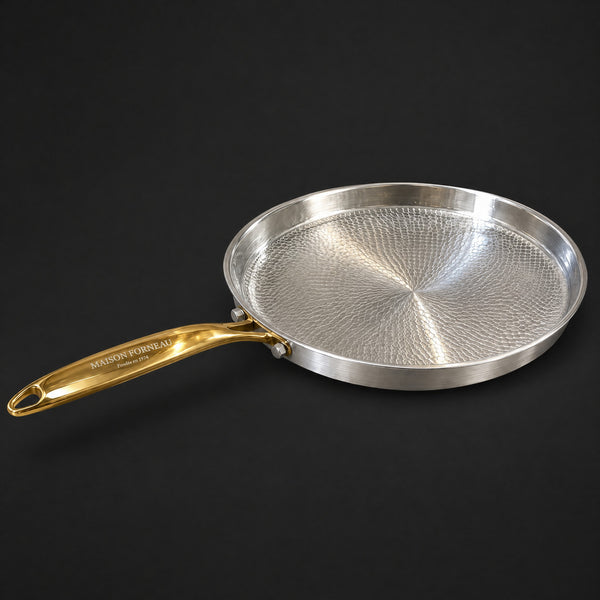
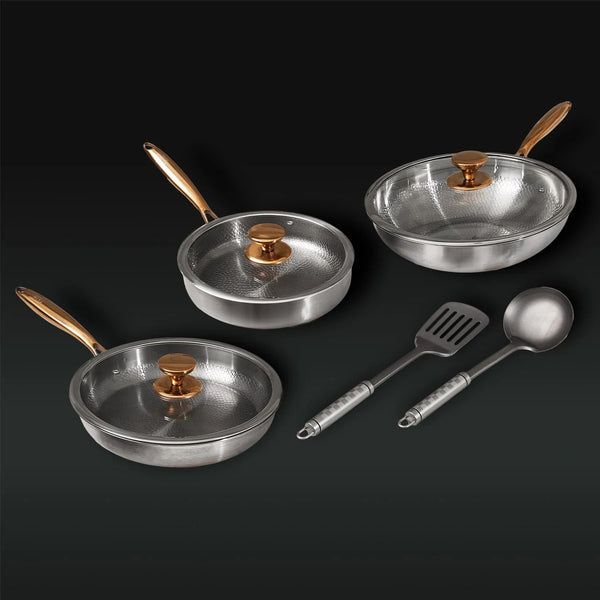
Here's the key fact: on Forneau pans, the cooking surface is pure grade 1 titanium, uncoated — a continuous layer, not a coating, not something applied on top of a base material. There's nothing that can flake off or peel away, because there's no second material layer sitting on a base. Underneath that titanium surface, three cores of recycled aluminum handle heat distribution, and a stainless steel base makes the pan induction-compatible.
Good to know
A scratch on the titanium surface is purely cosmetic and releases nothing, because there is no second layer that could come loose. Over time a light patina can appear, similar to cast iron, without the pan losing any of its function.
Good to know
A scratch on the titanium surface is purely cosmetic and releases nothing, because there is no second layer that could flake off. Over time a light patina can appear, much like cast iron, without the pan losing any function.

Why scratches on titanium are different from nonstick coatings
The difference comes down to structure. A nonstick coating is a thin layer sprayed or applied onto a base material. Once scratched, it creates weak points where the coating starts to flake off over time — exactly what so many people describe from experience: "scratched Teflon pans with a black plastic flipper" and the coating starts coming apart in chunks.
With a Forneau titanium pan, that second layer simply doesn't exist. A scratch only changes the surface texture of the titanium itself — it's the difference between scratching a solid door versus scratching a thin film stuck to a surface. There's no material that can separate, because the cooking surface is one continuous piece.
What a scratch does NOT mean
- No material shedding into your food
- No particle release of the kind associated with nonstick coatings
- No impact on cooking performance or safety
The difference from coating that flakes and peels
This is exactly the concern behind so many searches about PFAS, Teflon, or PTFE: what happens when small flakes of a coating come off and end up in your food? That concern is legitimate — coated pans depend on a nonstick layer that eventually wears out, mechanically and chemically.
| Feature | Nonstick coating | Forneau titanium surface |
|---|---|---|
| Structure | Thin layer applied to a base material | Pure titanium grade 1 cooking surface, uncoated |
| Scratches | Damage the protective layer | Purely cosmetic, no layer affected |
| Long-term effect | Flaking, peeling possible | Nothing to peel off |
| PFAS/PFOA/PTFE | Present depending on brand | None |
In other words, a titanium pan isn't just "a coated pan that happens to be more scratch-resistant." It's a fundamentally different approach — not a nonstick coating that eventually fails, but a surface that doesn't rely on an adhesive layer to work in the first place.
For more on how titanium pans differ from each other, see our titanium pan buying guide, and for the full health picture, read titanium pans, PFAS, and health.
« scratched Teflon pans with a black plastic flipper »
Reddit, cookware forum
Which utensils to use with titanium
Titanium is far more forgiving than a delicate nonstick coating, but using the right tools still helps the surface stay looking its best for longer.
- Metal spatulas: fine to use, since nothing can flake off
- Wood or silicone utensils: keep the surface looking cleaner if fine scratches bother you
- Steel wool: best avoided, not needed for cleaning anyway
- Dishwasher: safe to use, though hand washing keeps the shine longer
One honest note: titanium isn't a born nonstick star. For good results, preheat the pan and use a bit of fat, the same way you would with stainless steel or cast iron. If you've ever wondered why food sticks and how to avoid it, we cover that in detail in why food sticks to a titanium pan.
How titanium looks over time (patina, not damage)
Over time, the look of titanium changes — a light patina develops. This is a normal, purely visual aging process for the metal, comparable to a cast iron pan that darkens and develops character with years of use. It is not a sign of wear or material failure.
The difference from a coated pan is significant: there, "aging" usually means a slow loss of nonstick performance until the coating stops working altogether. With titanium, aging just means a slightly different shade — the cooking surface stays fully functional, durable, and long-lasting, with nothing being worn away.
If you're wondering whether titanium pans are genuinely safe for health, our article on titanium pans, PFAS, and health covers that question directly.
What users actually report
Across forums and discussions, a recurring pattern shows up: people switching from coated nonstick pans to PFAS-free alternatives like stainless steel, cast iron, or titanium almost unanimously describe relief — the fear of ingesting flakes or breathing toxic fumes from overheated coating simply disappears. At the same time, many mention that uncoated surfaces take a bit of practice to sear well.
That combination — durable and long-lasting, but without a "nonstick miracle" shortcut — is exactly what a titanium cooking surface delivers. It asks for a little technique in exchange for lasting safety, with zero risk of coating failure.
Frequently asked questions
Does a titanium pan scratch easily?
Titanium can pick up fine, purely cosmetic scratches from metal utensils or sharp edges. This doesn't affect the pan's safety or performance, since there's no coating that can be damaged.
Is a scratched titanium pan still safe to use?
Yes. A scratch in the titanium surface releases nothing and doesn't change the material's properties. Unlike a nonstick coating, there's no layer that can flake off or end up in your food.
What spatulas can I use on titanium?
Metal, wood, and silicone utensils all work. Metal may create fine cosmetic scratches over time but won't damage the cooking surface. If you want to avoid marks altogether, use wood or silicone.
Does titanium flake off like a nonstick coating?
No. Since the cooking surface is pure titanium grade 1, uncoated, rather than an applied layer, there's nothing that can peel or flake off.
Does titanium develop a patina over time?
Yes, a light patina is normal and purely cosmetic, similar to cast iron. The cooking surface stays fully functional and durable throughout.
