


















Fact-checked: composition and sources on our Facts & evidence page.
- 4.9/5 from over 5,000 reviews
- Lifetime warranty
- Ships within 48 h
- Free shipping
Wood, plastic, bamboo, glass, titanium: here's what the hygiene studies actually say, what happens to microplastics, and which cutting board makes sense for the next ten years.
The essentials in 30 seconds
- Titanium is non-porous, dishwasher-safe, and sheds no microplastics unlike plastic boards
- Plastic cutting boards shave off microplastic particles into food with every single cut
- Wood needs oiling and hand washing, and absorbs odors that titanium simply doesn't hold
- Titanium dulls knives faster than wood, so hone your blade before cutting
- A titanium board carries a lifetime warranty and is designed to never need replacing
Short answer: if you want a board that's genuinely non-toxic, doesn't shed microplastics, and doesn't need replacing every couple of years, a titanium cutting board is the only material that checks all three boxes at once. Wood is a solid second choice. Plastic is the one to phase out. Below is the full breakdown so you can decide for your own kitchen.
The materials available in 2026: wood, plastic, bamboo, glass, titanium
Five materials show up on every "what cutting board should I buy" list. Each one solves a different problem and creates a new one.
- Wood — self-healing surface, gentle on knife edges, but needs oiling and can't go in the dishwasher.
- Plastic (polyethylene) — cheap, dishwasher-safe, but it scars under the blade and those scars shed microplastics.
- Bamboo — marketed as eco-friendly, but it's harder than wood and dulls knives faster.
- Glass — easy to sanitize, but it's brutal on knife edges and it's the one surface that actually damages blades.
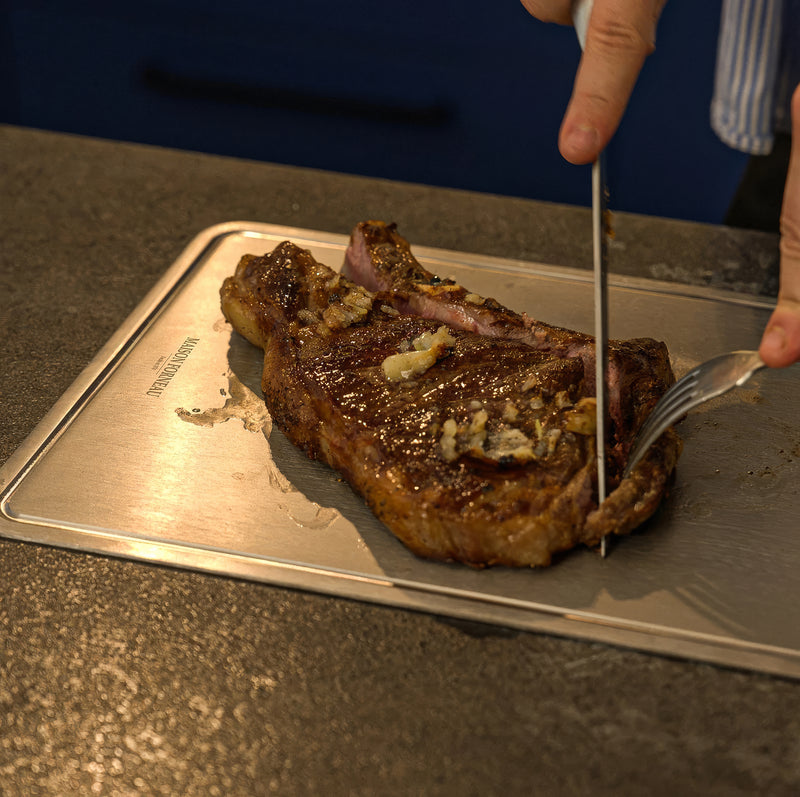
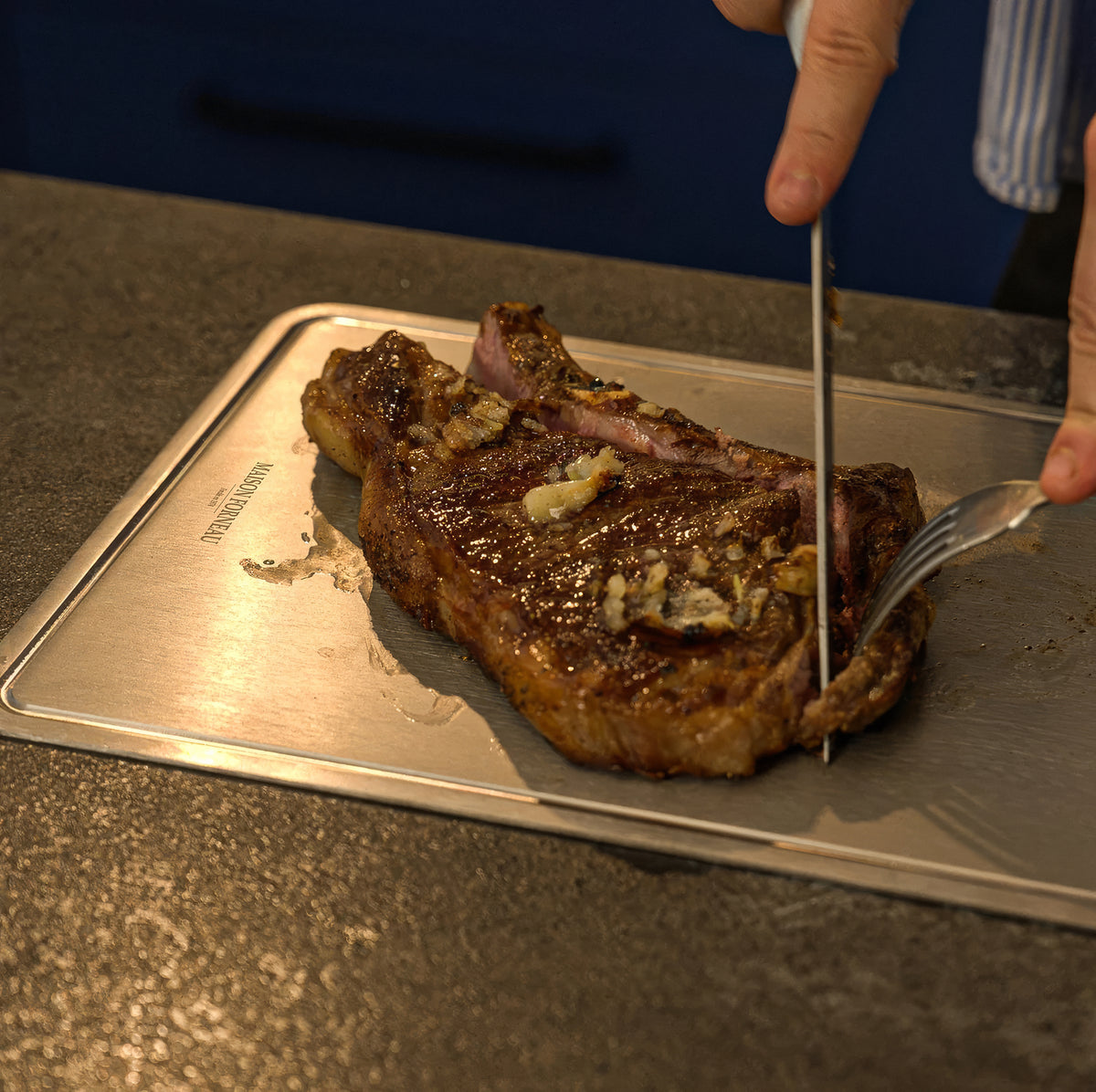
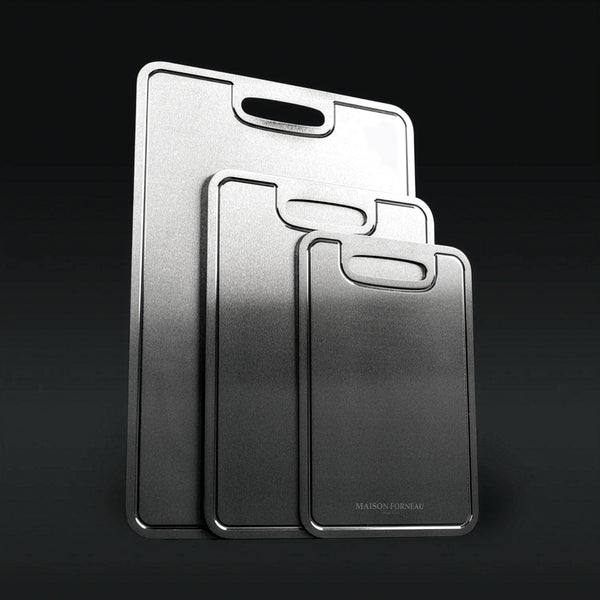
- Titanium — a solid metal surface, non-porous, nothing to flake, nothing to off-gas. The titanium board from Forneau is pure titanium, no coating, no PFAS/PFOA/PTFE.
Titanium is not a coating applied over something else — it's the material itself, top to bottom. That's the difference between "titanium cutting board" as a real material and "titanium-infused" marketing you'll see on some blades and nonstick pans.
Good to know
Titanium is a hard metal, so it will dull a knife edge faster than wood or plastic — a quick pass on a honing steel before you start fixes that. In exchange, you get a non-porous surface with no grooves to trap bacteria and nothing to shed into your food.

Hygiene and bacteria: what the studies actually say
The cutting board hygiene debate usually boils down to one question: does the surface trap bacteria in cuts and grooves? Wood and plastic both develop knife marks over time — the difference is what happens inside those marks.
- Plastic grooves are known to harbor bacteria that survive normal washing, which is why plastic boards are routinely replaced once they're visibly scored.
- Wood has some natural antimicrobial properties, but deep cuts still need to dry fully to avoid trapping moisture.
- A non-porous metal surface like titanium doesn't have the cellular structure that holds bacteria the way wood or plastic does, and it has no coating that can lift or crack open a hiding spot.
If you're asking what's the most hygienic cutting board, the honest answer is: a smooth, non-porous, coating-free surface that you can actually sanitize completely, not just rinse.
Microplastics: the problem with plastic cutting boards
Every time a knife drags across a plastic board, it shaves off microscopic plastic particles — and they end up on your food. This isn't theoretical: it's the mechanical reality of a blade on a soft polymer surface, repeated every single day, meal after meal.
Microplastics have since turned up in blood, placentas, and breast milk in various studies, which is part of why more people are actively trying to cut plastic out of food prep. A plastic cutting board sitting in your kitchen is one of the most direct, repeated sources of that exposure, because it's in contact with raw food on every single cut.
Titanium, glass, and wood don't have this problem in the same way — none of them shed plastic particles into your food. For anyone specifically trying to reduce microplastic exposure, swapping out the cutting board is one of the highest-impact, lowest-effort changes you can make. See our full breakdown in our piece on microplastics and plastic cutting boards.
« I'd really like to lower our exposure, but honestly don't know what I'm looking for »
Daily care by material
How much upkeep a board needs is often what actually decides what sits on your counter. Here's the realistic routine for each:
- Wood: hand wash, dry immediately, oil every few weeks to prevent cracking.
- Plastic: dishwasher-safe, but replace once grooves get deep — usually every one to two years.
- Bamboo: same care as wood, slightly more prone to splitting with heat and moisture.
- Glass: wipe clean, dishwasher-safe, but it's loud and hard on knife edges every single time.
- Titanium: wipe it down, or run it through the dishwasher. No oiling, no sealing, no conditioning.
On the question people actually search — how do I get rid of the smell on my cutting board — wood and plastic are the two materials that hold onto garlic, onion, and fish odors in their pores and grooves. A non-porous surface like titanium doesn't absorb those smells in the first place, so there's nothing to deodorize.
Dishwasher compatibility
This is one of the clearest dividing lines between materials.
| Material | Dishwasher safe | Notes |
|---|---|---|
| Wood | No | Warps and cracks with heat and moisture cycles |
| Bamboo | No | Same risk as wood, often worse |
| Plastic | Yes | Safe, but doesn't remove embedded microplastics in grooves |
| Glass | Yes | Safe, but heavy and hard on blades |
| Titanium | Yes | No limit, no warping, no corrosion |
A titanium cutting board is one of the only options that's both fully dishwasher-safe and non-porous. You get the cleanup convenience of plastic without the microplastic trade-off. More detail in our dedicated page on titanium boards and dishwashers.
Durability and real cost over 10 years
A cheap plastic board costs little upfront, but it's a recurring cost: deep grooves mean replacement every year or two, and each replacement is another board to manufacture, ship, and eventually throw away. Wood lasts longer if you maintain it, but it can crack, warp, or split without regular oiling.
Titanium doesn't wear the way plastic does under a blade. It's a hard, stable metal — it won't warp, crack, split, or develop the kind of grooves that trap bacteria and shed particles. Buy it once, and it's designed to be the last cutting board you need to replace. That's the actual math behind a titanium board with a lifetime warranty: higher price today, zero replacements over a decade.
Our recommendation by use case (meat, fish, vegetables)
There's one caveat worth being upfront about: titanium, like any metal surface, will dull a knife edge faster than wood or plastic will. A quick pass on a honing steel before you start cutting solves that in seconds — it's a small habit, not a drawback that outweighs everything else.
- Raw meat and poultry: titanium is the safer call — non-porous, nothing for bacteria to hide in, fully dishwasher-safe after handling raw proteins.
- Fish: same logic, plus titanium doesn't hold onto fish odor the way wood and plastic do.
- Vegetables and everyday prep: any material works here, but if you only want to own one board, titanium covers raw meat, fish, and produce without needing a separate plastic board "just for meat."
For a side-by-side on wood versus plastic versus titanium specifically, see our comparison article.
Frequently asked questions
Which cutting board is the most hygienic?
A non-porous, coating-free surface is the most hygienic option, because it doesn't develop the deep grooves that trap bacteria the way wood and plastic do over time. Titanium fits that description and can be fully sanitized in the dishwasher.
Does plastic release microplastics into food?
Yes. Every cut shaves off microscopic plastic particles from the board's surface, and that plastic ends up in your food. This is one of the most direct, repeated sources of microplastic exposure in a typical kitchen.
Can you put a titanium cutting board in the dishwasher?
Yes, without limit. Titanium doesn't warp, corrode, or degrade from dishwasher heat and moisture, unlike wood or bamboo boards.
Is wood healthier than plastic?
Wood doesn't shed microplastics the way plastic does, and it has some natural antimicrobial properties, but it still needs hand washing, drying, and regular oiling to stay safe and crack-free.
Will a titanium board dull my knives?
Titanium is a metal surface, so like glass, it will dull an edge faster than wood or plastic. A quick pass on a honing steel before cutting keeps your knife sharp.
Is a titanium cutting board made in France?
Forneau's titanium cutting board is designed in France. The material itself — titanium — is sourced and processed industrially, as with any metal cookware component.
