


















Fact-checked: composition and sources on our Facts & evidence page.
- 4.9/5 from over 5,000 reviews
- Lifetime warranty
- Ships within 48 h
- Free shipping
Are titanium cutting boards better than wood or plastic? Here's what the hygiene studies, microplastic research, and real-world durability actually show.
The essentials in 30 seconds
- Titanium cutting boards never develop bacteria-trapping grooves the way wood or plastic eventually do
- Plastic boards shed microplastics into food once knife grooves form, titanium does not
- Titanium is dishwasher safe with no limit, unlike most wood boards
- Titanium is harder than steel so a quick honing before cutting keeps knives sharp
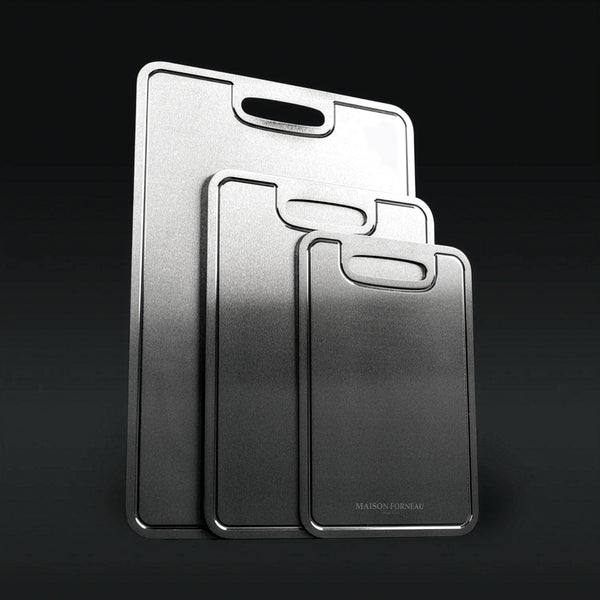
- Forneau's board is solid titanium, not a coating, with a lifetime warranty
The wood vs plastic vs titanium match, in brief
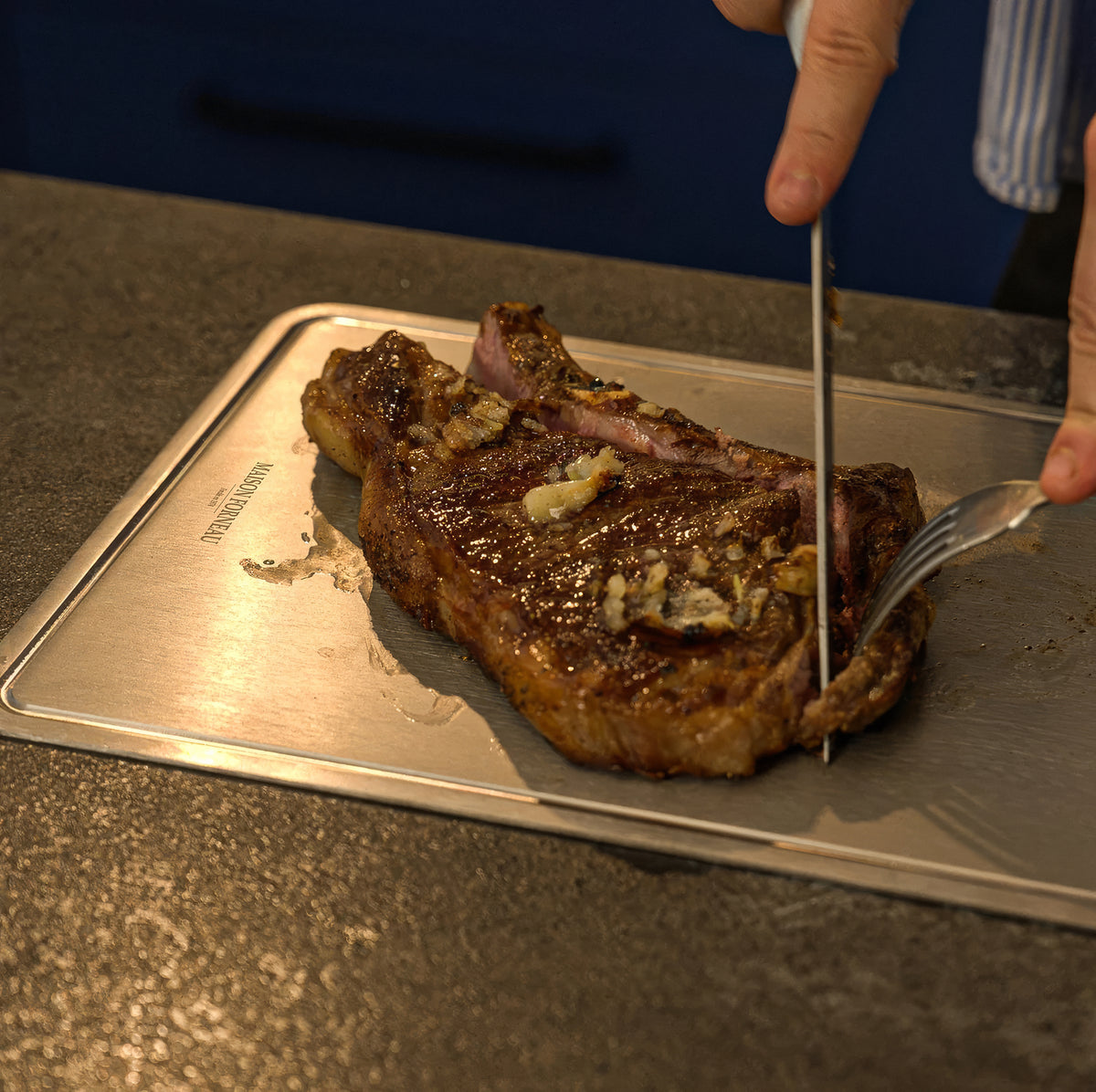
Wood and plastic both develop knife grooves over time — that's where bacteria hide and, with plastic, where microplastics shed into your food. Titanium doesn't groove the way softer materials do, it's dishwasher safe with no limit, and it carries no microplastic risk. The one tradeoff: titanium is harder than knife steel, so it wears an edge faster than wood or plastic, which a quick hone before cutting solves.
| Material | Hygiene (grooves/bacteria) | Microplastics | Dishwasher | Effect on knife edge |
|---|---|---|---|---|
| Plastic | Grooves trap bacteria as it wears | Sheds microplastics once scored | Yes, but warps/scores over time | Gentle on edge |
| Wood | Lower bacteria retention than worn plastic, but needs oiling and air-drying | None | No — warps and cracks | Gentle on edge |
| Titanium | No grooves to trap anything | None | Yes, no limit | Wears edge faster, needs honing |
Good to know
Titanium is harder than knife steel, so it wears an edge down faster than wood or plastic — a quick pass on a honing steel before you cut fixes that. In exchange you get a board with no grooves to trap bacteria, no microplastics, and no dishwasher limit.

Hygiene: what the studies actually say
The core hygiene problem isn't the material itself, it's the grooves a knife cuts into it. Wood and plastic both get cut up with use, and those grooves are where bacteria survive a wipe-down or even a wash. There's a reason you'll see people repeat that wood boards verkeimen weniger als Kunststoffbrettchen — wood has some natural antimicrobial properties and tends to dry out bacteria faster than plastic, but a heavily scored wood board is still a bacteria trap compared to a smooth surface.
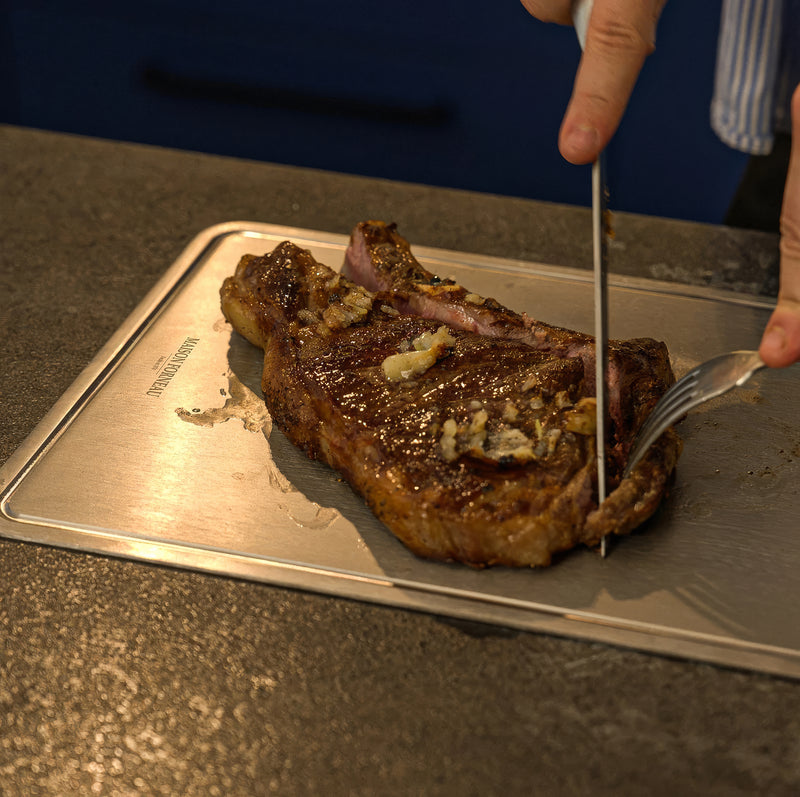
Titanium sidesteps the whole issue. It's hard enough that a knife doesn't carve deep, permanent grooves into it the way it does into wood or plastic, so there's no network of cuts for bacteria to colonize. That's the actual hygiene argument for titanium, not a marketing line — no grooves, nothing to hide in.
Microplastics: the problem with plastic boards
Every time you cut on a plastic board, you're shaving off microscopic plastic particles — more so as the surface gets scored and worn. Those particles end up in whatever you just cut, and from there, in you. This tracks with the broader concern people raise constantly: microplastics are in breastmilk, semen, placentas, and a cutting board is one of the more direct, avoidable sources of ongoing exposure, because it happens every single time you prep food.
Wood doesn't have this problem — it just wears down as wood. Titanium doesn't either. No microplastics, full stop, because there's no plastic to shed in the first place.
« Microplastics are in breastmilk, semen, placentas »
Maintenance and dishwasher safety
Wood boards need regular oiling, can't go in the dishwasher without warping or cracking, and have to air-dry standing up. Plastic boards are dishwasher safe early on, but heat cycles plus knife scoring speed up the wear that creates those bacteria-trapping grooves.
Titanium is dishwasher safe with no limit. No oiling, no warping, no cracking, no special drying ritual. It's the lowest-maintenance of the three by a wide margin — you use it, you rinse or run it through the dishwasher, done.
Durability and knife edge wear
Here's the honest tradeoff: titanium is harder than wood or plastic, and harder than the steel in most kitchen knives. That means it doesn't nick or chip the way a glass or stone surface would, but independent BESS edge-retention tests consistently show metal cutting surfaces take the edge off a knife faster than wood or polyethylene. Titanium isn't an exception to that. On top of that, like any metal surface, titanium will show surface scratches with use — that's cosmetic wear only, it doesn't flake off or release anything into your food.
In practice, this means a quick pass on a honing steel before you start cutting keeps your knife performing well. It's a small habit, not a dealbreaker — and it's a fair trade for a surface that never grooves, never harbors bacteria, and never sheds microplastics.
Price and real lifespan
Plastic boards are the cheapest upfront, but they wear out fastest — once scored and discolored, most people replace them within a year or two. Wood boards cost more and can last years with consistent oiling, but they crack, warp, or split if neglected, and they can't be sanitized in a dishwasher.
Titanium costs more upfront than either, but it doesn't wear out the way wood or plastic do. There's no coating to flake, no surface to crack, no grooves accumulating — which is why a lifetime warranty on a titanium board is a realistic promise rather than a marketing line.
Our verdict
Between the three, titanium is the only material that solves the actual hygiene problem — no grooves, nothing for bacteria to live in — while also removing microplastics from the equation entirely, something plastic simply cannot do and wood only avoids by not being plastic in the first place. Forneau's cutting board is pure titanium, dishwasher safe with no limit, and backed by a lifetime warranty. The one honest adjustment: hone your knife before you cut, because titanium's hardness that makes it so durable is the same property that wears an edge down a bit faster than wood or plastic.
If you're weighing hygiene and long-term durability over the small habit of honing a blade, titanium wins this comparison on the facts. Learn more about why titanium is more hygienic, read our full titanium cutting board guide, or see how it's designed.
Frequently asked questions
Are titanium cutting boards better than wood or plastic?
Yes, on hygiene and microplastics: titanium doesn't groove like wood or plastic, so there's nowhere for bacteria to hide, and it sheds no microplastics. The tradeoff is that titanium wears a knife edge faster, so a quick hone before cutting is worth doing.
Can you put titanium cutting boards in the dishwasher?
Yes. Titanium cutting boards are dishwasher safe with no limit, unlike wood, which warps and cracks under repeated dishwasher cycles.
Are titanium cutting boards healthy?
Titanium is an inert metal with no coating, no PFAS, and no microplastics to shed into food. Since it doesn't groove like wood or plastic, it also doesn't trap bacteria the way a heavily scored board does.
Do titanium cutting boards dull knives?
Titanium is harder than most knife steel, so it does wear an edge somewhat faster than wood or plastic, according to independent BESS edge-retention testing. A quick pass on a honing steel before cutting keeps your knife sharp.
Are titanium cutting boards dishwasher safe?
Yes, they're fully dishwasher safe with no limit on cycles, which is one of their main advantages over wood boards that need hand-washing and oiling.
