



















Fact-checked: composition and sources on our Facts & evidence page.
- 4.9/5 from over 5,000 reviews
- Lifetime warranty
- Ships within 48 h
- Free shipping
Titanium knives sound like the ultimate upgrade: rust-proof, light, non-toxic. Here's what's true, what's marketing, and why Forneau put titanium on the cutting board instead of the blade.
The essentials in 30 seconds
- Titanium is rust-proof and light, but it's softer than knife steel and dulls fast
- A titanium-coated blade is not the same as one-piece pure titanium: coatings flake, Forneau's steel doesn't
- Forneau's Chef Knife uses 60 ± 2 HRC stainless steel for the blade, titanium for the board
- one-piece pure titanium belongs on cutting boards and utensils, not on a knife edge
- The honest combo: a steel blade that holds its edge, resting on a titanium board
A titanium knife sounds like the dream kitchen tool: it won't rust, it's light, it never corrodes. Some of that is true. But titanium is also softer than knife steel, and a soft blade doesn't hold an edge. This guide explains what titanium actually does on a knife, where the marketing gets ahead of the metal, and why Forneau chose stainless steel for the blade and kept titanium for the cutting board.
What a titanium knife actually gives you, and what it costs
Titanium is corrosion-proof, non-reactive, and noticeably lighter than steel. That part of the pitch is real. The catch: titanium is a soft metal compared to knife-grade steel, so a titanium edge rolls and dulls faster, even with careful use.
- What you gain: no rust, no reaction with acidic food, lighter feel in the hand
- What you lose: edge retention — you'll be sharpening far more often than with a hardened steel blade
- The trade-off nobody loves: a knife that looks indestructible but needs constant touch-ups to actually cut well
For cookware and cutting boards, titanium's softness isn't a problem — nothing is cutting into titanium on purpose. On a knife blade, where the entire job is holding a sharp edge under pressure, that same softness becomes a real limitation.
Good to know
Titanium won't rust and won't flake, but on a blade it's the wrong metal: it's softer than knife steel and loses its edge fast. That's why Forneau uses hardened stainless steel for the blade and saves titanium for the cutting board.

one-piece pure titanium blade or steel blade with a titanium coating: the mix-up to avoid
Most "titanium knives" sold online aren't one-piece pure titanium. They're steel blades with a titanium coating, often titanium nitride, applied for color and a bit of scratch resistance. That's a very different product from a blade made entirely of titanium metal.
| Type | What it is | What happens over time |
|---|---|---|
| one-piece pure titanium blade | Blade is titanium metal all the way through | Rust-proof, but dulls quickly — soft edge, needs frequent sharpening |
| Titanium-coated steel blade | Steel core, thin titanium or titanium nitride layer on top | Coating wears, scratches, and eventually flakes off, same complaint people make about non-stick coatings |
| Hardened stainless steel blade | One solid metal, no coating | Holds an edge longer, nothing to flake, needs regular honing |
The coating confusion matters because it's the same pattern people already distrust in cookware: a thin layer over a different base metal, sold as if it were the "real" material. If a coating can flake off a pan, it can flake off a knife too — and now it's near your food on every cut.
Why Forneau chose 60 HRC steel for the blade
Forneau's Chef Knife has a 20.5 cm stainless steel blade, hardened to 60 ± 2 HRC, with a wood handle and a total length of 34 cm. Forneau does not make a titanium blade, and says so plainly: titanium is softer than knife-grade steel and would lose its edge too fast to be a serious kitchen tool.
That decision isn't a compromise, it's the point. A knife's only job is to cut and keep cutting. Hardened stainless steel at 60 HRC is built for exactly that: it holds an edge through real daily use, it doesn't rust, and it comes with no coating to wear down or flake into food. Titanium, on the other hand, earns its place elsewhere in the kitchen, where corrosion resistance and being inert matter more than edge retention.
- Blade: stainless steel, hardened to 60 ± 2 HRC
- Handle: wood
- Length: 20.5 cm blade, 34 cm total
- Weight: 237 g
- Care: hand wash only, hone on a ceramic or diamond steel
- Covered by a lifetime warranty
« What's the deal with these titanium pans? »
Reddit cookware forum
Edge, sharpening, and everyday care
A steel blade like this one needs a quick pass on a ceramic or diamond honing steel to realign the edge before serious cutting. It's a small habit, a few seconds before you start chopping, and it keeps the knife performing the way it's supposed to.
Hand wash only: dishwashers are hard on wood handles and can dull a fine edge by knocking the blade around with other utensils. Store it where the edge isn't touching other metal, and it will stay sharp far longer than a titanium blade would under the same use.
None of this is a downside unique to Forneau's knife. Any serious kitchen knife, titanium or steel, needs some care. The difference is what that care buys you: with hardened steel, honing restores a genuinely sharp edge. With a soft titanium blade, you're fighting the metal itself.
The right pairing: a steel blade on a titanium board
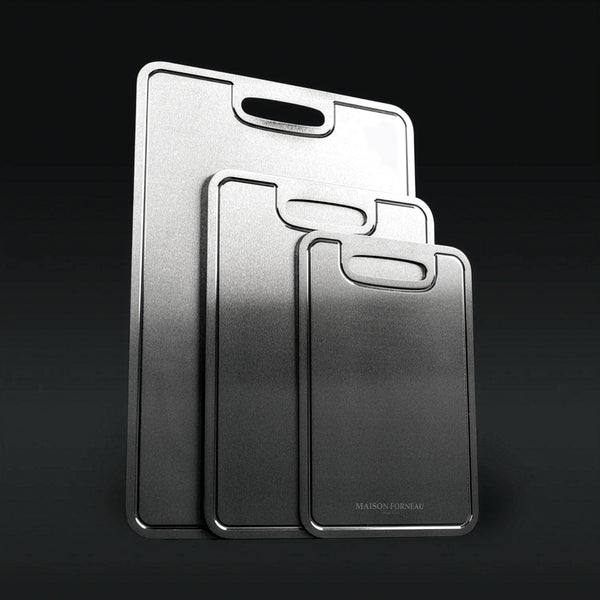
This is where titanium earns its keep. A titanium cutting board has no grooves to trap bacteria, nothing to flake into food, and it goes in the dishwasher without limit. It's exactly the "safe to use" peace of mind people are looking for after dealing with flaking coatings elsewhere in the kitchen.
One honest detail: titanium is harder on a blade's edge than wood or polyethylene. Independent BESS testing shows titanium ranks as one of the toughest surfaces on edge retention, meaning it dulls a knife faster over time than a softer cutting surface. It won't chip or damage the blade, titanium is too soft for that, but it will wear the edge down quicker. A quick pass on the honing steel before you cut solves this.
- Blade: hardened stainless steel, built to hold an edge
- Board: one-piece pure titanium, no coating, no microplastics, dishwasher safe
- Habit that makes it work: hone before you cut
That's the combination Forneau builds around: a Chef Knife with a steel edge that actually lasts, paired with a titanium cutting board that won't flake, stain, or hold onto bacteria the way grooved plastic or wood eventually does.
How to choose based on how you actually cook
If you're chasing a rust-proof, ultra-light knife and don't mind sharpening often, a one-piece pure titanium blade can work for light, occasional use. If you cook daily and want a knife that stays sharp through real prep work, hardened steel is the better tool, full stop.
- Daily cooking, lots of chopping: hardened stainless steel blade, honed regularly
- Looking for a titanium-coated knife because it's "non-toxic": check whether it's one-piece pure titanium or a coating over steel, coatings wear and flake like any other coating
- Want titanium's real benefits in your kitchen: put it on the cutting board and utensils, where corrosion resistance and being inert actually matter, and let steel do the cutting
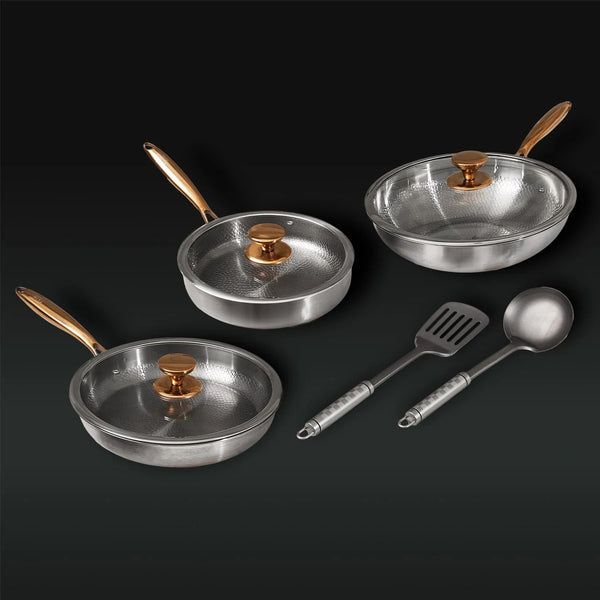
See the full Forneau Chef Knife and the titanium cookware and tools lineup for the full picture of where each metal is used and why.
Frequently asked questions
Is a titanium knife better than a steel knife?
Not for edge retention. Titanium is rust-proof and light, but it's softer than knife-grade steel, so it dulls faster and needs more frequent sharpening. Hardened steel holds a working edge much longer.
Why doesn't Forneau make a titanium blade?
Because titanium is too soft for a serious kitchen knife. Forneau's Chef Knife uses stainless steel hardened to 60 ± 2 HRC for the blade, and keeps titanium for the cutting board and utensils, where its corrosion resistance and inert surface matter more than edge retention.
Does a titanium coating on a knife wear off?
Yes, if it's a coating (often titanium nitride) over a steel blade, it's thin and can scratch and flake over time, similar to how non-stick coatings fail. A solid steel blade with no coating doesn't have that problem.
Does a titanium cutting board dull knives faster?
Slightly, yes. Independent testing shows titanium wears an edge down faster than wood or polyethylene boards. It won't chip or damage the blade, but a quick pass on a honing steel before cutting keeps performance sharp.
How do I keep a steel knife sharp day to day?
Hone it on a ceramic or diamond steel before use, hand wash it instead of using a dishwasher, and avoid cutting on hard surfaces like glass or stone that accelerate dulling.
Is titanium non-toxic compared to coated cookware?
one-piece pure titanium has no coating to begin with, so there's nothing to flake off and nothing comparable to PFAS or PTFE concerns. That's true for titanium cutting boards and utensils, and it's part of why Forneau uses one-piece pure titanium there.
